

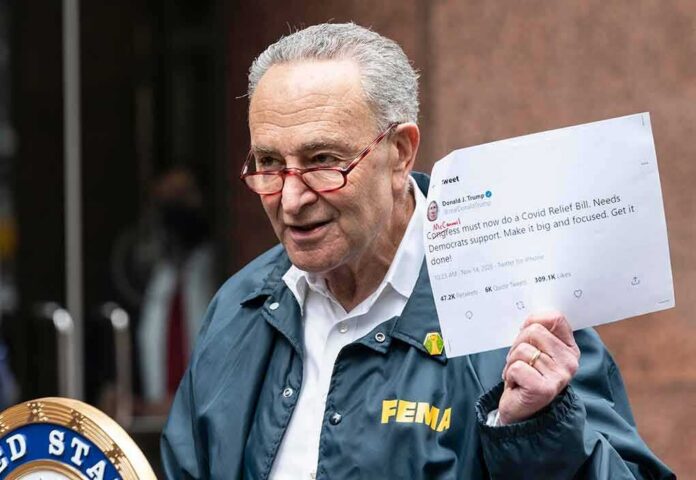
On the eve of a key Senate race, Chuck Schumer’s “despicable betrayal” attack boomeranged as another Democrat he once backed refused to support his leadership.
Story Highlights
- Schumer blasted Rep. Haley Stevens for endorsing Republican Mike Rogers over Democrat Abdul El-Sayed, calling it a “despicable betrayal.”
- Schumer said Senate Democrats are united behind El-Sayed and framed him as a champion for working families.
- El-Sayed said Democrats need new leadership and named Chris Van Hollen as his preferred leader over Schumer.
- Progressive figures and groups amplified calls to replace Schumer, deepening visible party fractures.
Schumer Condemns Stevens While Backing El-Sayed
Senate Democratic Leader Chuck Schumer publicly condemned Representative Haley Stevens after she endorsed Republican Mike Rogers in Michigan’s Senate race. Schumer called her move a “despicable betrayal” and insisted Democrats remain unified behind Abdul El-Sayed, the party’s nominee. He argued El-Sayed would fight for working families and cast Rogers as tied to President Trump and wealthy donors. The sharp rebuke drew wide coverage and set off a broader debate about loyalty and control inside the Democratic Party.
Reporting from multiple outlets confirmed Schumer’s stance. He reiterated party unity behind El-Sayed and economic messaging that targets household costs and wages. He also contrasted El-Sayed with Rogers, describing the Republican as aligned with national conservatives. The episode highlighted a key choice for Democrats in Michigan. They could lock arms in a competitive race or air internal grievances in public. Schumer chose confrontation with Stevens while pushing unity around the nominee.
El-Sayed Backs Different Leadership, Undercutting Unity Claim
Abdul El-Sayed, the very candidate Schumer defended, said Democrats need new leadership and that voters are hungry for it. He stated he would support Senator Chris Van Hollen for the top Democratic role in the Senate over Schumer. He also said he wanted leaders who reject big money in politics and focus on kitchen-table economics and universal health care. Those comments cut directly against Schumer’s statement that Democrats were united. They also gave progressives a rallying point.
Additional reports showed El-Sayed had already declined to endorse Schumer, reinforcing the split. Some incoming Democratic senators were also reported as opposing Schumer’s continuation as leader. The drumbeat from the left suggested a brewing fight after the midterms. That pressure carried risks for Democrats in close states. Open brawls over leadership distract from persuading swing voters and undermine claims of steady hands at the wheel. Republicans often benefit when Democrats fight each other.
Progressives Escalate: Calls to Replace Schumer Grow
Progressive activists and media figures seized on the Michigan fallout. The group Indivisible called for Democrats to replace Schumer and argued voters wanted a new generation of fighters. Left-leaning outlets echoed El-Sayed’s demand for leadership change and his praise of Van Hollen. The message was simple: the party should move further left on money in politics, wages, and health care. That push intensified the sense of a public rift at the worst possible time for Democrats.
Schumer’s original aim was to project discipline after Stevens broke ranks. Instead, his high-profile denunciation highlighted a fractured coalition. He had backed Stevens in the primary, then quickly endorsed El-Sayed after the result, only to face Stevens’s reversal and El-Sayed’s refusal to back him for leader. The chain of events gave Republicans a clean contrast. President Trump’s team can argue their side is focused on energy prices, the border, and crime while Democrats argue over who is in charge.
Why This Matters for Conservatives
Michigan’s clash shows why leadership and values matter. When Democrats fight, working families see an agenda that shifts with the winds. Schumer talks unity, yet his candidate rejects his leadership. That is not stability. Conservatives can make a simple case to voters who are tired of inflation, chaos at the border, and culture wars in schools. A party that cannot keep its own team together is in no shape to manage taxes, energy policy, or national security.
What Comes Next in Michigan and Beyond
El-Sayed still needs swing voters who dislike drama. Schumer still wants to claim unity while headwinds grow on his left. Stevens’s endorsement of Rogers gave Republicans a boost and a talking point. If Democrats keep sparring, they risk losing ground with workers who want lower prices and safer communities. Expect Republicans to keep pressing this divide. Expect Democrats to try to change the subject. Voters will judge who stays focused on their daily costs and freedoms.
Sources:
twitchy.com, cbsnews.com, thehill.com, nysun.com, cnn.com, aljazeera.com, democracynow.org, cw39.com, truthout.org, mytwintiers.com, newsweek.com