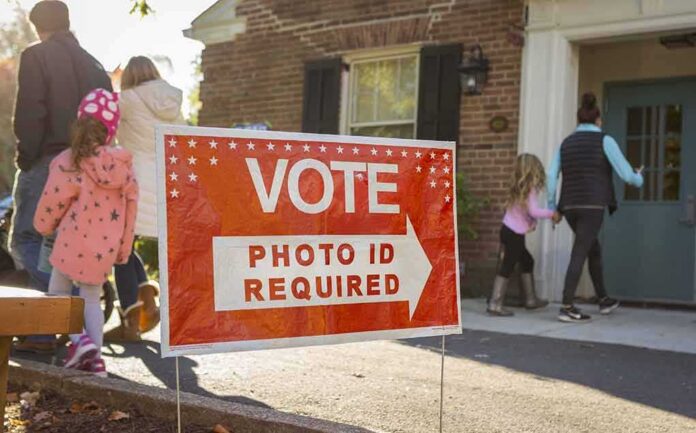
Undercover video from a Dearborn polling place shows a worker telling a self-identified noncitizen he could vote in a United States Senate race, a direct clash with federal and Michigan law.
Story Highlights
- Video captures a poll worker saying a noncitizen can vote for Senate candidates.
- Federal law bars noncitizen voting in any election for United States Senate.
- Michigan states only citizens can register or cast ballots in state or federal contests.
- Dearborn describes poll workers as responsible for assisting voters at polling places.
What The Undercover Video Shows In Dearborn
James O’Keefe’s outlet released footage said to be from a Dearborn polling place on November 4. The clip shows a worker speaking Arabic with an undercover man who says he is not a United States citizen. The worker replies, “Only U.S. president you can’t vote,” then adds, “But the others you can.” When asked if the man could vote for a Senate candidate named Abdul El-Sayed, the worker answers, “Yeah,” according to reporting on the video.
The video focuses on the single interaction at the polling site. It centers on the worker’s guidance, not on a ballot being cast. Published accounts do not identify the worker by name or precinct, and do not show a ballot or pollbook record tied to the exchange. The core allegation is the advice itself: that a declared noncitizen could vote in contests other than president, including a United States Senate race, which the worker appeared to affirm.
What The Law Demands In Federal And Michigan Elections
Federal law is clear. Title 18, Section 611 of the United States Code states it is unlawful for an alien to vote in any election held in whole or in part to elect a Member of the Senate. Violations can bring fines and up to one year in prison, subject to narrow exceptions that do not permit voting in Senate races. Michigan’s Secretary of State also states that only United States citizens may register or cast ballots in any state or federal election.
Michigan’s guidance says voters affirm citizenship under penalty of perjury when they register and when they vote. That means the rules are not a suggestion; they are sworn statements backed by law. A worker telling a self-identified noncitizen that he can vote for Senate conflicts with both federal and state rules. Even one instance of bad guidance can confuse voters and weaken trust in fair elections, which rely on clear, lawful instructions.
Why A Poll Worker’s Words Matter On Election Day
The City of Dearborn describes election workers, also called election inspectors, as people hired to assist at polling places and support ballot processing. Voters often take their lead from these workers. Their words carry weight because they guide who gets a ballot and how it is used. When guidance is wrong, even once, it risks an illegal vote or a challenge after the fact, which can raise tensions and spark legal fights that strain public faith.
🚨 Dearborn, Michigan
Poll Worker, Speaking in Arabic, Tells Undercover Reporter He Can Vote for U.S. Senate Despite Saying He’s Not a U.S. Citizen — Just Not President
Under 18 U.S.C. § 611, noncitizens are prohibited from voting in federal elections, including U.S. Senate… pic.twitter.com/2gVyQ397AW
— Debbie (@debbieliz56) November 4, 2026
The available reporting does not say a ballot was issued or cast in the Dearborn exchange. But the claimed advice itself touches a bright legal line: noncitizens cannot vote for federal offices, including United States Senate. A simple rule-of-thumb protects the process: if a voter states he is not a citizen, a worker must not direct him to any federal race. Clear training and fast correction help prevent errors at the counter where the law meets the voter.
What Comes Next And What To Watch For
Basic steps can bring clarity without politics. Officials can confirm worker training materials and remind every precinct that noncitizens cannot vote in federal or state contests. If needed, they can review pollbook notes and incident logs for this location. Public, plain-language guidance should be posted where voters check in. That will help honest workers, protect lawful voters, and shut down confusion before it spreads, which is the goal of good election administration.
Sources:
thegatewaypundit.com, uscode.house.gov, dearborn.gov