
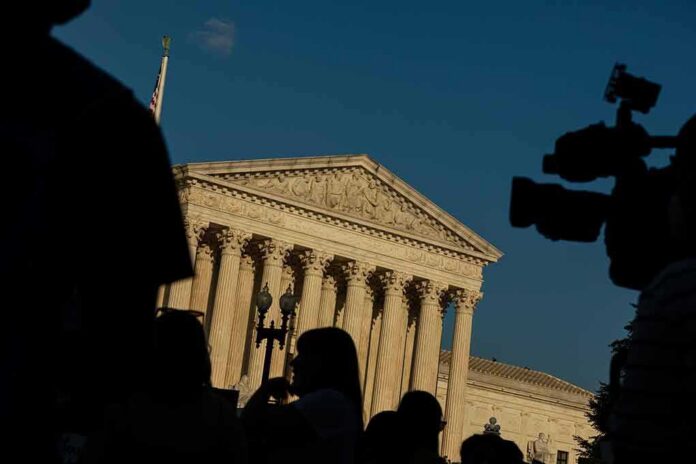
A federal grand jury is now probing the Dobbs leak, raising the stakes for the most serious breach of Supreme Court secrecy in modern history.
Story Highlights
- Prosecutors issued grand-jury subpoenas tied to the Dobbs leak, escalating the case beyond the Court’s internal probe.
- Justice Samuel Alito said he has a “pretty good idea” who leaked but lacks proof to publicly name the person.
- The Supreme Court’s investigation interviewed 97 employees but did not identify the leaker or a clear method.
- Investigators found no evidence of a hack and reported 80 people had access to the draft opinion.
Grand Jury Escalation Signals A New Phase
The New York Times reported that federal prosecutors sent grand-jury subpoenas seeking testimony and records from people who worked at the Supreme Court during the time of the Dobbs leak, with the United States Attorney for Washington, D.C., Jeanine Pirro, overseeing the inquiry. This step moves the case out of quiet internal channels and into a forum with subpoena power. A grand jury can test sworn claims, compare timelines, and pursue false-statement charges if witnesses lied.
Prosecutors have not publicly named a suspect, charged a crime, or listed a statute under review. That restraint fits normal practice at this stage. The point now is to lock down accounts and preserve records under oath. Conservative readers should see this as a needed reset. The Court could not close the loop internally. A federal forum can compel evidence and testimony that the Court could not reach on its own authority.
What The Supreme Court’s Probe Found — And Missed
The Supreme Court’s Marshal reported in January 2023 that investigators conducted 126 interviews with 97 employees, took sworn affidavits, and reviewed phone, email, printing, and access logs. The report said investigators found no forensic proof of who leaked the draft or how Politico received it. Investigators identified 80 people who had or received electronic access to the draft. That broad access, plus limited logs, made a clean chain of custody hard to build.
The report said there was no evidence of improper outside access, while noting it could not absolutely rule out a hack. The technical review did not identify a suspect among those with legitimate access. No one confessed, and every interviewed employee denied the leak. The result was a stalemate that damaged trust inside chambers. Justice Samuel Alito later said the leak created “an atmosphere of suspicion and distrust,” a reality any close-knit team would feel after a breach of that scale.
Alito’s “Pretty Good Idea,” Evidence, And Due Process
Justice Alito told reporters he has a “pretty good idea” who was responsible, while stressing that available proof does not meet the bar to publicly name that person. That line matters for justice and for fairness. Suspicion is not proof. The Court’s official position remains that it could not identify the leaker by a preponderance of the evidence. A grand jury can test whether any witness lied in sworn statements or whether metadata, device images, or messages fill gaps left by the internal review.
For conservatives who value the rule of law, this balance is key. The goal is not a political scalp. The goal is to defend the Court’s deliberative process, which protects every American when hot issues arise. If the leak aimed to pressure justices, that strikes at the heart of independent judging. If it was reckless or negligent, it still shattered trust. Either way, the system must show that rules, not mobs or leaks, guide outcomes.
Why This Matters Now Under President Trump
President Trump’s administration is responsible for federal law enforcement today. The Department of Justice can show equal justice by following the facts and resisting media spin. The New York Times noted it is still unclear what laws might apply or whether new evidence points to a suspect. That uncertainty argues for careful, methodical steps. It also argues for transparency where possible once the probe ends, so the public sees process, not politics.
Trump DOJ Pursuing Criminal Investigation Into the Dobbs Decision Leak https://t.co/8qS3RGcypa
— Brian Craig 🇺🇸 (@BrianCraigShow) November 7, 2026
Conservatives should also press for lasting fixes. The Court can narrow document access, strengthen printer and device logs, and ensure sworn compliance from everyone with access to draft opinions. The Court’s own record shows justices participated in interviews, but the Marshal’s report did not include sworn affidavits from them like it did for staff, a gap that invites doubt and should be addressed going forward. Clear, even rules make the Court stronger and protect its public standing.
What To Watch Next
Watch for subpoenas focused on access logs, print histories, and communications near the date Politico received the draft. Watch for whether prosecutors signal interest in false statements or obstruction tied to the earlier inquiry. Watch for whether the grand jury seeks testimony from investigators and court personnel who handled the draft’s distribution. Each step will show if the probe seeks the leak itself, a cover story, or both. Careful work now can help restore confidence later.
Sources:
zerohedge.com, whitehouse.senate.gov, npr.org, abajournal.com, americamagazine.org, thehill.com, cnn.com