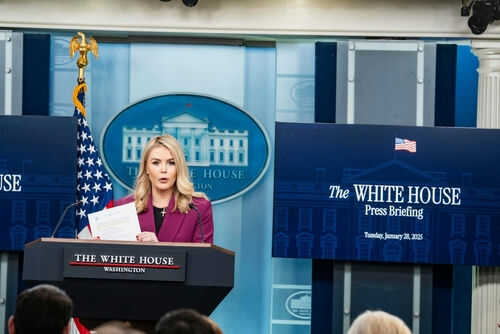
White House Press Secretary Karoline Leavitt abruptly deflected mounting bipartisan scrutiny of Commerce Secretary Howard Lutnick’s admitted post-conviction meetings with Jeffrey Epstein by rattling off Trump administration accomplishments the media supposedly ignored, then ending her briefing—raising serious questions about transparency and accountability within the Cabinet.
Story Snapshot
- Commerce Secretary Howard Lutnick admitted to post-2008 meetings with convicted sex offender Jeffrey Epstein, contradicting his prior claims of cutting ties in 2005
- Lutnick faces bipartisan calls for resignation from lawmakers including Republican Rep. Thomas Massie and Democrat Rep. Ro Khanna after Epstein files revealed a 2012 family lunch on Epstein’s private island
- Press Secretary Karoline Leavitt defended Lutnick by pivoting to administration policy wins and confirming President Trump’s full support, deflecting questions about ethics and disclosure
- Senate Republicans including Roger Wicker, Thom Tillis, and John Thune expressed concerns about the relationship, demanding full transparency while Democrats accused Lutnick of misleading Congress
Lutnick’s Contradictory Timeline Exposed
Commerce Secretary Howard Lutnick testified before the Senate Appropriations subcommittee on February 10, 2026, acknowledging meetings with Jeffrey Epstein that directly contradict his previous public statements. Lutnick had claimed on a podcast he severed ties with Epstein after touring his New York home in 2005. Unsealed Epstein case files from 2025 revealed otherwise: Lutnick met with Epstein for an hour at his residence in 2011 and took his wife, children, nanny, and another family to lunch on Epstein’s private island in 2012—three to four years after Epstein’s 2008 Florida conviction for soliciting prostitution from a minor. This reversal raises fundamental concerns about honesty and judgment in Trump’s Cabinet.
Bipartisan Pressure Mounts Despite White House Defense
Republican Rep. Thomas Massie of Kentucky called for Lutnick’s resignation over the weekend before the hearing, followed by Democrat Rep. Ro Khanna of California on February 9, 2026. During the Senate hearing, both Democrats and Republicans voiced alarm. Senator Chris Van Hollen of Maryland accused Lutnick of misleading Congress and requested all relevant documents. Republican Senators Roger Wicker of Mississippi, Thom Tillis of North Carolina, and Majority Leader John Thune of South Dakota raised concerns about the island visit and demanded Lutnick lay out the full extent of his relationship. Senator Chris Coons of Delaware stated he was troubled by the family lunch revelation and urged complete disclosure. Despite this rare bipartisan consensus, Press Secretary Karoline Leavitt defended Lutnick as “a very important member” with President Trump’s full support.
White House Deflection Strategy Raises Red Flags
Rather than address the substance of Lutnick’s contradictions and the serious ethical implications of maintaining a relationship with a convicted sex offender, Leavitt pivoted to listing Trump administration achievements she claimed the media ignored before ending the briefing. This tactic mirrors the media manipulation conservatives rightly criticized during the Biden years—using unrelated talking points to dodge accountability questions. Lutnick downplayed his contacts as “a handful of emails” and “a pair of meetings,” insisting he has “nothing to hide,” yet refused to commit to releasing all correspondence and records during his testimony. The Commerce Department and White House declined further comment after the hearing, leaving transparency demands unmet. This stonewalling contradicts the administration’s promise to release Epstein files and hold elites accountable.
Accountability Standards Applied Unevenly
The contrast with the United Kingdom’s response to Epstein file revelations is stark. British officials linked to Epstein faced resignations and revoked privileges, including Prince Andrew losing royal status. President Trump campaigned on transparency regarding Epstein files, pledging to expose connections the establishment buried. Yet Lutnick remains in his Cabinet post despite admitting he brought his family—including young children—to dine with a known pedophile on his private island years after his conviction. Representative Ro Khanna articulated the core frustration: the rich and powerful cannot “skate” on ties to predators while ordinary Americans face consequences for far less. This double standard erodes public trust in government institutions conservatives fought to restore. For an administration elected to drain the swamp, protecting a Cabinet member who misled the public about socializing with Jeffrey Epstein sets a troubling precedent that undermines the very principles of accountability and integrity voters demanded.
Senate Majority Leader John Thune emphasized the public must judge Lutnick’s answers for themselves, signaling ongoing scrutiny without immediate formal action. As of February 10, 2026, no resignation has occurred, no documents have been released, and bipartisan calls for transparency remain unanswered. The episode distracts from Commerce Department policy priorities and fuels questions about whether this administration will enforce the ethical standards it campaigned on or shield insiders from legitimate oversight. Conservatives who voted to restore honesty in Washington deserve better than rhetorical deflection and selective accountability when a Cabinet official’s credibility collapses under oath.
Sources:
Commerce Secretary Howard Lutnick acknowledges meetings with Epstein that contradict previous claims
White House defends Lutnick amid Epstein scrutiny