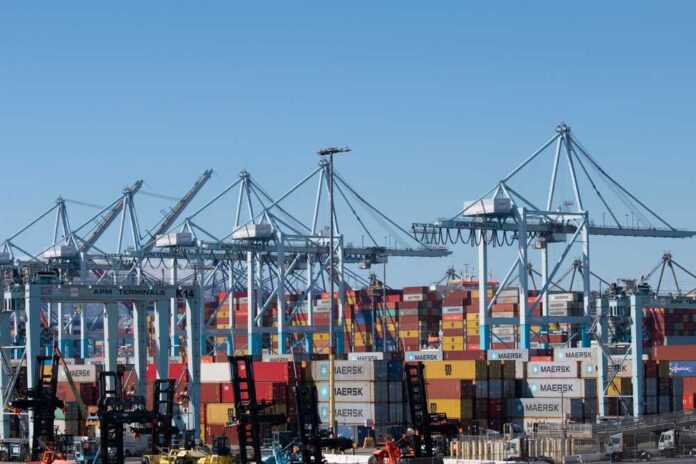
President Trump bypassed the Supreme Court’s rejection of his global tariffs by immediately imposing new import taxes under untested legal authority, leaving businesses facing another round of chaos and uncertainty just hours after the nation’s highest court ruled against his original trade policy.
Story Snapshot
- Supreme Court struck down Trump’s IEEPA tariffs 6-3, with three Trump appointees joining the majority against executive tax power
- Trump imposed new 10% global tariffs within hours using Section 122 authority, limited to five months and already facing legal challenges
- Businesses must navigate refund claims for $133-175 billion in collected tariffs while adjusting to new import taxes
- The rushed replacement tariffs expose continuing tensions between presidential authority and constitutional limits on taxation
Supreme Court Blocks Emergency Powers Tariffs
The Supreme Court ruled 6-3 that President Trump exceeded his constitutional authority by imposing global tariffs under the International Emergency Economic Powers Act, determining that taxation power belongs exclusively to Congress. Three justices Trump appointed—Neil Gorsuch, Amy Coney Barrett, and Chief Justice John Roberts—joined the liberal justices in striking down tariffs that had collected between $133 billion and $175 billion since implementation last year. The ruling represents the first time the high court explicitly rejected Trump’s use of emergency trade powers, establishing a precedent that limits future presidential authority over import taxes regardless of declared national emergencies.
Immediate Replacement Under Questionable Authority
Within hours of the Supreme Court decision, Trump announced new 10% baseline tariffs on imports from nearly every country, invoking Section 122 balance-of-payments authority that has never been used for broad tariff implementation. Trade analysts immediately flagged the replacement policy as legally vulnerable, noting the statute carries a five-month time limit and faces certain court challenges. Trump declared “we’re immediately instituting the 10% provision, which we’re allowed to do,” but legal experts warn the administration has unleashed a new set of complications while attempting to preserve what analysts call his “favorite tool” for addressing trade deficits.
Refund Chaos Compounds Business Uncertainty
Importers and businesses now face what trade lawyer Joyce Adetutu describes as a “bumpy ride” navigating refund claims through U.S. Customs and Border Protection and the Court of International Trade. The National Retail Federation is pushing for expedited refunds to stimulate economic activity, while states like Illinois demand per-family rebates of approximately $1,700. However, legal experts confirm refunds will go to importers who paid the tariffs, not consumers who absorbed higher prices. Businesses gain certainty that IEEPA tariffs were unconstitutional but must simultaneously adjust operations to new tariffs that carry their own expiration date and legal risks, creating ongoing volatility for retailers and manufacturers.
The administration’s rapid pivot demonstrates determination to maintain protectionist trade policies despite judicial pushback, raising fundamental questions about separation of powers that resonate with Americans frustrated by government dysfunction. The reality is clear: while Trump pursues his economic nationalism agenda and courts assert constitutional boundaries, ordinary businesses and workers bear the costs of this institutional conflict through disrupted supply chains, price uncertainty, and administrative chaos. The five-month clock on the replacement tariffs ensures this dispute will continue, potentially forcing Congress to finally exercise its constitutional role in trade policy rather than allowing executive branch experimentation with untested legal theories.