
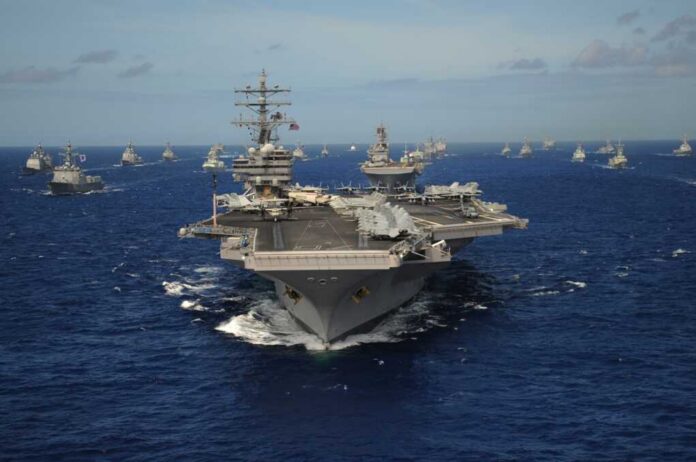
The USS Nimitz carrier strike group has entered the Caribbean at the same moment Washington is turning up the heat on Havana, and the timing is impossible to ignore.
Quick Take
- U.S. Southern Command publicly described the deployment as a display of readiness and presence [1].
- The Navy had already planned USS Nimitz for Southern Seas 2026 as part of a broader regional mission [2].
- The move came as the Justice Department unsealed murder charges against former Cuban leader Raúl Castro [1].
- Officials cited by reporters said the carrier would stay in the Caribbean for several days with no immediate combat operation planned [1].
Why the Carrier’s Arrival Matters
The United States Navy said the Nimitz Carrier Strike Group is operating in the Caribbean as part of a planned Southern Seas 2026 deployment, not as a sudden response to a single event [2]. That matters because the public debate has quickly shifted from routine force movement to speculation about Cuba. For conservatives who have watched too many administrations hide behind vague messaging, the real issue is whether this is legitimate deterrence or another high-visibility political signal.
U.S. Southern Command described the strike group’s arrival as a demonstration of “readiness and presence, unmatched reach and lethality, and strategic advantage” [1]. The force centers on the aircraft carrier USS Nimitz, the guided-missile destroyer USS Gridley, and the replenishment oiler USNS Patuxent [3]. That is a serious naval package, and it is not the kind of asset the Navy sends around casually. Still, the public record does not show a specific Cuban threat that required this exact move.
Planned Mission Versus Political Message
The Navy said USS Nimitz would deploy to the United States Southern Command area of responsibility as part of Southern Seas 2026 and conduct exercises with partner nations while circumnavigating South America [2]. That planning detail is important because it undercuts the claim that the carrier was rushed into the region for a sudden crisis. It also shows the deployment had a bona fide operational purpose, even if the timing now makes it look like part of Washington’s pressure campaign on Cuba.
Reporters also noted that U.S. officials planned to keep the strike group in the Caribbean for several days and described the posture as a “show of force,” with no immediate combat operation planned [1]. That phrasing tells readers a lot. It suggests deterrence and signaling, not an imminent strike. For Americans who value restraint, clear missions, and accountable government, that distinction matters. A show of force may be lawful and useful, but it is not the same as a defined military necessity.
Why the Cuba Link Is Driving Attention
The deployment landed on the same day the Justice Department unsealed murder charges against former Cuban leader Raúl Castro in connection with the 1996 Brothers to the Rescue shoot-down [1]. That coincidence is what fuels the broader drama, and it is also why the story has spread so fast. The legal action against Castro makes the naval move look more confrontational, even though the Navy’s own announcement points to a preplanned regional exercise rather than a sudden Cuba contingency.
The available reporting leaves one major gap: it does not provide a declassified threat assessment, operational order, or commander testimony explaining why this carrier strike group had to be in the Caribbean at this moment [1][2]. Without that, readers should be cautious about headlines that imply an invasion or immediate military action. The better reading is more measured: a powerful U.S. naval presence, a planned mission, and a White House that is clearly trying to project strength toward a hostile communist regime.
Sources:
[1] Web – USS Nimitz enters Caribbean as pressure on Cuba intensifies
[2] Web – U.S. 4th Fleet Announces Southern Seas 2026 Deployment – Navy.mil
[3] Web – U.S. 4th Fleet Announces Southern Seas 2026 Deployment