

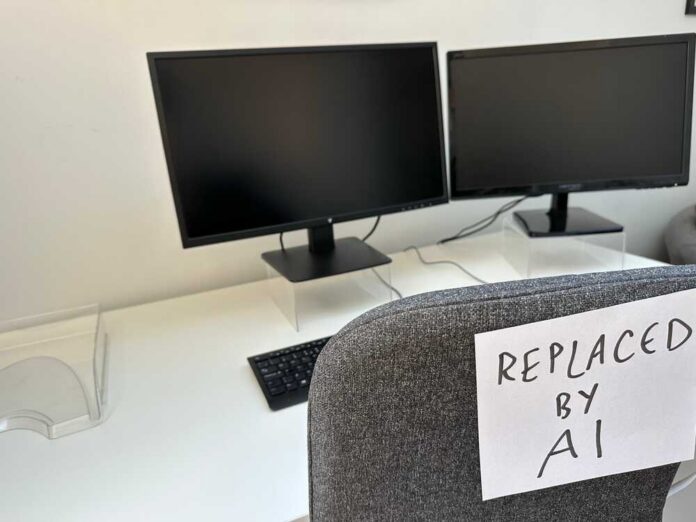
A leading artificial intelligence executive says half of entry-level office jobs could vanish within five years—exactly where young Americans start their careers and build families.
Story Snapshot
- Anthropic’s chief executive warned that artificial intelligence could erase 50% of entry-level white-collar roles and push unemployment toward 10–20% within one to five years [3][1].
- Targeted risk includes junior consultants, lawyers, and finance workers—jobs long seen as ladders to the middle class [3].
- Reports cite early stress signals: hiring freezes, layoffs, and junior headcount declines in artificial intelligence–exposed roles [5].
- Skeptics argue labor markets will adjust more slowly and less brutally than the dire forecasts suggest [6].
Amodei’s On-Record Warning And The Jobs Most Exposed
CBS News’ 60 Minutes recorded Anthropic chief executive Dario Amodei agreeing that artificial intelligence could wipe out half of all entry-level white-collar jobs and drive unemployment to 10–20% within one to five years, naming entry-level consultants, lawyers, and financial professionals as squarely in the blast radius [3]. Axios reported similar comments, emphasizing his call to stop “sugar-coating” artificial intelligence’s labor impact across technology, finance, legal services, and consulting—especially at the junior level [1]. These statements establish a consistent, public forecast tied to specific occupations rather than vague generalities.
Amodei’s risk framing connects to his company’s own experience with artificial intelligence externalities. CBS News highlighted Anthropic’s documented misuse incidents and security concerns while underscoring the firm’s stress testing and safety posture [3]. That record strengthens the signal that the company treats artificial intelligence side effects as real and material, not a theoretical debating point. While his figures are projections, the message is direct: entry-level white-collar work now overlaps with tasks that current models already perform credibly and at scale [3].
Early Labor-Market Stress Signals And Corporate Restructuring
Media roundups describe contemporaneous layoffs, hiring freezes, and restructuring in white-collar functions at brand-name firms, often paired with artificial intelligence adoption narratives [5]. A widely cited summary notes an employment decline among early-career software developers in artificial intelligence–exposed roles, while senior headcount grew, suggesting that automation may compress the bottom rungs first [5]. Axios likewise framed the risk as a near-term “white-collar bloodbath,” reflecting employer incentives to harvest efficiency at the junior level where routine tasks dominate [1]. Each datapoint is imperfect alone, but together they track with Amodei’s targeted exposure map.
Fortune reported that Amodei pairs the displacement warning with macroeconomic upside—higher productivity and growth—even as he flags potentially severe transition pain and inequality [6]. That high growth plus high dislocation mix recurs in historical debates over general-purpose technologies. The timing matters: if firms rush to automate support tasks before new roles emerge, junior cohorts can face multi-year gaps that derail family formation, small business starts, and community stability. For conservative readers, that is not an abstraction; it is the backbone of Main Street.
Forecast Limitations, Pushback, And What To Watch Next
The forecast’s weaknesses are clear. The most dramatic numbers are forward-looking; no public technical model from Anthropic appears alongside the 50% and 10–20% figures in the cited coverage [1][3][6]. The leap from role-specific displacement to economy-wide unemployment remains unproven with hard data, and some claims in the public conversation rely on summaries, commentary, or videos rather than primary labor metrics [5]. These gaps do not negate the risk, but they caution against treating any single figure as settled fact.
Dario Amodei of Anthropic says the quiet part out loud:
> The rich will benefit the most from AI
> Many jobs will be destroyed
> GDP could surge along with unemployment
> Enabling the largest upward wealth transfer in human historyThe time to learn how to use AI is now. pic.twitter.com/mWdLFQg77E
— Markets & Mayhem (@Mayhem4Markets) May 19, 2026
Critics counter that organizations adopt technology slower than headlines imply and that artificial intelligence still stumbles on reliability, oversight costs, and legal liability—constraints that can blunt rapid substitution [6]. The question then becomes speed and scope: do firms replace large shares of junior work within a few budgeting cycles, or does complementary deployment dominate? To answer, readers should watch internship pipelines, entry-level requisitions in law and finance, and documented workflow redesigns. If those lines shrink in tandem, Amodei’s timeline gains credibility; if not, the shock may diffuse over longer horizons.
What This Means For Conservative Priorities And Practical Safeguards
Protecting family formation, local enterprise, and upward mobility means not leaving the entry ladder to an algorithmic auction. The federal government under President Trump can prioritize transparency before regulation: require plain-English disclosure when companies replace defined categories of junior work with artificial intelligence; publish sector-level hiring and promotion data quarterly; and fast-track skills grants tightly linked to verifiable job placements rather than bureaucratic programs that miss the shop floor [1][6]. Clear facts first, targeted action second, and no blank checks for corporate buzzwords.
Congress should also defend fair competition and speech. Concentrated artificial intelligence compute and proprietary datasets can tilt markets toward a few gatekeepers who set de facto rules the public never voted on. Narrowly tailored measures—such as procurement standards favoring auditable systems, and liability clarity for misuse without smothering innovation—can align incentives with American workers and small firms [3][6]. The goal is durability: preserve opportunity for young strivers, keep wages tied to real productivity, and ensure that technology serves families, not the other way around.
Sources:
[1] Web – AI jobs danger: Sleepwalking into a white-collar bloodbath – Axios
[3] Web – Why Anthropic CEO Dario Amodei spends so much time warning of …
[5] YouTube – Tech expert warns AI could spike unemployment over the next five …
[6] Web – Dario Amodei spent last year warning of an AI white-collar … – …