

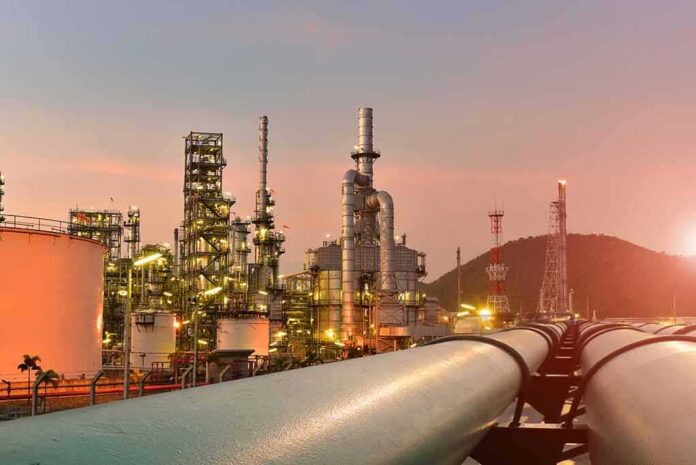
As wars squeeze global fuel supplies, U.S. refineries are running near full throttle, turning America into the world’s pressure valve for gasoline and diesel.
Story Snapshot
- U.S. refineries are running at about 96% of operable capacity, near the highest levels on record.
- Strong demand, tight fuel inventories, and fat refining margins are driving this “run hard” strategy.
- Global wars and shipping chokepoints are boosting export demand for U.S. fuel, adding strain to the system.
- High utilization helps hold prices down for American drivers but raises safety, maintenance, and reliability concerns.
Refineries Running Near the Red Line
U.S. refinery data from the U.S. Energy Information Administration show operable utilization near multi‑decade highs, with weekly readings around **96%**, well above the long‑term average near 90%. Industry trackers note that rates in the mid‑to‑high 90s signal a system “running hot,” with very little spare capacity to absorb shocks. Trade press reports describe plants “pushing run rates to maximum levels,” as companies keep more units online and delay some maintenance to meet demand. For a complex machine like a refinery, this is the real‑world version of driving a pickup truck up a mountain with the engine constantly near the red line.
American Fuel and Petrochemical Manufacturers explain that anything in the ballpark of **90% or higher** is considered a high utilization rate, and that refineries are not built to sit at 100% for long stretches. Their recent commentary says U.S. plants are “running full‑out, at about 95% of total capacity,” putting more gasoline, diesel, and jet fuel into the global market than any other country. Energy analysis firms add that utilization has stayed at multi‑year seasonal highs thanks to “light maintenance activity,” meaning fewer units are taken down for inspections and repairs. In simple terms, plants are working longer and harder, with fewer breaks, to keep fuel flowing.
Why America’s Refineries Are Working Overtime
Analysts say several forces are stacked on top of each other to keep U.S. refineries running this hard. Strong demand at home, especially in the summer driving season, pulls more gasoline and diesel through the system. Low fuel inventories act like a warning light on the dashboard, pushing refiners to keep output high even when profit margins dip. At the same time, crack spreads and other margin measures remain healthy, so every extra barrel of fuel a refinery can sell is worth good money, especially for complex Gulf Coast plants that can process heavy sour crude at a discount. Together, demand, low stocks, and solid profits make high utilization the “common‑sense” business choice.
Global events are adding a powerful extra pull. Industry and research groups report that wars affecting the Middle East and broader disruptions to oil flows have tightened fuel supplies worldwide, especially for diesel and jet fuel. One analysis notes that reduced energy flows through key chokepoints like the Strait of Hormuz have forced Asian refiners to cut runs, leaving a gap that U.S. exports help fill. A Reuters‑linked report says Gulf Coast refiners are enjoying the strongest margins in years as the Iran war raises demand for U.S. fuel exports, with regional utilization climbing into the low 90% range. Commentators on social media and trade sites point to global jet and diesel shortages from “war‑hit” refineries abroad as a reason every extra American barrel is “extraordinarily profitable.”
Normal Economics or War‑Driven Supply Squeeze?
Here is the key debate: are these breakneck refinery speeds mainly a normal response to economics, or a sign of war‑driven stress in the fuel system? Official data and industry blogs emphasize that high utilization around 90% has long been a standard operating condition for U.S. refineries during strong demand years. The Energy Information Administration has forecast refinery utilization “above 90%” as a typical level, noting that annual averages rarely climb much higher than 95% because of routine maintenance and seasonal demand changes. From this angle, current readings look like a hotter version of a familiar pattern, not an outright emergency.
On the other hand, several recent analyses tie the *current* near‑record readings directly to global strain. Energy News Beat reports refiners “delaying scheduled maintenance amid strong refining margins and steady‑to‑robust fuel demand,” fueled by export opportunities into tight overseas markets. IndexBox and other trackers say U.S. downstream operations are at “multi‑year peaks as worldwide markets compete for processed fuels,” calling America the “primary swing supplier” for much of the world. The Dallas Federal Reserve notes that rising utilization, high profitability, low product inventories, and “dislocation of supplies due to the war in Europe” have combined to boost exports and tighten balances. That picture looks less like normal business and more like a home garage stepping in because the whole neighborhood’s generators are failing.
Risks, Trade‑offs, and What It Means for Families
Running refineries this hard is not free of risk. A detailed review warns that pushing plants toward maximum levels can raise safety concerns and force maintenance trade‑offs, as operators choose to keep units online longer instead of shutting them down for repairs. High utilization with delayed maintenance increases the chance that a single breakdown or accident could knock out a large slice of capacity, especially on the Gulf Coast where plants are clustered. Analysts also caution that hurricane season or a major unplanned outage could quickly flip today’s “ample supply” into tomorrow’s price spike when there is so little slack left in the system.
For American families, the picture is mixed. On the positive side, these high run rates have helped keep gasoline and diesel flowing and held down prices compared with what they might be if refineries pulled back. The American Energy Alliance praises refiners for “keeping American families on the road” by running near capacity to meet both domestic and international demand. Yet the same global forces that make exports profitable can also send prices higher if overseas shortages worsen or if a major U.S. plant trips offline. The system today leans heavily on American refining strength to buffer the world, which means any shock abroad or at home can land right in the laps of U.S. drivers, truckers, and small businesses who depend on affordable fuel.
Sources:
afpm.org, eia.gov, reuters.com, kpler.com, youtube.com, seekingalpha.com, inspectioneering.com, finance.yahoo.com, energynewsbeat.co, instituteforenergyresearch.org, indexbox.io