

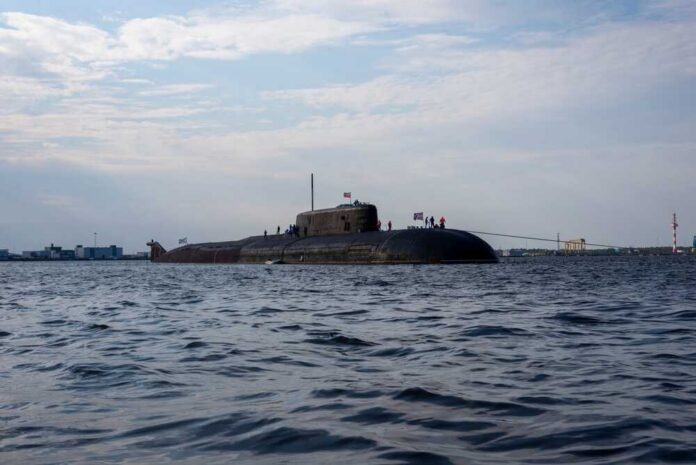
The U.S. Navy is burning through its most advanced — and scarce — nuclear submarines on everyday patrol duties, and some defense analysts say that’s a serious mistake that could leave America exposed when a real crisis hits.
Story Snapshot
- The Navy’s entire submarine fleet is now nuclear-powered, with Virginia-class and Columbia-class boats carrying the full load of all missions.
- The Navy plans to spend $124.9 billion on submarine construction over the next five years — but only on nuclear boats, with no cheaper alternatives in the plan.
- Critics argue that using $3 billion nuclear subs for routine patrols is wasteful, while the Navy says only nuclear power can meet its global mission demands.
- This debate is not new — the Navy has faced the same “fleet mix” argument since the 1990s, when its attack submarine force shrank dramatically after the Cold War.
A Shrinking Fleet Doing More With Less
The U.S. Navy today operates an all-nuclear submarine force. Every boat in the water is either a Virginia-class attack submarine or a Columbia-class ballistic missile submarine. Older Los Angeles-class and Seawolf-class boats are gone from active service. That means every patrol, every intelligence mission, and every routine task falls on the same small pool of expensive, hard-to-replace vessels. The Navy’s total active fleet sits at roughly 243 units, with submarines making up about 29% of that strength.
The Navy also plans to shrink its overall battle force. It targets 287 ships in fiscal year 2025, down from 296 — a move officials frame as choosing quality over numbers. That logic makes sense on paper. But fewer ships doing more jobs means each one gets worn down faster. When a nuclear submarine needs maintenance, there is no cheaper backup boat to fill its slot. The fleet has no bench.
$124 Billion Plan — But Only One Type of Boat
The Navy’s shipbuilding plan, released in May 2026, commits $124.9 billion over five years specifically for submarine construction. That is a massive investment — and it goes entirely to Virginia-class and Columbia-class programs. Air-independent propulsion submarines, a cheaper non-nuclear technology used by allied navies around the world, get no mention at all. Critics say this is the core problem: the Navy is doubling down on one expensive solution instead of building a smarter mix.
Air-independent propulsion, or AIP, submarines cost between $200 million and $600 million each — a fraction of a Virginia-class boat’s roughly $3 billion price tag. They are quieter than nuclear subs in certain conditions and work well for coastal patrol and surveillance tasks. Several U.S. allies, including Germany, Japan, and South Korea, rely on them for exactly those jobs. The argument is simple: why send your best and most expensive tool to do a job a cheaper one could handle?
The Navy’s Case for Going All-Nuclear
The Navy has a firm answer to that question, and it is rooted in geography. The United States is not a coastal power defending a nearby shoreline. It projects force across two oceans and must be ready to respond anywhere on the globe. Nuclear submarines can stay submerged for three to four months and cross oceans without surfacing. AIP boats cannot match that. A German Type 214 AIP submarine tops out at about 23 miles per hour underwater. A U.S. nuclear attack submarine can sustain speeds above 35 miles per hour. That gap matters in a real fight.
The Navy has not built a diesel-electric submarine since the late 1950s. Restarting that industrial capacity would take years and cost money the service says it does not have. Officials also argue that maintaining an all-nuclear fleet keeps the specialized American submarine-building industry sharp and ready. Splitting focus between nuclear and conventional programs could weaken both. President Trump’s executive order signed in April 2025, focused on restoring American maritime dominance, aligns with this all-in approach to high-end naval power.
A Debate That Keeps Coming Back
This argument is not new. In 1992, after the Cold War ended, the Navy canceled the Seawolf program and stopped ordering new attack submarines for years. Analysts warned at the time that the force would shrink by two boats per year after 2010 if production did not recover. It did not recover fast enough. The Navy is still dealing with the consequences of that gap today. The fleet mix debate has resurfaced every time budgets tighten or submarine numbers fall short of demand.
The honest answer is that both sides have a point. Nuclear submarines are genuinely irreplaceable for high-end combat and long-range missions. But sending a $3 billion boat to do a job that a $400 million boat could handle is hard to justify when the fleet is already stretched thin. Whether the Navy should explore AIP submarines for lower-stakes duties is a legitimate question — and one that $124.9 billion in nuclear-only spending suggests the Pentagon has already decided to ignore.
Sources:
19fortyfive.com, youtube.com, media.defense.gov, c7f.navy.mil, nationalsecurityjournal.org, subsim.com