
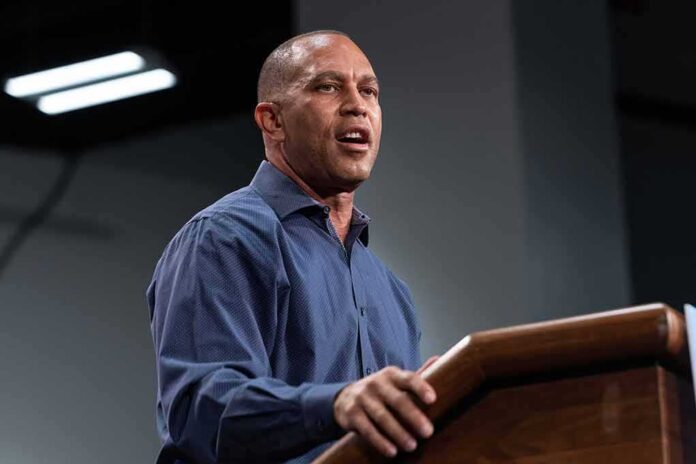
House Democratic leader Hakeem Jeffries labeled routine voter-eligibility checks a “diabolical scheme,” even as federal filings show the dispute centers on setting aside suspected noncitizen ballots for verification, not canceling legitimate votes.
Story Snapshot
- The Justice Department asked a court to set aside mail ballots linked to about 20,000 likely noncitizens in California pending verification.
- Democratic leaders, including Jeffries, sued President Trump and federal agencies, alleging threats and intimidation of election officials.
- The Justice Department said it is not purging rolls or canceling valid votes, but preventing ineligible voting while status is checked.
- The court has not ruled that any illegal scheme exists, and no election results are shown to be changed in the record yet.
What Triggered Jeffries’s Charge
News reports said the United States Department of Justice filed suit on October 15, 2026, over California voter rolls. The filing sought to stop the state from counting mail ballots tied to roughly 20,000 registrants the federal government flagged as likely noncitizens until their status could be confirmed. The Justice Department described a process to set aside these ballots for review, not a purge. California officials disputed the methodology and resisted rapid action based on a password-protected list.
Democratic leaders, including Senate and House leadership, responded with a 44-page complaint filed October 21, 2026, in the United States District Court for the District of Columbia. The lawsuit named President Trump, the Department of Justice, and the Department of Homeland Security. The filing alleged a pattern of threats and intimidation against election officials who did not act on federal demands, citing reported warnings of potential criminal consequences. The complaint framed the conduct as unlawful coercion under the Voting Rights Act.
What The Federal Case Actually Seeks
Reporting on the federal suit makes a key point that undercuts the “purge” label used by critics. The Justice Department said it did not request mass removals from voter rolls or blanket rejection of votes. Instead, it asked that ballots linked to people on the federal list be segregated while citizenship gets verified. That remedy is narrower than a roll cleanup and focuses on preventing ineligible votes. The distinction matters for both election integrity and voters’ rights, especially with tight timelines before midterms.
California officials challenged the federal list’s accuracy and the demand for rapid action. Reports described a tight 48-hour review window and a password-protected thumb drive containing the names, which raised process and validation concerns. The public record does not show the underlying matching method, error rate, or completed status checks. That leaves open how many flagged registrants are truly ineligible. It also explains why courts and administrators face pressure to balance speed with accuracy before counting.
Claims, Evidence, and What We Know So Far
Jeffries’s “diabolical scheme” claim lands amid charged rhetoric, but the available record shows contested litigation, not a proven plot. Democrats sued to block what they describe as intimidation and unlawful pressure. They cited statements warning that officials could face jail if they ignored federal notices. However, a court has not yet found that these actions violate the law. The case is pending, and the evidence will be tested in hearings and filings before any ruling is reached.
No source in the record shows a nationwide Republican directive ordering states to remove lawful voters. The documentation instead confirms a California-focused lawsuit and broader political and legal fights over roll maintenance and ballot handling. The record also does not show that ballots were rejected or that results were changed due to the lawsuit. Those outcomes may be clarified only after discovery, court orders, and any audits are complete. Until then, claims of a finished purge remain unproven in the record.
Why This Matters To Readers
Election integrity is basic: every legal vote should count, and illegal votes should not. The Department of Justice’s request to set aside suspected noncitizen ballots for verification fits that core principle. It protects citizens’ votes without canceling valid ballots. Democratic leaders say the approach crosses into coercion and creates fear among election workers. That charge will rise or fall on the proof they present in court, not in press conferences or interviews.
Conservatives want guardrails that are simple and fair. Clear proof-of-citizenship checks at registration. Transparent matching methods before any ballot is set aside. Fast notice and a way for eligible voters to fix errors before counting. None of that should threaten lawful voters. It simply protects the value of every ballot while respecting due process. The court fight now underway will decide where that line is drawn and whether any official crossed it this cycle.
Bottom Line
The Department of Justice asked to pause counting of specific California mail ballots flagged as likely belonging to noncitizens until status is confirmed, not to purge rolls or cancel valid votes. Democratic leaders, including Hakeem Jeffries, sued President Trump and federal agencies, alleging threats and unlawful pressure on election officials. A judge has not ruled that a scheme exists, and the record does not show changed results or mass rejections. Facts, filings, and rulings—not slogans—will settle this dispute.
Sources:
politico.com, abcnews.com, apnews.com, yahoo.com, washingtonpost.com