

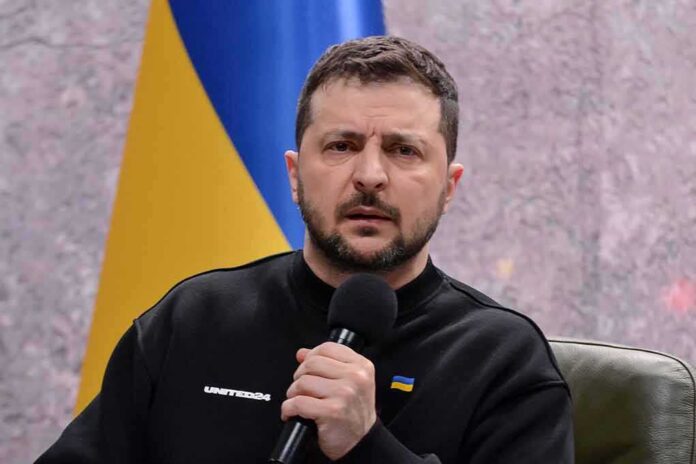
A reported land-for-NATO idea surfaced in Ukraine talks, raising alarms about trading borders for promises.
Story Snapshot
- Zelenskyy says U.S. negotiators asked if Ukraine would leave Donbas in exchange for NATO entry.
- The question came after talks in Abu Dhabi, not as a formal, written American plan.
- NATO membership needs all allies to agree, which the reports do not show.
- Zelenskyy continues to reject giving up any Ukrainian land and warns against legitimizing occupation.
Zelenskyy’s Account of a Territorial-for-NATO Question
President Volodymyr Zelenskyy told reporters that American negotiators asked whether Ukraine would withdraw from Donbas if it could join the North Atlantic Treaty Organization. CNBC reported that Zelenskyy called this the first time the issue came up in talks. The report ties the question to discussions that followed a round of Russia-Ukraine peace contacts in Abu Dhabi. The outlets did not publish a U.S. paper or transcript that shows a formal offer behind the question.
CNN summarized the idea as a swap: Ukraine cedes or withdraws from Donbas in return for NATO membership. That frame makes the stakes clear for Ukraine and Europe. But the same report notes that joining the alliance requires approval by all NATO members. Washington alone cannot deliver that outcome. The accounts do not show that Russia accepted the idea or that allies endorsed it. The public record remains Zelenskyy’s description of what U.S. envoys asked.
What Is Known, What Is Not, and Why It Matters
The reports outline a possible broader package that could include security guarantees, a strong and funded Ukrainian army, and reconstruction support. Such terms echo common end-of-war frameworks, where territory, security, and money are linked. Yet there is no posted accession timetable, no North Atlantic Council decision, and no shared map of what “Donbas” means in legal lines. That lack of detail leaves big questions on enforcement, funding, and borders unresolved for any real deal.
For the American public, the key point is authority and accountability. A stray question in a meeting is not a binding U.S. policy. Only a clear statement from the White House, the Department of State, or the alliance could set that. None of the cited reports include such a statement. That means readers should separate a diplomatic probe from a commitment. The difference guards against mission creep, unclear promises, and deals that Congress and allies never approved.
Ukraine’s Red Lines and Domestic Consent
Zelenskyy has said many times that Ukraine cannot give away its land and that Donbas and Crimea must be brought back. He has also said any historic compromises must go to the people through Ukraine’s parliament or even a national vote. Those points show his domestic limits and the need for public buy-in on any settlement. He has warned that treating Ukrainian territory as negotiable risks blessing Russia’s occupation, which Kyiv rejects outright.
Following the Kremlin talks and the U.S. envoys' debriefing in Dublin, Ukrainian President Volodymyr Zelenskyy revealed that American negotiators floated the idea of Ukraine withdrawing from the Donbas region in exchange for NATO membership. Meanwhile, European leaders finalized… pic.twitter.com/8RTSA9abWF
— Jamarr Jabari (@jabarivocmedia) November 14, 2026
Kyiv also pushes for “Article 5-like” guarantees, clear roles for partner countries on land, in the air, and at sea, and steady funding for a strong army. Ukraine’s position favors collective guarantees from major powers, not vague pledges. That approach aims to keep the peace durable and avoid a repeat of failed ceasefires. Any framework that skips enforceable security or steady support could fail fast and reward aggression instead of deterring it.
What Conservatives Should Watch in U.S. Policy
American leaders must not trade sovereignty for headlines. Any proposal that shifts borders must pass strict tests: It should be lawful, limited, and backed by clear allied votes and U.S. oversight. It must not force U.S. troops into open-ended risks without Congress. It should not spend unknown billions with no plan for results. Reports so far show an exploratory question, not a signed plan. Demanding clarity now protects U.S. interests and avoids another blank check abroad.
President Trump’s team faces a hard balance. The United States wants a stable Europe that does not drain American strength. A credible peace must deter Russia, not reward it. It must stop endless aid without end goals, not lock taxpayers into years of bills. If talks move forward, the administration should insist on enforceable terms, tight budgets, and allied burden-sharing. Anything less invites mission creep and weakens our focus on the border, energy, and inflation at home.
Bottom Line: No Blank Checks, No Border Trades in the Dark
Reports show U.S. envoys asked a tough, high-stakes question in talks about Ukraine and NATO. They do not show a formal American offer, an allied green light, or clear borders and enforcement. Ukraine still rejects giving up land and seeks real security guarantees. Conservative readers should press for written terms, legal authority, and strict limits before any deal. America should defend peace through strength and clarity, not with vague swaps that could fail on day one.
Sources:
cnbc.com, cnn.com, kyivindependent.com, president.gov.ua