
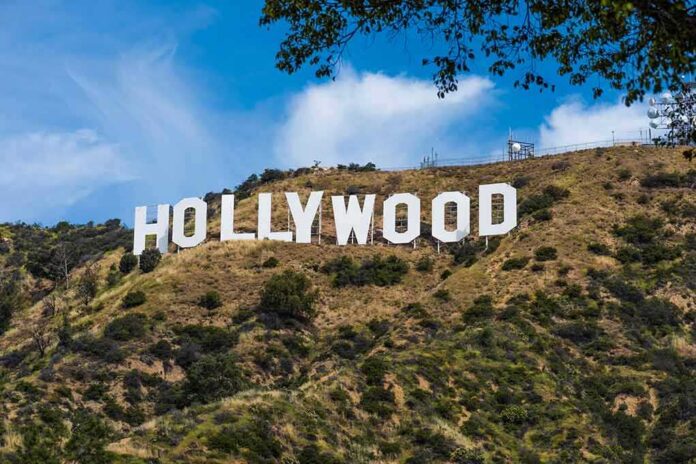
An artist hijacked the Hollywood Sign and strapped a nearly naked, “mummified” man to it — and police say it was trespassing, not art.
Story Highlights
- Artist Sabine Tautou staged a stunt at the Hollywood Sign and was detained for trespassing.
- The performance, “Public Figure, 2026,” lasted about 25 minutes late Friday morning.
- The artist’s release pushed symbolism about fame and erasing identity, but access was not permitted.
- Past Hollywood Sign pranks also drew trespass arrests, reinforcing a clear legal line.
Police Response Treated the Stunt as Trespassing, Not Protected Speech
Los Angeles police detained artist Sabine Tautou after she staged a live performance at the Hollywood Sign. The act involved strapping a nearly naked man to the landmark, wrapped to appear “mummified.” The performance started around 10 a.m. and lasted about 25 minutes before officers intervened, according to reporting that cited police action. Authorities cited Tautou for trespassing. That response mirrors how past sign stunts were handled when access to the restricted site was not allowed.
Police and park managers have long warned that climbing near or onto the Hollywood Sign is off-limits. After prior incidents, local officials increased surveillance and made clear that unauthorized entry triggers misdemeanor trespassing cases. In 2017, a separate “Hollyweed” alteration led to an arrest on suspicion of trespassing. The consistent pattern shows the rule: intent does not erase unlawful access. If you step past the marked lines, you face charges, even if nothing is damaged.
The Artist’s Message Claims Symbolism — the Law Still Sets Boundaries
Tautou titled the performance “Public Figure, 2026” and described it as a “compelling physical and ideological juxtaposition.” The press language framed the sign as a symbol of aspiration and fame. The wrapped man was said to show how fame strips identity and limits movement. That is the claim. But the venue choice required entering a protected area. The law treats that as trespass, not speech in a public forum. Courts and city policies draw bright lines on access to restricted property.
Fans of performance art may see public critique in a high-visibility place. Yet the First Amendment does not grant a right to enter secured landmarks. Legal scholars and officials have said this for years: speech is protected, trespass is not. Past stunts at the sign, including a 2021 banner incident, brought arrests or citations and statements that the sign’s space is not open to use. Even when no harm occurs, the response is the same because access rules govern first, and expression must operate within them.
Public Safety, Property Rights, and Common Sense Enforcement
Police actions at the sign are about more than order. Crews must weigh safety for the public and for first responders. The Hollywood Hills terrain is steep, brushy, and fire-prone. Climbing to stage a show can trigger rescues, tie up units, and risk falls. Those costs land on taxpayers and strain limited resources. Consistent trespass enforcement protects landmark integrity and deters copycats who could push a risky stunt even further next time, with worse outcomes.
Conservatives see a simple principle at work: rights come with duties, and property lines matter. You can make your point in lawful spaces. You cannot endanger others or misuse what the community maintains. The Hollywood Sign is a civic icon kept up with public and private support. Protecting it from hijacks respects the people who fund, maintain, and visit it. Clear rules, equal enforcement, and respect for property keep society fair and safe for everyone.
Pattern of Prior Incidents Underscores the Legal Bottom Line
Reports over decades show the same outcome when the Hollywood Sign becomes a stage. In 2017, the person behind the “Hollyweed” alteration was arrested on suspicion of trespassing. In other cases, police investigated similar changes as misdemeanors because no damage occurred, but access was still illegal. Officials also said that more cameras and patrols would help stop repeat attempts. The message has been steady: unauthorized sign interventions end with citations or arrests.
This latest event fits that record. The artist framed the action as a statement. Police called it trespass. Both can be true in different senses, but only one controls at the gate. Law sets and guards the boundary, while speech remains free in lawful places. That balance is core to ordered liberty. It protects landmarks, saves public safety resources, and keeps debate open without letting thrill-seekers gamble with other people’s property or safety.
What Comes Next: Accountability Without Hype
Officials will likely review footage, cost impacts, and whether others helped the stunt. Charges could remain a citation if there was no damage or injury. The case will still serve as a warning. Future attempts face the same rules and the same outcome. The right lesson is not that art is banned. The lesson is that access rules are real, and famous places are not blank canvases for whoever climbs fastest. Respecting the line keeps freedom strong and communities safe.
Sources:
nypost.com, tmz.com, news.artnet.com, dw.com