
A federal arson trial in Los Angeles is about to decide whether a single late-night spark — allegedly set by an Uber driver above Pacific Palisades — will be blamed for one of the deadliest wildfires in city history.
Story Snapshot
- Federal prosecutors say a 2025 hillside fire set by Jonathan Rinderknecht smoldered underground for days before erupting into the deadly Palisades Fire.
- The case hinges on whether jurors agree that one alleged act of arson legally caused a week-later inferno that killed 12 and destroyed thousands of structures.
- Defense lawyers argue the government is stretching evidence and causation, raising major due process questions.
- The outcome will shape how aggressively federal power can be used in future climate and wildfire politics in Democrat-run California.
What Prosecutors Say Happened Above Pacific Palisades
Federal prosecutors allege that early on January 1, 2025, then‑29‑year‑old former Pacific Palisades resident Jonathan Rinderknecht intentionally set a small fire along a trail above the coastal neighborhood after finishing a late shift as an Uber driver.[3][4] According to the indictment and criminal complaint, investigators concluded this “Lachman Fire” was deliberately lit with a lighter applied to vegetation or paper, after they ruled out fireworks, lightning, power lines, or other accidental causes at the origin point.[3][4] Prosecutors say that initial blaze, not fully extinguished in the soil and roots, is the ignition that ultimately matters.
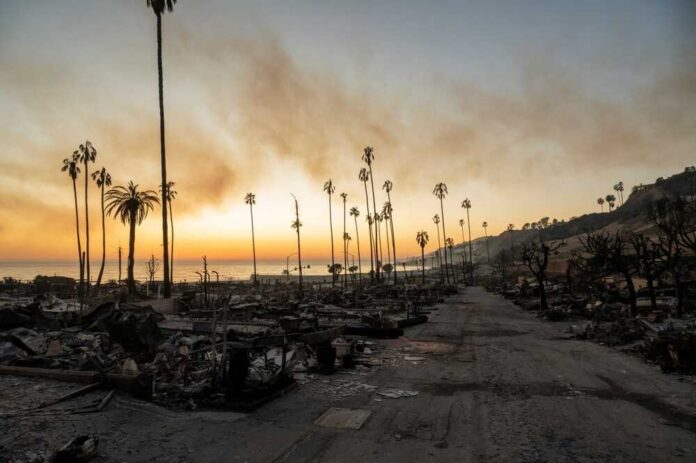
The United States Department of Justice (DOJ) says that underground embers from the January 1 fire continued to burn undetected in root systems on the hillside.[4][6] A week later, authorities say, those smoldering roots flared back to life and exploded into what became known as the Palisades Fire, one of the most destructive and deadly wildfires in Los Angeles history.[4][5][6] Federal court filings describe this theory in stark terms: one malicious act on New Year’s morning allegedly triggered the catastrophe that followed days later.
The Charges, the Stakes, and the Government’s Theory of Causation
On October 15, 2025, a federal grand jury indicted Rinderknecht on three serious counts: destruction of property by means of fire, arson affecting property used in interstate commerce, and timber set afire, all arising from the Lachman and Palisades Fires of January 2025.[4][5] According to prior court summaries, conviction on all counts could expose him to up to forty‑five years in federal prison, an enormous sentence driven by the scale of destruction and death tied to the Palisades blaze.[5] Government trial strategy treats the original hillside fire and the later wildfire as one continuous criminal event.
News accounts summarizing the case say that investigators and prosecutors blame the Palisades Fire for killing twelve people and destroying or severely damaging thousands of homes and businesses across the Pacific Palisades area.[5][6] The Justice Department case narrative argues that once jurors accept the January 1 blaze was intentionally set, they should also accept that its underground persistence and eventual “rekindling” make Rinderknecht responsible for the full human and economic toll.[4][6] That expansive causation theory lets Washington lawyers tie a neighborhood ignition to a region‑wide disaster, with all the political and financial ramifications that follow.
Defense Pushback, Juror Confusion, and Due Process Concerns
Defense attorneys counter that so far the public record shows allegations, not proof beyond a reasonable doubt that Rinderknecht intentionally set the January 1 fire or that he can be legally blamed for everything that happened a week later.[2][3] The Justice Department’s own case page confirms that, going into June 2026, the charges remained just that — charges — with no jury verdict.[4] Court coverage describes judges and lawyers wrestling with how to keep jurors from simply equating tragedy with guilt, especially when complex wildfire science and timing are involved.[5]
Reporting on pretrial hearings indicates that both sides recognize a gap between proving a small, early‑morning fire and proving that same fire, days later, caused the massive Palisades inferno.[5] That gap is where the defense is expected to focus, challenging the government’s chain of causation, the reliability of fire origin reconstruction, and any attempts to overplay suggestive evidence like online activity or personal obsessions.[3] For conservatives who care about due process, the question is whether the federal government is carefully proving each link, or trying to ride public anger and fear into a conviction.
Wildfire Politics, Federal Power, and What This Trial Signals
National coverage emphasizes that the Palisades Fire trial is not just about one man, but about how government will handle future catastrophic wildfires in Democrat‑controlled states.[1][6] Prosecutors are framing the disaster strictly as a criminal act, not as a failure of state and local policies on forest management, fuel buildup, power grid reliability, or evacuation planning.[1][4][6] That framing conveniently protects long‑standing California political leadership from serious scrutiny for how badly prepared communities were when the hills above Pacific Palisades finally ignited.
Was the destructive Palisades Fire of January 2025 arson or a tragic accident? Prosecutors are arguing a case against Jonathan Rinderknecht for allegedly starting the Lachman Fire, which eventually blew over into the Palisades Fire. His defense says their evidence is… pic.twitter.com/7FQ3ZCABOh
— CBS News (@CBSNews) June 1, 2026
Wildfire arson cases like this one are usually built on circumstantial reconstructions — burn patterns, timing, digital records, and the elimination of alternative ignition sources — rather than direct eyewitness proof.[1][6] That reality makes it vital that jurors insist on real evidence instead of emotional narratives, especially when the federal government pairs climate‑era fear with sweeping criminal statutes. For readers worried about government overreach, this trial will be a test of whether Washington respects individual rights even in the shadow of a devastating, politically charged fire.[1][4]
Sources:
[1] Web – Los Angeles trial to begin for man accused of sparking the deadly …
[2] Web – United States v. Jonathan Rinderknecht – Department of Justice
[3] Web – Federal trial date set for Palisades Fire suspect | FOX 11 Los Angeles
[4] YouTube – Prosecutors questioned on plans for the upcoming Palisades Fire …
[5] Web – Federal arson trial begins for Palisades Fire suspect in California
[6] Web – Palisades Fire suspect must remain jailed while awaiting trial, judge …