
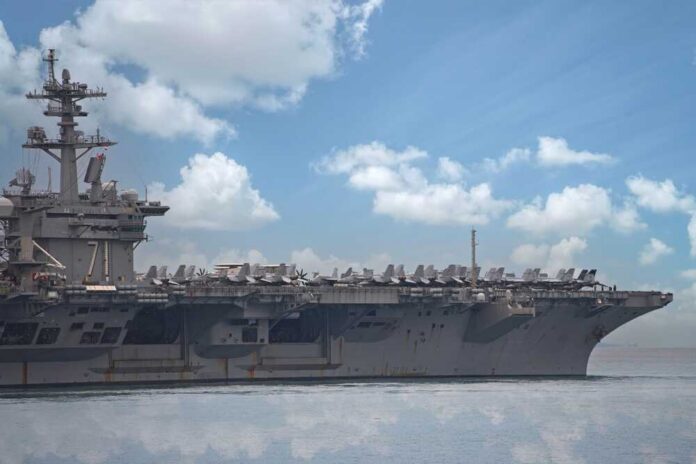
A Navy carrier is set to sail with a robot ship, and the move could reveal whether the fleet is finally ready to turn unmanned warfare from slogan into practice.
Quick Take
- The United States Navy says a medium unmanned surface vessel will deploy with the aircraft carrier USS Theodore Roosevelt later this year.[2]
- Vice Admiral Brendan McLane said the Navy will use the deployment to evaluate how the pairing works in real-world conditions.[2]
- The Navy has already practiced at-sea refueling for an unmanned surface vessel ahead of the planned carrier strike group deployment.[1]
- Theodore Roosevelt is a proven carrier strike group flagship, which gives the Navy a major test platform for unmanned integration.[3]
The Navy Is Testing a New Carrier Pairing
The United States Navy is preparing to send a medium unmanned surface vessel alongside USS Theodore Roosevelt and its strike group later this year, according to remarks from Vice Admiral Brendan McLane at WEST 2026.[2] He said the Navy wants to “evaluate how that pairing works,” which makes this less a publicity stunt than a live operational test. For sailors and taxpayers, the central question is whether the service can make unmanned hardware useful without adding confusion, cost, or risk.[2]
The timing matters because the Navy has already shown it is working through the basics needed to support a robot ship at sea. Naval News reported that the service practiced at-sea refueling of an unmanned surface vessel before the planned deployment with a carrier strike group.[1] That detail matters more than buzzwords. Fueling, coordination, and recovery at sea are the kinds of practical tasks that determine whether unmanned vessels become real force multipliers or just another expensive experiment.[1]
Why Theodore Roosevelt Is a Serious Test Case
USS Theodore Roosevelt is not a small or symbolic platform. The carrier has served as the flagship of Carrier Strike Group 9 and has deployed with Carrier Air Wing 11 and major escorts, including the cruiser USS Lake Erie and destroyers USS John S. McCain, USS Halsey, and USS Daniel Inouye.[2][3] That history means the Navy is not testing unmanned integration on the margins. It is placing the concept inside a fully functioning carrier formation that already has a demanding operational rhythm.[2][3]
Theodore Roosevelt also has recent deployment experience that underscores its significance. The ship returned to its homeport in Coronado in October 2024 after a nine-month deployment that included operations in the Indo-Pacific and a later shift to the United States Central Command area of responsibility.[1] In September 2025, the carrier was again underway conducting exercises to improve strike group readiness and capability in the United States Third Fleet area of operations.[3] That record makes it a credible platform for judging whether unmanned systems can work alongside a crewed carrier.[1][3]
What the Deployment Can and Cannot Prove
The coming deployment can show that the Navy can physically coordinate a medium unmanned surface vessel with a carrier strike group, but it cannot by itself prove that the concept is mature for every mission.[1][2] A planned demonstration is not the same as broad fleet adoption, and the Navy’s own language suggests it understands that distinction.[2] Even so, the fact that the service is moving from concept talk to an actual underway pairing suggests the experiment has crossed an important threshold.[1][2]
Alice Roosevelt Longworth christens the USS Theodore Roosevelt, the submarine named in honor of her father, in 1959. pic.twitter.com/g6GIAqFDDK
— Past To Present History (@PastToPresentH1) June 4, 2026
For conservatives who have watched the federal government waste money on flashy but hollow initiatives, this test deserves a hard look because the Pentagon has a long history of selling transformation before delivering results. The value here is not in hype about “robot warships,” but in whether the Navy can improve combat reach, logistics, and survivability without bloated bureaucracy or gimmicks.[1][2] If the pairing works, it strengthens readiness. If it fails, the Navy should say so plainly and avoid turning a trial run into another permanent program.[1][2]
Sources:
[1] Web – A Navy Carrier Is About To Deploy With a Robot Ship
[2] Web – U.S. Navy drills in at-sea USV fueling ahead of CSG deployment
[3] Web – Navy to experiment with tailored force pairing with Theodore …