Barack Obama’s Iran nuclear deal did exactly what many conservatives feared: it traded billions in sanctions relief for temporary promises that let Tehran keep its nuclear infrastructure and left the next president to clean up the mess.
Story Snapshot
- Obama’s Joint Comprehensive Plan of Action (JCPOA) let Iran keep key nuclear capabilities in exchange for phased sanctions relief.[4][8]
- President Donald Trump called the deal “defective at its core” and withdrew the United States, vowing Iran would never get a nuclear weapon.[1][2][6]
- Critics argue the deal’s “sunset” clauses merely rented Iranian restraint and guaranteed a future nuclear crisis.[5][6]
- The Trump administration has replaced Obama’s bet on trust and temporary limits with maximum pressure, verification, and the threat of tariffs and renewed sanctions.[2][4]
How Obama’s Iran Deal Was Sold To The American People
When President Barack Obama announced the Iran nuclear agreement in 2015, his administration promoted it as a “historic” deal that would block every pathway to a bomb and allow inspectors unprecedented access.[1][4] The White House boasted that Iran would reduce its enriched uranium stockpile by 98 percent, cap enrichment at 3.67 percent, cut centrifuges to just over six thousand, and accept heavy monitoring for years.[1][4] Supporters framed this as proof that diplomacy and international oversight could manage a hostile regime’s nuclear ambitions.[3][8]
Behind the soaring rhetoric, the basic bargain was simple: temporary limits and inspections in exchange for phased relief from crippling international sanctions that had finally pressured Tehran.[3][4][8] Iran agreed to redesign its Arak reactor so it could not produce weapons-grade plutonium and to ship out spent fuel, while promising not to build new heavy-water reactors for at least fifteen years.[1][4] In return, United Nations sanctions would be lifted and Iran would regain access to tens of billions of dollars in frozen assets and global markets.[4][7]
Why Conservatives Call It “That Stupid Deal”
For many conservatives, the fine print confirmed their worst fears: the deal did not dismantle Iran’s nuclear program, it temporarily rented it.[5][6][8] Restrictions on enrichment, centrifuges, and key facilities all came with “sunset” dates between the mid‑2020s and early 2030s, after which Iran could expand an internationally blessed industrial‑scale nuclear program.[5][8] The agreement left out Iran’s ballistic missile work and its sponsorship of terrorism, allowing Tehran to pocket sanctions relief while continuing to destabilize the Middle East.[5]
Critics argue that by granting political approval to a time‑limited nuclear program, the Obama framework ultimately made military confrontation more likely, not less.[5][6] Analysis from organizations focused on nonproliferation has noted that international inspectors verified Iran’s compliance under the deal, but that verification could only monitor what the text allowed, not eliminate the underlying capabilities.[6][7] By front‑loading financial and diplomatic benefits to the regime, the agreement strengthened Iran’s hand while leaving future American leaders with fewer tools and a shorter nuclear “breakout” clock once the sunsets arrived.[5][6]
Trump’s Rejection Of The JCPOA And A New Course
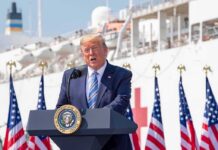
On May 8, 2018, President Donald Trump formally withdrew the United States from the Joint Comprehensive Plan of Action, declaring that America could not “prevent an Iranian nuclear bomb under the decaying and rotten structure of the current agreement.”[1][6][7] Trump labeled the Obama deal “defective at its core” and argued that remaining inside it would eventually lead to an arms race or a nuclear‑armed Iran.[1][6] He made clear that America’s objective was not retreat from nonproliferation, but a stronger posture that truly denied Iran the bomb.
In a separate address on Iran, President Trump vowed, “As long as I am President of the United States, Iran will never be allowed to have a nuclear weapon,” tying American policy to a firm red line rather than flexible diplomatic timelines.[2] His administration reimposed sanctions, reaffirmed the national emergency with respect to Iran, and in 2026 moved to expand economic pressure further through an executive order that created a process to impose tariffs on entities supporting the Iranian government.[2][4] This strategy signaled to Tehran and American allies that Washington would use financial, diplomatic, and, if necessary, military leverage instead of trusting temporary paper promises.
Ongoing Dangers And The Stakes For American Security
As the years passed after the United States exit, Iran expanded its enrichment again, highlighting how fragile the Obama framework had been and how quickly the nuclear issue could return once limits eroded.[6][8] International reporting has documented significant growth in Iran’s stockpile of highly enriched uranium, underscoring why both supporters and critics agree on at least one point: Tehran must never be allowed to obtain a nuclear weapon.[6][8] The debate is over means, not ends, with one side favoring negotiated limits and the other insisting only sustained pressure deters a revolutionary regime.
For constitutional conservatives, the Obama administration’s choice to treat the deal as a political commitment rather than a ratified treaty remains a separate concern about process and accountability.[2] By sidestepping the full advice‑and‑consent role of the Senate, the prior White House made it easier for a future president to withdraw, but also weakened the sense of bipartisan ownership over a major national security decision.[2][6] Today, under President Trump’s second term, the lesson is clear for many on the right: deals with hostile powers must be transparent, time‑proof, and backed by American strength, not built on optimistic assumptions that leave the next generation to face a more dangerous world.
Sources:
[1] Web – “Obama signed that stupid deal.”
[2] Web – Remarks by President Trump on the Joint Comprehensive Plan of …
[3] Web – Remarks by President Trump on Iran – The White House
[4] YouTube – President Trump Makes Major Statement From The White House
[5] Web – Fact Sheet: President Donald J. Trump Addresses Threats to the …
[6] YouTube – Trump’s New Ceasefire Definition Raises Questions as Iran War …
[7] Web – Trump and the Iran Nuclear Deal: The United States Is Out