Years of short‑sighted American foreign policy helped weld Moscow and Beijing into a powerful anti‑U.S. axis that today threatens our security, our economy, and the world our children will inherit.
Story Snapshot
- China and Russia have tightened a hard‑nosed partnership explicitly aimed at curbing American power and U.S.-led institutions.[1][2][5]
- Western sanctions and the Ukraine war accelerated Russia’s pivot away from Europe and deeper into China’s economic and strategic embrace.[2][3]
- Despite deep mistrust and uneven power, both regimes use this partnership to challenge the U.S.-built order and promote a “multipolar world.”[1][2][4][5]
- Analysts warn that Washington’s decisions on sanctions, NATO, and China policy have influenced this convergence—and will shape whether it grows or fractures.[2][4]
How Washington Helped Push Moscow and Beijing Together
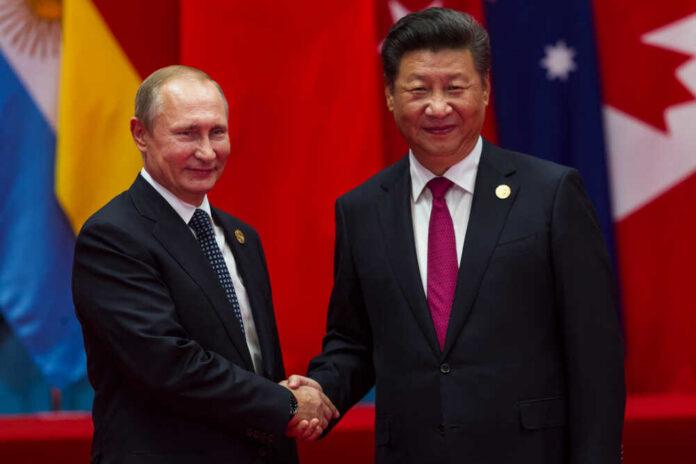
Chatham House describes today’s China‑Russia relationship as rooted in “shared opposition to Western dominance” and a partially overlapping agenda that is increasingly showcased at high‑profile summits.[1] A detailed study for Spain’s Defense Ministry similarly says their main motivation is to promote an alternative to the world order “imposed by the United States and the West,” underscoring how both powers openly frame themselves as counterweights to U.S. leadership.[2] In plain terms, they rally their publics around resisting America.
Research from the Brookings Institution finds that since Russia’s 2022 invasion of Ukraine and the wave of U.S.-led sanctions, trade between Moscow and Beijing has more than doubled, with China becoming an “economic mainstay” for the Kremlin.[3] Analysts note that Russia has been forced to divert energy exports away from Europe, turning to China as a buyer and partner for pipelines like Power of Siberia, which were designed to offset lost Western markets.[2] Sanctions intended to isolate Russia instead deepened its dependence on Beijing.
A Pragmatic Axis Aimed at the U.S., Not a Love Story
Multiple studies stress that this is not a warm friendship but a hard‑edged, transactional partnership of convenience.[1][6] The Australian Navy analysis calls it “strategic ambivalence and convenience rather than true strategic alliance,” highlighting that there is no mutual defense pact and plenty of historical mistrust.[6] Yet that same research, along with work by the Council on Foreign Relations, shows they are coordinating diplomatically to undermine the U.S.-led order, including joint messaging against American “hegemony” and “unilateralism.”[4][5] They do not have to like each other to agree they want a weaker America.
Economic complementarity makes this alignment useful for both regimes without a single shot fired at each other.[2][3] The Spanish Defense Ministry paper notes that Russia provides raw materials and energy while China supplies manufactured goods and advanced technology, creating a natural fit that sanctions only reinforced.[2] Brookings and other analysts report growing settlement of trade in rubles and yuan, expanded energy ties, and Chinese components flowing into Russia’s defense industry.[3][5] Every new workaround to Western sanctions tightens their economic interlock and erodes the reach of the U.S. dollar system American families depend on.
Limits, Hidden Weaknesses, and What It Means for Americans
Even as many commentators talk about a seamless anti‑U.S. bloc, other research underlines the partnership’s real weaknesses. A ChinaPower study from the Center for Strategic and International Studies points to deep mistrust, growing power asymmetry, and distinct security priorities that limit full alignment. Carnegie’s analysis adds that Beijing and Moscow have different long‑term goals and are unlikely to form a formal anti‑Western alliance, meaning their cooperation remains contingent and interest‑based rather than automatic. These limits matter because they give U.S. policy choices more leverage than defeatists admit.
At the same time, the historical record shows this did not begin with recent sanctions alone. Early 2000s work from Princeton documents that Russia and China were already coordinating to blunt U.S. democracy promotion, contest American influence in Central Asia, and shape regional institutions like the Shanghai Cooperation Organization. Chatham House and MERICS describe the partnership as a long‑running “marriage of convenience” that has deepened over time, not overnight.[1] American missteps may have sped up the train, but the tracks were being laid years earlier.
Sources:
[1] Web – The Russia–China Partnership Was Made in America
[2] Web – China and Russia’s strategic duo endures – but its limits are clear
[3] Web – [PDF] A Comprehensive View of the Russia-China Strategic Partnership
[4] Web – The dynamics of the Russia-China partnership – Brookings Institution
[5] Web – [PDF] No Limits? The China- Russia Relationship and U.S. Foreign …
[6] YouTube – What China & Russia’s new stage of ties means for Global South …