
AOC’s coy “my ambition is way bigger” line is fueling fresh suspicion that Washington’s progressive machine is building power first—and asking voters questions later.
Quick Take
- Rep. Alexandria Ocasio-Cortez brushed aside direct 2028 presidential questions, saying her “ambition is way bigger” than a single election cycle.
- Her comment lands after months of speculation tied to a “We are one” campaign-style video and a nationwide “Fighting Oligarchy” tour with Sen. Bernie Sanders.
- Organizers say the tour raised about $15 million and focused on scaling community mobilization, not declaring a candidacy.
- Analysts disagree on what her endgame is, with reporting and commentary floating everything from a White House bid to a possible future Senate play.
AOC sidesteps 2028 talk while the speculation keeps growing
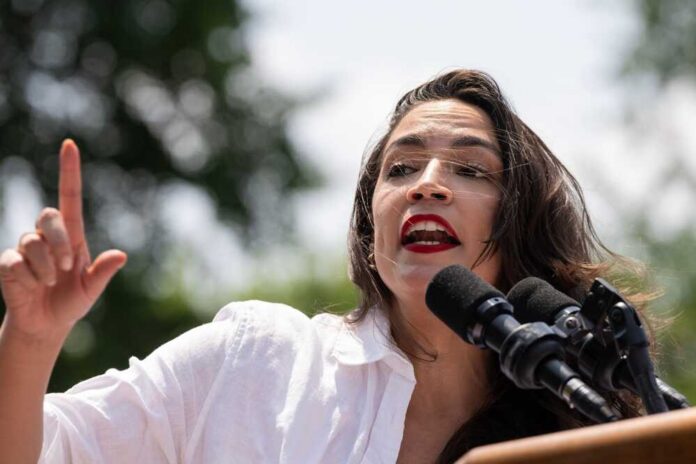
Rep. Alexandria Ocasio-Cortez, the New York progressive who rose to national fame after her 2018 upset win, is again at the center of 2028 chatter—this time because she refuses to play the usual pre-campaign game. Asked about a presidential run, she dismissed the premise as too narrow and said her “ambition is way bigger.” The remark, reported as a clear brush-off, keeps her options open while leaving voters guessing about the destination.
That ambiguity matters in 2026 because Democrats are still searching for their next national figurehead after the 2024 cycle, while Republicans control the White House and Congress. In that environment, presidential speculation can function like free advertising, building a donor list and a national following without the obligations of an official race. AOC’s move—neither confirming nor denying—also makes it harder for critics or rivals to pin down a single plan to attack.
The “Fighting Oligarchy” tour signals movement-building, not a ballot test
AOC’s political team has highlighted organizing work as the point of her national push with Sen. Bernie Sanders. The “Fighting Oligarchy” tour featured events beyond her district, including town-hall style stops, and organizers have pointed to roughly $15 million raised for mobilization. Supporters describe it as building long-term infrastructure—community groups, volunteers, and networks—rather than a traditional candidate-centered rollout. The strategy mirrors a broader progressive debate: win elections first, or build a movement that can pressure institutions over time.
From a conservative vantage point, the practical question is less about AOC’s personal ambition and more about what a well-funded national organizing apparatus does to governance. Conservatives frustrated by inflation, energy prices, and “woke” cultural enforcement see these campaigns as a pipeline: activist messaging becomes agency policy, then becomes taxpayer-funded programming. Liberals frustrated by inequality and distrustful of corporate power see the same apparatus as a counterweight to entrenched interests. Either way, the common denominator is a public that increasingly doubts government serves ordinary people.
The “We are one” video and the familiar shadow-campaign pattern
Speculation accelerated after a campaign-style video—“We are one”—circulated and drew media attention as potential presidential signaling. The pattern is familiar across both parties: high-production messaging, national travel, and friendly coverage can function like a “soft launch” without filing paperwork. Still, the available reporting does not establish a declared candidacy, and some claims about internal planning rely on unnamed sourcing or third-party interpretation. The one confirmed fact is the broader media ecosystem is treating her as a plausible contender—and that itself shapes donor behavior.
What analysts are projecting—and what remains unproven
Political analysts have offered competing reads. Nate Silver identified AOC as a leading Democratic contender at this moment, while other strategists and commentators described her as “test ballooning” a run. At the same time, reporting has floated alternative paths, including the possibility—unconfirmed by on-the-record evidence—of a future Senate challenge to Majority Leader Chuck Schumer. The strongest, most verifiable takeaway is that AOC is maximizing flexibility: she can deny a presidential timeline while expanding national influence through organizing and media attention.
For voters who already believe the “deep state” and political elites prioritize self-preservation over solving problems, the episode reinforces a cynical lesson: politicians can build power while withholding clarity. Conservatives who want smaller government and accountability will watch whether movement fundraising translates into policy pressure on agencies, schools, and workplaces. Liberals who distrust concentrated wealth will watch whether the movement produces tangible outcomes beyond slogans. AOC’s “bigger” ambition may not be a single office—but the infrastructure to steer the party and, eventually, the country.
VIDEO – AOC Brushes Aside 2028 Question: ‘My Ambition Is Way Bigger’ https://t.co/GeANOuZbv0
— Grabien (@GrabienMedia) May 9, 2026
The bottom line is that AOC’s statement narrows nothing for the public. It widens the field of possibilities while she continues touring, fundraising, and shaping a national narrative. In a political era where Americans on left and right increasingly agree government is failing them, that kind of strategic ambiguity can look less like inspiration and more like insulation—protecting leaders from accountability until the moment they decide it’s time to ask for power directly.
Sources:
‘We are one’: AOC campaign video swirls 2028 presidential rumors
AOC presidential race 2028: Senate option floated amid speculation