

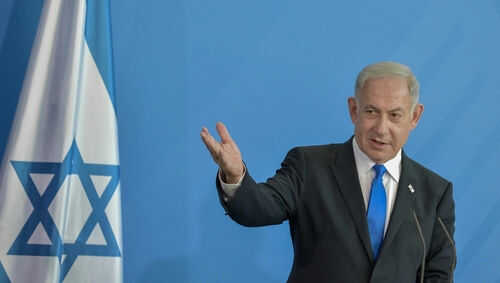
Iran’s Revolutionary Guard just issued a public vow to “pursue and kill” Israel’s prime minister—then admitted it isn’t even sure whether he’s alive.
Story Snapshot
- Iran’s Islamic Revolutionary Guard Corps (IRGC) posted a statement on March 15, 2026 vowing to hunt down and kill Israeli Prime Minister Benjamin Netanyahu “with full force,” amid online rumors about his status.
- Netanyahu’s office rejected the death and assassination claims and said the prime minister is fine, as questions swirled about a recent video that some online users claimed looked AI-altered.
- The threat lands during the third week of a widening Iran-Israel-U.S. war that began after joint U.S.-Israel strikes on Feb. 28 reportedly killed Iran’s Supreme Leader Ayatollah Ali Khamenei.
- Iran’s retaliation has included missile launches toward regional targets, including a reported strike on a U.S. base in Saudi Arabia, while Israel has continued targeting IRGC personnel and infrastructure.
IRGC escalates with leader-targeting rhetoric amid uncertainty
Iran’s IRGC escalated its messaging on March 15 by publishing a statement vowing to “pursue and kill” Israeli Prime Minister Benjamin Netanyahu if he is alive. Reports say the statement was carried on Sepah News, an outlet linked to the IRGC, and framed Netanyahu as a war criminal while casting the threat as open-ended because of circulating rumors. That unusual qualifier—threatening assassination while questioning the target’s status—shows how information warfare is shaping this conflict as much as missiles.
Israeli officials responded by rejecting the rumors outright. Multiple reports say Netanyahu’s office dismissed claims that he had been assassinated and indicated he is fine. The rumors appear to have accelerated after a March 12–13 video message from Netanyahu circulated online, with some accounts claiming the footage showed AI-style anomalies, including an apparent “six fingers” detail. At least one report referenced AI tools being used online to challenge those claims, underscoring the fast-moving fog.
War timeline: from Khamenei’s reported death to expanding strikes
The current phase of war traces back to Feb. 28, when reports say the United States and Israel launched joint airstrikes on Iran that killed Supreme Leader Ayatollah Ali Khamenei, triggering open conflict. Subsequent coverage describes Israel expanding strikes against Iranian leadership and nuclear-related targets under what Netanyahu has described as “Operation Roaring Lion,” while Iran has launched missiles and drones toward Israel and U.S. positions across the region.
On the same day the IRGC issued its threat, reports said Iran launched missiles at a U.S. base in Saudi Arabia’s Al-Kharj, a significant escalation because it draws Gulf partners and American forces deeper into the line of fire. Separate reporting also described Israel striking back by targeting IRGC intelligence officials. With active operations underway on multiple fronts, the contest is not just about territory—it is increasingly about command, control, and the perceived survivability of national leadership.
Deepfakes, rumors, and the risk of strategic miscalculation
The Netanyahu rumors are a case study in how AI-era misinformation can distort real-world decision-making. When leader status becomes a trending question, adversaries may feel pressured to posture publicly, allies may overcorrect with secrecy, and civilians can lose trust in official statements. The available reporting confirms a denial from Netanyahu’s office, but also notes limits: there has been no universally cited, definitive public appearance that settles the matter for every audience. That uncertainty is a vulnerability.
What it means for Americans: energy shocks, base security, and limits on credibility
For Americans, the immediate stakes include the protection of U.S. forces and the economic shock tied to Middle East instability. Reporting describes disruptions tied to Iran’s actions in the region, including pressure on shipping lanes and oil markets, with some outlets highlighting surging crude prices. The IRGC’s approach—pairing kinetic strikes with propaganda—also tests the credibility of institutions and the media environment at home, where viral narratives can outpace confirmation and complicate public support for decisive policy.
IRGC vows to pursue Netanyahu as conflict deepens. Brent Crude tops $100/barrel, making the energy shock a reality. Investors are bracing for major supply hits.https://t.co/WIETTFdoLZ pic.twitter.com/tkMmaABy7n
— Global Market News (@MWatchGlobal) March 15, 2026
So far, the solid, cross-reported facts are narrow but consequential: the IRGC published a direct threat, Netanyahu’s office denied the death rumors, and the broader war continues to expand in time and geography. What remains unclear is how much of Iran’s statement reflects operational intent versus psychological warfare—and whether the information chaos created by suspected AI manipulation will drive further escalation. Until verifiable evidence replaces viral speculation, the fog itself remains part of the battlefield.
Sources:
Iran Guards Vow to Kill Netanyahu
Iran war: Iran Guards vow to “pursue and kill” Israel’s Benjamin Netanyahu
IRGC vows to hunt down and kill Israel’s Netanyahu as conflict enters third week
Middle East war live: Iran’s Revolutionary Guards vow to pursue and kill Netanyahu
Iran’s Revolutionary Guards vow to pursue and kill Netanyahu