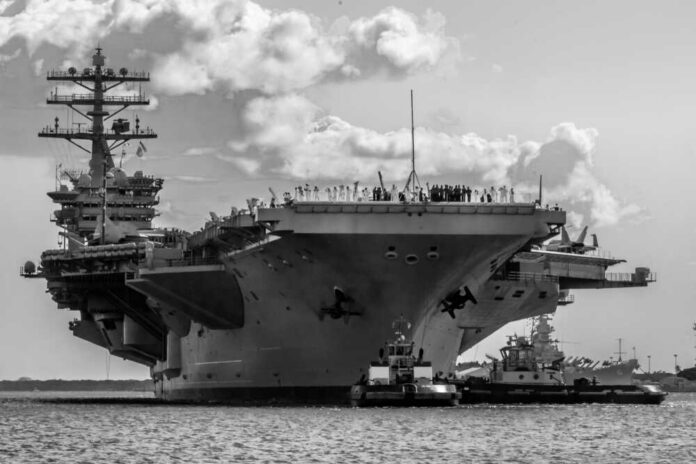
The USS Nimitz, America’s first Nimitz-class supercarrier and a symbol of naval dominance for half a century, faces mandatory retirement in May 2026 despite critical global tensions—a stark reminder of how past delayed modernization and shipbuilding failures now threaten our military readiness when we need it most.
Story Snapshot
- USS Nimitz begins deactivation in May 2026 after 50 years of service, as nuclear reactor cores reach their designed lifespan limits
- Retirement drops active carriers to 10, below Congress’s 11-carrier mandate, creating a dangerous “Nimitz Gap” until replacements arrive around 2029
- Economic necessity drives decision—multi-billion dollar overhauls deemed uneconomical as Navy prioritizes modernizing with Ford-class carriers
- Decommissioning occurs amid Operation Epic Fury tensions in Middle East, exposing vulnerability from years of shipbuilding delays and maintenance backlogs
Historic Carrier Reaches End of Service Life
The USS Nimitz (CVN-68), commissioned May 3, 1975, served as the lead ship of ten Nimitz-class nuclear-powered supercarriers that formed America’s backbone for global power projection. Designed for a 50-year service life, the carrier’s nuclear reactors have reached their fixed core lifespan limits, making further refueling economically unfeasible. The vessel completed its final Indo-Pacific deployment in late 2025 and returned to Naval Base Kitsap in Bremerton, Washington, in December before embarking on its final cruise toward Norfolk, Virginia. The Navy extended the carrier’s service from an initially planned 2025 retirement to May 2026, squeezing one last deployment despite the technical constraints.
Dangerous Carrier Shortage Created by Retirement
The Nimitz retirement reduces America’s active carrier fleet to ten vessels, falling short of the congressionally mandated eleven-carrier minimum at a precarious moment. This “Nimitz Gap” emerges while two carrier strike groups conduct Operation Epic Fury operations in the Middle East, exposing the vulnerability created by years of shipbuilding delays and maintenance backlogs. The USS John F. Kennedy won’t achieve full deployment readiness until approximately 2029, leaving a multi-year capability hole. This squeeze stems directly from poor planning under previous administrations that failed to prioritize naval modernization, instead focusing resources on social engineering projects and bureaucratic bloat. The Pacific Northwest also loses its homeport carrier presence, straining regional basing capacity until replacements arrive.
Billions Saved but Strategic Risks Mount
Navy leadership determined that overhauling the Nimitz’s expired nuclear reactors would cost billions without extending service meaningfully, making retirement economically imperative despite the strategic gap. Huntington Ingalls Industries Newport News Shipbuilding will handle the complex defueling and reactor inactivation process beginning in May 2026, with full decommissioning taking years. The shipyard faces massive backlogs from Ford-class construction projects including CVN-80 and CVN-81, bottlenecks worsened by being the sole facility capable of nuclear carrier work. Reusable equipment will be offloaded through the Ship Terminal Off-load Program before nuclear work begins. The savings enable Ford-class transition and fleet modernization, but critics rightfully question whether we’re managing decline rather than maintaining the superiority American taxpayers deserve.
Delayed Modernization Consequences Exposed
The timing underscores consequences of prior mismanagement—the USS Dwight D. Eisenhower faces 2027 decommissioning while replacement carriers remain years from operational status, creating rolling shortages that embolden adversaries. Previous administrations allowed maintenance backlogs to accumulate while delaying new carrier construction, prioritizing politically correct initiatives over combat capability. The USS Enterprise decommissioned in 2017 as the first retired nuclear carrier, setting precedent as the USS Gerald R. Ford entered service. Independence-class Littoral Combat Ships like USS Jackson and USS Montgomery face early retirement for foreign sales, signaling broader fleet optimization amid constrained resources. Congress must hold leadership accountable for these gaps that threaten American security and global stability during heightened tensions worldwide.
Time to Say Goodbye to Nuclear Aircraft Carrier USS Nimitz of the U.S. Navyhttps://t.co/AuHryzyocb
— 19FortyFive (@19_forty_five) March 12, 2026
The Nimitz’s final voyage symbolizes both a proud legacy and a cautionary tale about neglecting naval readiness. After first deploying to the Mediterranean in July 1976 and supporting critical operations from the Iran hostage crisis rescue attempt to decades of deterrence missions, this workhorse deserves a proper farewell. Yet Americans should demand answers about why we’re forced to retire irreplaceable assets before adequate replacements stand ready, leaving dangerous capability gaps that undermine our ability to project strength when authoritarian regimes test our resolve.
Sources:
The U.S. Navy’s Great Aircraft Carrier Shortage: Why Nuclear Supercarrier USS Nimitz Must Be Retired
The U.S. Navy’s Great Aircraft Carrier Shortage: Why Nuclear Supercarrier USS Nimitz Will Be Retired
Nimitz Gap: Retirement of Oldest Aircraft Carrier
USS Nimitz Returns Home for Likely Last Time Before Retirement
U.S. Navy May Deploy USS Nimitz Carrier in Southern Seas 2026 Exercise During Decommissioning Voyage
Prior to Its Retirement, USS Nimitz Would Carry Out Final Deployment in South America
USS Nimitz Begins Last Cruise Ahead of Decommissioning