The U.S. Postal Service published a final mail-ballot tracking rule tied to President Trump’s order, even as an Obama-appointed judge moved to block enforcement before November.
Story Highlights
- USPS finalized a rule requiring state voter lists and unique ballot barcodes for mail voting.
- The rule implements President Trump’s directive to tighten ballot chain-of-custody and tracking.
- A federal judge said the executive branch lacks election-regulatory power and issued injunctions.
- USPS adjusted the effective date while litigation continues, not abandoning the rule.
What USPS Finalized And Why It Matters
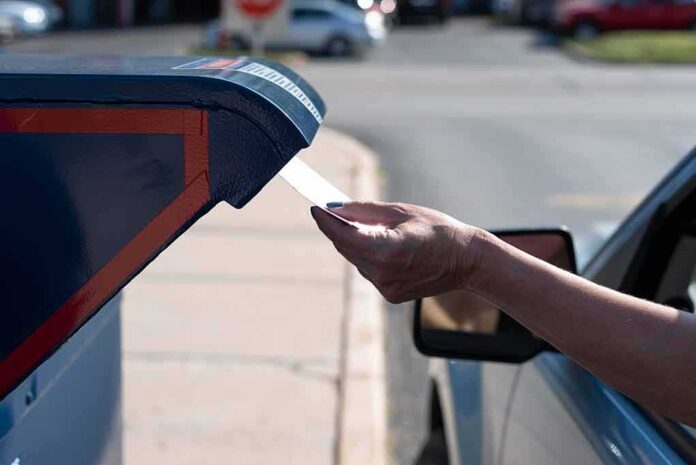
USPS published a final rule that would require states to provide lists of voters receiving mail ballots and to use unique barcodes on outbound and return ballot envelopes. Reuters and the New York Times reported the agency’s plan after publication, describing stricter delivery standards and ballot tracking if courts allow implementation. The White House said the rule follows President Trump’s March 31 directive to build secure, tracked ballot handling using unique Intelligent Mail barcodes for every ballot envelope.
The final rule aims to tighten chain-of-custody by linking each mailed ballot to a state-provided record and scan data from the barcode. Supporters say this can deter illegal ballot harvesting and improve delivery certainty for voters. Earlier coverage described a USPS portal for states to submit lists and barcode details, setting a clearer data path for election mail. USPS then revised its own Federal Register timeline, shifting the effective date to January 17, 2027, indicating the agency is proceeding through formal channels.
The Court Fight And What It Changes For Now
Federal courts stepped in ahead of the midterms. A judge blocked key parts of President Trump’s order, finding the Constitution does not give the president authority over elections and saying USPS lacks statutory power to impose binding voting rules. A later injunction targeted USPS’s implementation that would restrict mail voting, halting enforcement before November. These rulings do not erase the USPS rule, but they stop it from taking effect during the current election cycle.
Opponents frame the rule as late, confusing, and outside federal authority. They argue the timing risks voter disruption and pushes USPS beyond its role as a neutral carrier. NPR summarized the court’s view that the postal agency cannot control mail-in voting rules, and that the executive branch overreached with the order. Backers counter that the plan does not decide who may vote, but strengthens verification and tracking through lists and barcodes. The court’s final word is still pending on the merits.
How The Trump Directive Connects To Fraud Prevention
The White House fact sheet says President Trump’s directive told USPS to transmit ballots only to people on a state-specific mail and absentee list, and to require secure envelopes with unique barcodes to enable end-to-end tracking. The idea is simple: know who is supposed to receive a ballot, track each envelope through the mail, and confirm the return path. That approach mirrors how private carriers track valuable items. It uses data to protect one person, one vote, and to stop sloppy mailing lists.
Supporters note that strong tracking helps voters and election workers. It gives proof that a ballot was mailed, moved, and delivered. It also flags mismatches, like returns without a matching outbound scan. Critics point to unresolved questions about state data quality and federal databases. Reports said the plan relied on information that might be incomplete, and that the rule arrived close to voting deadlines. Those concerns weigh on courts that prioritize stability as elections near.
What To Watch Next For Voters And States
USPS signaled the rule’s new effective date in January 2027, which gives time to address legal and technical issues. That window matters. States could test data feeds, refine barcode standards, and confirm that list-sharing does not slow deliveries. Courts will decide whether USPS can set these conditions under existing postal law while states keep control over who is eligible and how votes are counted. If allowed, the rule could standardize tracking without taking over election administration.
For now, nothing changes for this November if the injunctions stand. Ballots will move under current practices. Conservatives who want cleaner lists and better tracking should keep pressing lawmakers and state officials to tighten their own systems. Clean rolls, secure envelopes, and verified scans are common-sense tools. President Trump’s team put those tools on the table. The courts will decide how far USPS can go, but the push for honest, trackable elections is not going away.
Sources:
nypost.com, reuters.com, cnn.com, whitehouse.gov, foxnews.com, npr.org, pe.usps.com, washingtonpost.com