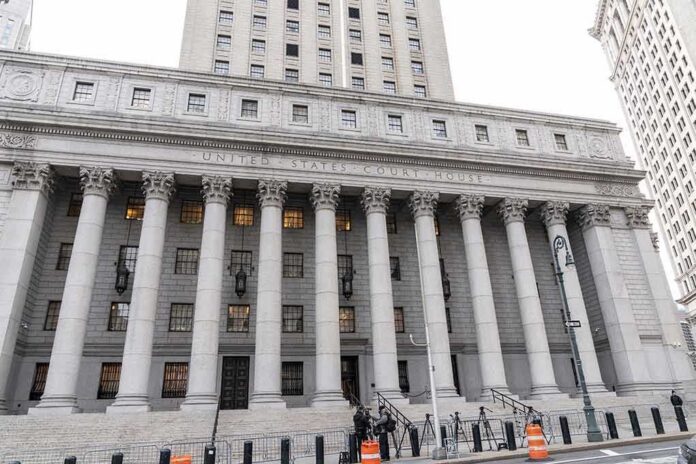
A federal judge lifted her nationwide block on President Trump’s mail-in ballot order after a Supreme Court ruling cleared key obstacles, opening the door to stronger ballot security standards before November.
Story Highlights
- The judge removed her nationwide injunction after the Supreme Court narrowed lower-court blocks.
- The Postal Service can move toward enforcing envelope and tracking rules once injunctions are cleared.
- The rule requires Official Election Mail markings and unique barcodes to track ballot mail.
- Opponents still pursue limits in separate cases, keeping some implementation steps on a tight timeline.
What Changed After The Supreme Court’s Ruling
The Supreme Court allowed the administration to move forward with core parts of President Trump’s mail-in ballot order, which had been stalled in multiple courts. That decision removed a major barrier and prompted a federal judge to lift her own nationwide block. The order directs the Postal Service to set uniform standards for federal ballot mail, including secure envelope designs, tracking barcodes, and list-based controls for who can receive mailed ballots.
The Court’s action did not end every dispute. Another case still narrowed timing and scope in some regions, and lawyers continued to argue over what counts as “implementation” versus “publication.” But the practical effect of the Supreme Court’s ruling was clear: the Postal Service gained room to prepare enforcement steps, subject to remaining injunctions. That is why the judge reversed her broad stop, while warning the agency to follow court limits precisely as the election nears.
What The USPS Rule Actually Requires
The Postal Service’s finalized rule amends the Domestic Mail Manual for federal ballot mail. It requires ballot envelopes to carry the Official Election Mail marking, be automation compatible, and include a unique Intelligent Mail barcode to enable tracking and chain-of-custody checks. The rule also expects states to transmit lists of voters who are sent mail ballots, so the Postal Service can match ballot mailings to verified recipients and reject noncompliant batches before acceptance into the mail stream.
The agency says postal workers will not judge voter eligibility, maintain voter rolls, open sealed mail, or inspect ballot contents. The focus is on envelope standards, tracking tech, and data handoffs that help keep ballot mail clean and timely. The Postal Service stated that front-line staff would verify that outbound mailings meet the new envelope, barcode, and data requirements before acceptance to reduce misprints, prevent stray mail, and speed delivery scans during peak volumes.
Why Supporters Call This Common-Sense Integrity
Supporters argue the order delivers basic chain-of-custody tools that every high-volume shipment uses. Official markings and unique barcodes let the Postal Service trace ballot mail like priority items, flagging missing or late trays. State-provided lists allow quick cross-checks so federal ballot mail is sent only to the right people and returned ballots travel in approved, scannable envelopes. The White House says these steps defend legal votes, deter abuse, and set one clear national standard for federal ballot mail.
Backers also note that clear mail design rules and pre-acceptance checks reduce chaos. When rules are vague, counties improvise. That leads to jams in sorting machines, unread scans, and late deliveries. The updated manual tells election offices exactly how to print, package, and manifest federal ballot mail, so the system can move faster under stress. The goal is simple: protect the franchise, deliver ballots on time, and cut off loopholes that bad actors could exploit.
What Opponents Argue And What Comes Next
Opponents say the Postal Service moved too fast and risked changing rules close to an election. They point to earlier injunctions that paused implementation and claimed the agency blurred the line between publishing a rule and enforcing it. News reports tracked how the Postal Service published a final rule while legal fights continued, even as the agency said it would only implement if courts lifted the blocks. Those timing fights kept pressure on the calendar for November.
Next steps turn on strict compliance with the courts and tight coordination with states. The Supreme Court’s action unlocked key provisions, and the judge’s decision removed her nationwide block. But election officials still must adjust envelopes, add barcodes, and upload recipient lists fast. Voters should see clearer ballot tracking and cleaner processing. If remaining disputes linger, further court guidance may refine timing. For now, ballot integrity standards are back on track to protect lawful votes.
Sources:
twitchy.com, reuters.com, aclu.org, cnbc.com, axios.com, theguardian.com, nytimes.com