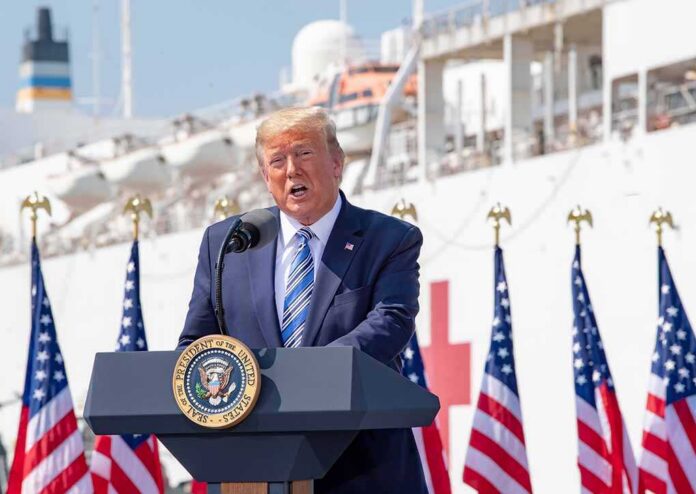
President Trump announced a $6.6 billion submarine-manufacturing push anchored by a new Anduril shipyard in Maryland to speed Virginia-class production and create thousands of jobs.
Story Highlights
- Anduril will invest $3.7 billion to build the Arsenal-2 shipyard at Sparrows Point.
- The U.S. Navy tied in up to $2.9 billion through a related contract.
- Officials project 3,100 direct jobs and over 11,000 indirect jobs.
- The facility will make key Virginia-class submarine parts and large assemblies.
Trump Announces Arsenal-2 to Rebuild Maritime Strength
President Trump highlighted a combined $6.6 billion effort to expand U.S. submarine output, anchored by Anduril’s $3.7 billion private investment in a new Arsenal-2 shipyard at Tradepoint Atlantic in Sparrows Point, Baltimore County. Reporting states the Navy connected the project to a contract worth up to $2.9 billion. Officials said the plant will support Virginia-class submarine production with critical parts and large modules needed to raise throughput and restore American maritime dominance.
Coverage describes Arsenal-2 as a “software-defined” industrial site that blends advanced manufacturing with digital workflow to speed delivery and improve quality. Anduril said the investment will fund construction, workforce buildup, and production capacity. The site selection at the former Bethlehem Steel area aims to tap deepwater access, rail links, and an existing heavy-industry footprint. Leaders cast the project as a major step to fix long-running supply bottlenecks that slowed submarine output.
Jobs, Capacity, and the Sparrows Point Buildout
Officials and company statements project 3,100 direct jobs and more than 11,000 indirect jobs once the facility scales, with operations expected by the end of the decade. Local and state materials describe the shipyard as exceeding 2 million square feet on about 187 acres, signaling one of the largest new defense industrial builds in years. Maryland and Baltimore County leaders called it a generational economic win with a focus on skilled trades, apprenticeships, and supplier growth across the region.
The manufacturing mission centers on Virginia-class submarine components, including torpedo tubes and, over time, larger sections. Reporting links the capacity expansion to Navy needs that outpace current industry output. Despite budgets buying two Virginia-class boats per year, actual deliveries have lagged near about one to just over one boat per year since 2022 due to workforce and supplier strains. The new site is pitched as added muscle to help close that gap.
How Arsenal-2 Fits the National Submarine Push
Congressional research says the Navy must raise Virginia-class output to meet U.S. fleet needs and AUKUS obligations with allies. Analysts describe a recent production range near 1.1 to 1.2 boats per year, while targets call for roughly two or more boats per year. That shortfall drives investments in people, tooling, and suppliers across the country. Arsenal-2 slots into that push by adding capacity for heavy assemblies and freeing legacy yards to focus on final integration and delivery.
Maryland’s announcement underscores a public-private model: the company commits private capital while the Navy uses contract tools to steer demand and de-risk factory buildouts. The approach mirrors broader efforts to expand the maritime industrial base and reward on-time performance. While the project is forward-looking and still under construction, the contract structure and scale signal a serious bid to grow output, speed schedules, and harden the supply chain against delays that weaken deterrence.
Why This Matters for Security and American Workers
Rising threats at sea demand more attack submarines with stealth, endurance, and strike power. A stronger industrial base helps the United States deter rivals and back allies without sacrificing readiness. Arsenal-2 aims to ease parts shortages, cut wait times, and add quality control at scale. For workers, the build brings thousands of well-paid, hands-on jobs. For taxpayers, aligned incentives and modern factories can mean faster deliveries and better value when every month on schedule counts.
Under President Trump, the administration has pressed for maritime strength and onshoring of critical supply lines. This project tracks with that vision: build at home, hire American, and make the tools that keep the peace. The stakes are clear. If the nation cannot build fast enough, the fleet falls behind and risk grows. If America builds smarter and faster, the fleet stays ahead, and our sailors sail with confidence that industry can meet the mission.
Sources:
youtube.com, governor.maryland.gov, baltimoresun.com, nypost.com