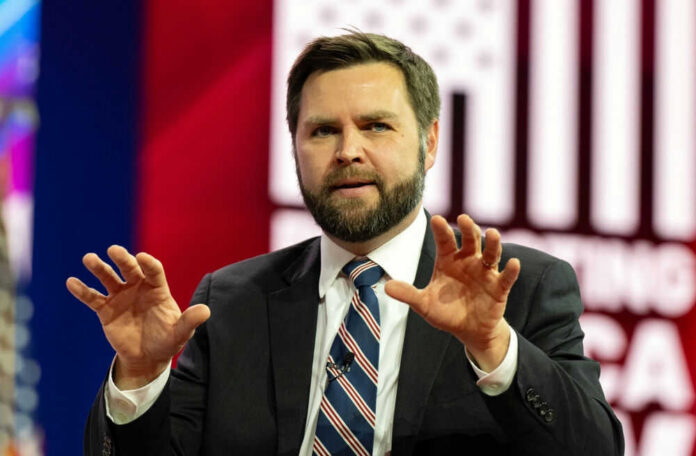
Iran is now flatly denying Vice President J.D. Vance’s claim that it agreed to reopen its nuclear sites to United Nations inspectors, raising hard questions about what was really achieved in Switzerland.
Story Snapshot
- Vance says Iran agreed to invite nuclear inspectors back, calling it a “major milestone.”[1]
- Iranian officials now publicly reject his claim, saying no such deal on inspectors was made.[6][8]
- Tehran insists it will only follow its old limited rules with the nuclear agency, not new access.[6][8]
- The clash shows how far words and reality can drift when dealing with the Iranian regime’s nuclear program.[12]
Vance Hails “Major Milestone” After Swiss Talks
After the first round of United States–Iran talks in Burgenstock, Switzerland, Vice President J.D. Vance stepped before cameras and declared what he called a breakthrough. He told reporters that “the Iranians have agreed to invite International Atomic Energy Agency inspectors back into their country,” describing it as a “major milestone for the American people” and “the first step in permanently” ending Iran’s nuclear weapons program.[1] Vance said this outcome was exactly what the United States team had asked for and claimed the talks “laid a very good foundation” for a final deal.[1]
Vance also stressed timing, saying conversations with inspectors could begin “as soon as today” and that teams from the United States, Iran, Qatar, and Pakistan would keep working out technical details in the coming days and weeks.[1] Media reports repeated his language almost word for word, with anchors and headlines framing the move as Iran “allowing” inspectors back in and moving toward denuclearization.[5] For many Americans watching at home, it sounded like tough pressure had finally forced Tehran to back down and open its secretive program to real checks again.
Tehran Pushes Back And Says “No New Deal” On Inspectors
Within a day, Iran’s foreign ministry moved to knock down that story. Spokesperson Esmaeil Baqaei told Iran’s state news agency that the country’s interaction with the International Atomic Energy Agency would only continue under existing “Safeguards Agreements” and in line with laws passed by Iran’s parliament and decisions of its Supreme National Security Council.[6] He did not describe any fresh invitation to inspectors or wider access. Instead, he framed Iran’s stance as business as usual, tied to its older, narrow obligations.
On Iranian and regional outlets, officials went even further. They said no agreement on the return of inspectors had been reached during the Switzerland talks and claimed there were no discussions on changing inspection terms at all.[8] Some sources accused Washington of giving an “inaccurate picture” of what happened behind closed doors.[8] In plain language, Tehran is telling its own people and the region that Vance oversold or misrepresented the inspection piece. That is a big red flag when dealing with a regime that has a long record of hiding nuclear work and playing games with inspectors.[12]
Why Nuclear Inspections Matter For American Security
For conservative Americans who remember the 2015 Iran deal and years of broken promises, the inspection question is not a side issue. It is the core of whether Iran can race toward a bomb while the world looks the other way. The International Atomic Energy Agency has warned in recent years that gaps in access and missing data mean it has lost “continuity of knowledge” about parts of Iran’s nuclear stockpile.[12][14] When inspectors cannot freely enter sites, check records, and take samples, they cannot tell if uranium is being diverted to weapons work.
Analysts at independent institutes have documented how Iran has shifted to higher levels of uranium enrichment and added advanced centrifuges while restricting inspection and monitoring.[10][12][14] That pattern matters now. Vance’s team may hope that even a limited opening is a step toward rolling back those gains. But if Iran is simply restating old, narrow safeguards and refusing broader access, then American leaders must ask what, if anything, has changed on the ground. A photo-op announcement does not stop a centrifuge from spinning.
Trump Voters Want Proof, Not Another “Trust Iran” Deal
Many Trump supporters still feel burned by years of globalist foreign policy that trusted paper promises from hostile regimes more than common sense. They watched the old Iran deal shower Tehran with cash while the regime kept funding terror proxies and pushing missiles toward Israel and our allies. Now they hear one story from Washington and another from Tehran about something as basic as whether inspectors can get in the door. That disconnect feeds real anger and distrust.
Iran's Foreign Ministry spokesperson, Esmail Baghaei, denied these claims, stating that the return of IAEA inspectors was not part of their discussions and that Iran made no new nuclear-related commitments.
— Don't move (@gotchainmysite) June 23, 2026
From a conservative view, the path forward is simple in principle, even if hard in practice. Any real deal must tie sanctions relief and economic benefits to verifiable facts, not hopeful statements. Iran should face automatic penalties if it denies access to any suspicious site or drags its feet on inspections, as several experts have argued when laying out strict monitoring models.[15] Until there is a written agreement, clear terms from the International Atomic Energy Agency, and inspectors physically back inside Iran’s key facilities, talk of “milestones” should be treated with caution. Strong diplomacy can serve American interests, but only when backed by hard power, clear red lines, and a firm refusal to let a radical regime write the narrative.
Sources:
[1] Web – Iran agreed to invite IAEA inspectors back into country: Vance
[5] Web – Iran agrees to invite IAEA inspectors back, Vance says
[6] Web – Iran agreed to invite IAEA inspectors back into country: Vance
[8] YouTube – Iran Has agreed To Invite IAEA Inspectors Back Into The Country: JD …
[10] Web – Tehran has agreed to invite IAEA inspectors back into the …
[12] Web – US-Iran talks yield breakthrough, Vance says Tehran agrees to IAEA …
[14] Web – Analysis of IAEA Iran Verification and Monitoring Report — May 2025