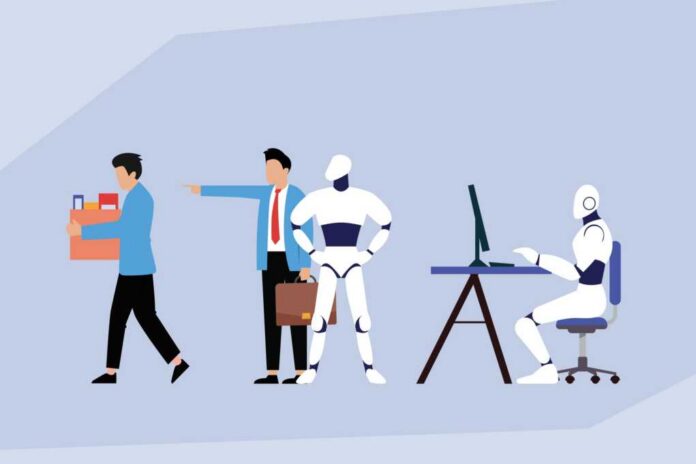
AI Cuts Jobs: What’s the Real COST?
A fast-moving AI layoff wave is colliding with years of elite-driven “disruption” talk—and working Americans may be the ones forced to pay the price.
Story Snapshot
- Surveys of business leaders show AI-driven job replacement is no longer theoretical, with sizable shares of companies reporting workers already replaced and more cuts planned through 2026.
- Layoff announcements tied to AI are real, but multiple analyses say the macro labor market still shows limited nationwide disruption so far.
- Early-career and entry-level workers appear especially exposed, raising concerns about opportunity, family stability, and upward mobility.
- Experts warn some firms may be cutting “because of AI’s potential,” not proven performance, creating incentives for premature workforce reductions.
Companies Are Replacing Workers—But the “Apocalypse” Claim Still Overreaches
U.S. employers are increasingly using AI to eliminate roles, with survey-based reporting indicating that a meaningful share of companies have already replaced workers and an even larger share expects to do so by the end of 2026. That’s the hard reality behind the headlines. At the same time, broader labor-market measurements cited by economists and researchers suggest the country has not yet seen a clear, economy-wide unemployment shock attributable to generative AI.
That split—real layoffs in specific firms and sectors, but no obvious nationwide collapse—matters for readers trying to separate data from hype. In political terms, it also matters because “AI emergency” narratives can be used to justify sweeping federal interventions that often expand bureaucratic power without solving the underlying problem. The available reporting points to targeted disruption now, with bigger uncertainty around how quickly it spreads.
AI is already eliminating jobs across the economy.
Manufacturing was first, software developers are next, and Amazon is already cutting tens of thousands as AI replaces human labor.
As I told @JeffCrouere on @RealAmVoice, blue collar jobs may last longer, but robots are being… pic.twitter.com/uwtOIjv0Yc
— Jeff Dornik (@jeffdornik) February 5, 2026
Layoffs, “AI Washing,” and the Incentive to Cut Before Results Arrive
Several recent reports have described a pattern where companies cite AI initiatives while reducing headcount, even when AI is not clearly outperforming humans at the tasks being cut. Analysts have referred to this dynamic as “AI washing,” where leadership sells investors and the public on an AI transformation story while simultaneously treating payroll as the easiest lever to pull. In that environment, workers can become line items in a strategy memo.
Even when executives frame reductions as “cutting bureaucracy” or “streamlining,” the practical outcome is the same for households: fewer paychecks, fewer benefits, and more uncertainty. For a country that has already lived through years of inflation pressure and shaky confidence in institutions, the key question is whether corporate America is building durable productivity—or simply importing another round of churn that hollows out the middle and entry rungs of the ladder.
Entry-Level Opportunity Is the Pressure Point—And That Has Long-Term Consequences
Research summaries and statistics compilations indicate that younger and early-career workers can be disproportionately exposed when AI tools absorb routine tasks that used to be training ground work. When entry-level hiring slows, the damage isn’t always visible in a single month’s unemployment rate. It shows up later, as delayed careers, weaker wage growth, and fewer pathways into stable family life—especially for people without elite networks or expensive credentials.
That’s where the “apocalyptic” framing can mislead. The evidence described in multiple analyses suggests displacement is happening, but it’s uneven—clustered in certain job types and industries—and often entangled with broader corporate cost-cutting. Still, conservatives are right to focus on the cultural and economic impact: a society that can’t reliably help young adults start careers is a society that undermines marriage, home ownership, and community stability.
What the Data Actually Says About Scale—and What We Still Don’t Know
Layoff-tracking and academic research cited in the provided reports indicate AI-related job cuts remain a small share of overall labor-market churn, even during periods when separations are high for many reasons. That is a strong caution against claims that AI has already triggered a nationwide jobs collapse. However, forward-looking indicators—like business leader surveys and CEO forecasts—signal a growing willingness to replace workers as AI capabilities improve and as management gains confidence.
The honest conclusion is uncomfortable for both hype merchants and complacent commentators: the current evidence supports real, localized pain and credible risk of broader disruption, but it does not prove an “end-times” scenario is already here. Policymakers should resist using fear to expand federal control over the economy. At the same time, employers, states, and education and training pipelines should prepare workers for new workflows so Americans aren’t left dependent on government or corporate gatekeepers.
Conservative Bottom Line: Protect Workers Without Growing the Bureaucracy
The strongest lesson from the research is that AI is already changing hiring and layoffs, while the national picture remains mixed. That creates a narrow window for practical responses that don’t repeat the mistakes of the previous era—top-down spending sprees, politicized workforce programs, and ideological box-checking that fails working families. Americans benefit most when the private sector competes, skills are portable, and people keep the freedom to adapt without Washington picking winners.
For readers watching this closely, the next credible signals won’t be dramatic predictions. They’ll be measurable changes: sustained pullbacks in entry-level postings, rising AI-attributed layoffs as a share of total cuts, and persistent wage pressure in routine white-collar roles. Those indicators can be tracked without surrendering to panic—and without letting “AI crisis” become the next excuse for government overreach.
Sources:
Companies will replace workers with AI by 2026
Fact Check: Has AI Already Caused Some Job Displacement?
Companies Are Laying Off Workers Because of AI’s Potential, Not Its Performance
Measuring US workers’ capacity to adapt to AI-driven job displacement
New skills and AI are reshaping the future of work
WEF_Four_Futures_for_Jobs_in_the_New_Economy_AI_and_Talent_in_2030_2025