

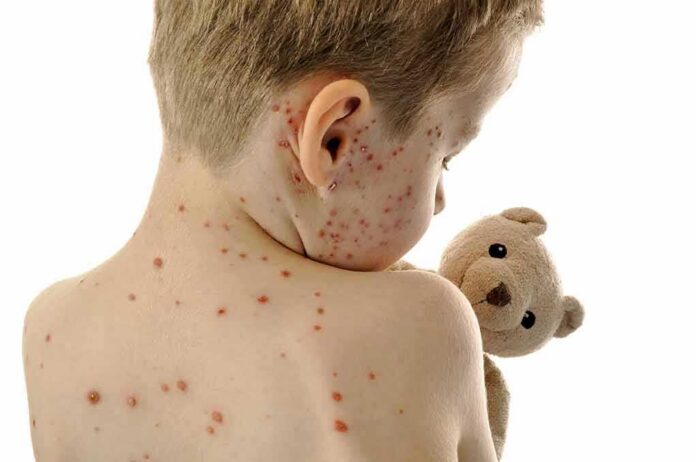
America just lost its measles-elimination status after cases surged past 5,000 this year, pushing doctors to treat a disease many have barely seen.
Story Snapshot
- U.S. measles cases in 2026 exceeded 5,000, the highest in decades.
- Global health officials say the U.S. no longer meets measles-elimination criteria.
- Most 2026 cases involved people unvaccinated or with unknown status.
- Clinicians report treating far more measles patients than in prior decades.
Record Case Surge Ends a 26-Year Public-Health Achievement
Centers for Disease Control and Prevention data reported more than 5,400 confirmed measles cases in 2026, the highest annual total in decades. Reuters reported a similar figure earlier in November and called it the largest count in 35 years. The spike marks a sharp break from the two decades after 2000, when the nation maintained elimination, meaning no continuous domestic spread. Case totals typically stayed low because outbreaks fizzled when they met strong community immunity.
The Pan American Health Organization said sustained transmission exceeded 12 months following outbreaks that began in early 2025, which ends the U.S. measles-elimination designation held since 2000. That determination uses a technical standard: if the virus keeps spreading for at least a year, the country is no longer considered to have eliminated measles. The designation is not a judgment on every policy choice. It measures whether spread has been continuous inside the country over time.
Who Is Getting Sick and Why It Matters for Community Risk
Reported data show that most 2026 measles patients were unvaccinated or had unknown vaccination status, while a small fraction had one or two doses of the measles, mumps, and rubella vaccine. That pattern fits how measles spreads: it moves fast in pockets with weaker immunity. National kindergarten coverage slipped from about 95 percent before the pandemic period to roughly 92 percent by the 2025–2026 school year, which widens those pockets and raises outbreak risk. Even small percentage drops can leave thousands more children unprotected.
Health systems also reported real clinical impact. KFF Health News coverage said states recorded hundreds of hospitalizations over the last two years and multiple deaths during the ongoing resurgence, while the Centers for Disease Control and Prevention listed confirmed 2026 deaths on its dashboard as verification progressed. Counts can differ across agencies and dates because they use different verification steps, but the main point stands: the burden rose with the surge. That strains hospitals and public-health teams who track exposures.
Doctors Face Diseases They Rarely Saw in the Elimination Era
Frontline clinicians described a rapid change in what they now see. One infectious-disease specialist in Pennsylvania reported treating only two measles patients across more than 30 years, then helping care for about 50 in a single year during this surge. That kind of jump shows why emergency rooms and clinics refreshed training on infection control and diagnosis. Measles spreads easily in waiting rooms if staff do not isolate patients fast. Quick recognition, masks, and rooming plans now matter far more than before.
During the elimination era, many younger providers learned measles from textbooks, not from practice. Today’s outbreaks force real-time learning. Clear triage steps help: ask about rash, fever, cough, red eyes, and recent travel. If measles is possible, separate the patient and notify infection control. Laboratories can confirm, but the first minutes still count most. These common-sense actions protect newborns, pregnant women, and people with weak immune systems, who face the highest risk of severe complications.
What Loss of Elimination Means for Families, Schools, and Travel
Loss of elimination does not mean the country accepts defeat. It signals that communities must rebuild immunity to stop long chains of spread. Families can talk with their doctors about the measles, mumps, and rubella vaccine schedule and catch up missed doses for school-age children. Schools and pediatric offices can check records to prevent clusters from taking hold. Strong local coverage turns big outbreaks into short, local events that end fast, rather than months of rolling transmission.
Officials warn that measles travels quickly across borders and states when people move or gather in close quarters. That includes airports, sporting events, and holiday trips. Parents can plan ahead: verify shots before travel and watch for symptoms after return. Communities can support vulnerable neighbors by staying home when sick and following public-health guidance during known exposures. These steps guard individual liberty the American way—through informed choices that also shield the most fragile among us.
Sources:
washingtonpost.com, tools.cdc.gov, news24.com, people.com, abc10.com, reuters.com