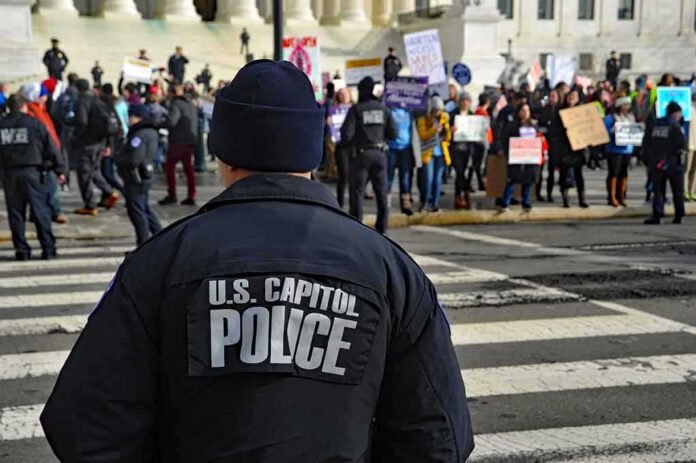
A Nebraska Republican senator literally called Capitol Police rather than answer a basic question about Mitch McConnell’s health, laying bare how secretive Washington has become about a powerful lawmaker’s condition.
Story Snapshot
- A reporter’s simple health question led one GOP senator to summon Capitol Police and walk away.
- Mitch McConnell has been hospitalized for weeks after a fall and pneumonia, with few medical details shared.
- Republicans are split between demanding answers and defending McConnell’s privacy and leadership.
- The blackout on health information raises serious concerns about accountability to Kentucky voters.
Reporter’s Question Sparks Capitol Police Call
TMZ reporter Charlie Cotton approached Nebraska Senator Pete Ricketts in the Capitol, asking whether Mitch McConnell had been transparent enough about his health and long hospital stay. Ricketts first said McConnell deserved time to recover and that people should be “praying for him” and wishing him well. When Cotton tried to follow up, Ricketts suddenly flagged down Capitol Police officers, insisting the reporter and cameraman were “not” part of his group and needed to go through security, before walking away. Ricketts later admitted he had “reacted poorly” and called Cotton to apologize.
This tense exchange came after weeks of speculation over whether the 84‑year‑old Kentucky senator is fit to keep serving, and whether his office has shared enough with the public. The fact that a sitting senator turned to law enforcement rather than answer a routine press question struck many voters as a sign that Washington insiders are more interested in controlling the story than in telling the truth. For conservative readers who value open government and straight answers, the incident highlights a growing gap between elected officials and the people they serve.
What We Know About McConnell’s Health So Far
McConnell’s team has confirmed that he was hospitalized after falling at his Washington, D.C., home, briefly losing consciousness and later being treated for a mild case of pneumonia. His statement said doctors found no heart attack, stroke, tumors, bleeding, broken bones, or concussion, but that he needed extended care in a rehabilitation center to regain strength and reduce his risk of future falls. McConnell added that, on his doctors’ advice, he was still not ready to return to the Senate floor to vote, even as weeks passed and key business stacked up.
Republican leaders say they have spoken with McConnell directly while he recovers and describe him as engaged and eager to come back. A spokeswoman for Senator John Barrasso said McConnell was “fully engaged” and working closely with his staff on Kentucky and Senate matters. Other colleagues told reporters that he “sounded good,” was “in good spirits,” and was paying close attention to what was happening in Washington. Those accounts offer some reassurance that McConnell is mentally aware, but they still rely on second‑hand descriptions rather than clear medical updates or public appearances.
Republicans Split Over Transparency and Fitness
Inside the party, Republicans are divided over how much the public deserves to know. Alabama Senator Tommy Tuberville says “somebody needs to do something” and that senators have not received meaningful internal updates on McConnell’s condition or timeline to return, even as important votes approach. He told Fox News Digital that colleagues “didn’t get any information” during a recent Senate luncheon and that he “doesn’t know what’s going on.” For many conservatives, this lack of information about a senior lawmaker’s health sounds like the same elite secrecy they resent in big government agencies.
Other Republicans defend McConnell and push back on rumors. Louisiana Senator John Kennedy urged people to “leave Mitch alone,” blasting talk that McConnell is “brain dead” as nonsense and telling critics to “get a life.” Iowa Senator Joni Ernst has argued that a letter from the Capitol physician and private updates to colleagues are enough unless Kentucky voters ask for more. Kansas Senator Roger Marshall, a doctor, points to McConnell’s long fight with polio and says he is making progress and will be back. This split shows two views on the right: one focused on transparency and accountability, the other on loyalty to a longtime party leader.
Health Secrecy and Voter Accountability
McConnell’s case fits a wider pattern in Congress, where there is no formal rule that forces lawmakers to share detailed medical records with the public. National Public Radio notes that health transparency for members of Congress is “a choice, not a requirement,” which means voters usually get only brief office statements rather than full reports. When information is limited, speculation on social media and cable news quickly fills the gap, and trust in institutions erodes even further. For a conservative base already wary of Washington games, that is a real problem.
Some GOP voices outside the Senate are now warning that the silence itself dishonors McConnell’s record and disrespects Kentucky citizens. Indiana Representative Marlin Stutzman said he has “not heard from” McConnell, questioned whether the senator is even alive, and argued that his constituents “deserve answers” about where he is and what shape he is in. Stutzman’s blunt comments reflect a basic principle many conservatives share: powerful officials serve at the consent of the governed, and they owe those citizens straight talk, especially when age or illness may limit their ability to do the job.
Sources:
townhall.com, cnbc.com, washingtonpost.com, time.com, pbs.org, nytimes.com, apnews.com