
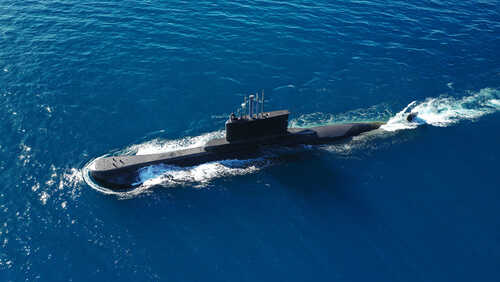
A new chapter in U.S.-Russia relations unfolded when President Trump ordered the deployment of two nuclear submarines in response to Russian threats, reigniting debate over the true motives and risks behind such nuclear signaling.
Story Snapshot
- President Trump publicly announced the deployment of two U.S. nuclear submarines after provocative comments from former Russian President Dmitry Medvedev.
- Experts and analysts argue Trump’s move was largely symbolic, serving as political posturing rather than a genuine military escalation.
- The episode highlights ongoing tensions over Ukraine and raises concerns about the dangers of casual nuclear rhetoric between major powers.
- Arms control organizations warn that normalizing such threats could erode critical norms and increase the risk of miscalculation in global security.
Trump’s Nuclear Submarine Announcement: Symbolism and Strategy
President Donald Trump, in early August 2025, confirmed the deployment of two U.S. nuclear submarines to undisclosed “appropriate regions” after former Russian President Dmitry Medvedev cited Soviet-era nuclear capabilities in response to U.S. pressure over the war in Ukraine. Trump’s announcement, made both in public statements and direct comments to the press, was widely interpreted as a calculated show of force designed to project American resolve in the face of Russian threats. The deployment occurred against a backdrop of heightened rhetoric, but most defense analysts and arms control experts agreed that the move represented political theater rather than a substantive shift in military posture.
Media coverage and expert commentary emphasized that the U.S. Navy frequently positions nuclear-armed submarines around the globe as part of its regular deterrence strategy. What made this episode unusual was the decision to publicize the movement, a step often avoided to preserve operational security and strategic ambiguity. European media outlets, along with the Center for Arms Control and Non-Proliferation, underscored that the deployment did not signal an actual escalation and instead served to reinforce Trump’s image as a strong leader responding decisively to foreign threats.
Watch: Pres. Trump orders nuclear submarines near Russia
Expert and Institutional Responses
The Center for Arms Control and Non-Proliferation issued a pointed statement warning that “there is no such thing as casual language about nuclear weapons and nuclear war,” and criticized Trump’s engagement as risky and inappropriate. The organization’s experts argued that using nuclear assets as tools for political messaging undermines decades of established norms regarding the handling and communication of nuclear deterrence. They cautioned that even symbolic gestures can be misinterpreted, contributing to instability between nuclear-armed states.
European media and U.S. military analysts echoed these concerns, noting that public announcements of nuclear deployments were rare during the Cold War, when secrecy was the norm. They pointed out that the Trump administration’s approach marked a departure from past practices, which prioritized measured and discreet signaling to avoid unnecessary escalation or misunderstanding between adversaries. Despite the heightened rhetoric, the actual U.S. military posture remained unchanged, with no evidence of increased readiness or imminent conflict.
Political Context and Broader Implications
This recent exchange between Trump and Medvedev fits within a larger pattern of nuclear saber-rattling that has become more frequent since the onset of the Ukraine conflict. Both Russian and American officials have resorted to escalating language, using references to nuclear capabilities as a form of political leverage. Trump’s decision to announce submarine movements was seen by many as an effort to capitalize on domestic political dynamics, projecting toughness to supporters frustrated by years of perceived weakness and indecision under the prior administration.
Remember when the media told us Donald Trump was a Russian agent?😂
— Rob Finnerty (@RobFinnertyUSA) July 24, 2025
While there was no tangible change in the military balance, the episode raised questions about the long-term effects of normalizing such threats. Arms control advocates warned that repeated public references to nuclear force could erode the taboo against nuclear war that has held since the end of World War II. Should rhetoric of this kind become standard practice, there is a real risk that miscalculation or misunderstanding could lead to unintended escalation, especially during periods of heightened international tension.
Historical Parallels and Conservative Perspectives
Historically, U.S.-Russia nuclear posturing was characterized by secrecy and careful calibration, rooted in Cold War deterrence theory. The current episode, however, unfolded in full public view, with both sides seeking to leverage nuclear signaling for political advantage. For many in the conservative community, Trump’s actions are seen as a necessary corrective to years of perceived appeasement and erosion of American strength. The symbolism of deploying nuclear submarines—while criticized by arms control experts—resonates with voters who believe that projecting power is essential to defending American interests and deterring adversaries.
Critics argue that such tactics carry unnecessary risks, but supporters maintain that a clear demonstration of strength is required to counter provocations from aggressive foreign leaders. The debate touches on foundational questions about how the United States should wield its military power, communicate its red lines, and uphold its responsibilities as the world’s leading constitutional republic.
Sources:
eurotopics.net – What to make of Trump’s nuclear sub threat?
armscontrolcenter.org – Statement on President Trump’s Announced Movement of Nuclear Submarines
legion.org – Five Things to Know, Aug. 4, 2025