
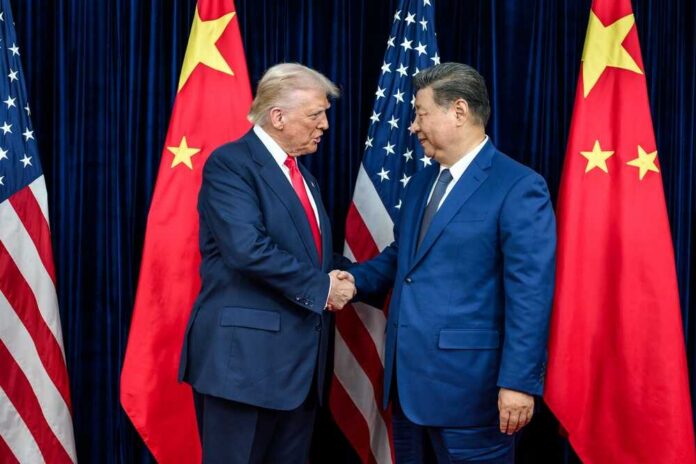
President Trump is using a delayed Beijing summit as leverage to stop America from again being stuck policing a vital global oil chokepoint while other nations free-ride.
Quick Take
- Trump says his China trip could be pushed back “five or six weeks,” after he asked Beijing to delay the late-March summit by “a month or so.”
- The White House is pressing China and other major economies to back a multinational effort to secure the Strait of Hormuz, a route for about one-fifth of the world’s traded oil.
- Treasury Secretary Scott Bessent has framed any rescheduling as “logistics,” signaling an effort to prevent market turbulence and keep trade disputes separate.
- Key allies remain hesitant: France has sounded conditional, Britain appears unlikely, and China has not publicly committed to joining a security coalition.
Why the Beijing Summit Is Sliding—and What Trump Is Asking for Instead
President Trump has indicated his planned summit with Chinese President Xi Jinping will likely be delayed, with the White House floating a window of roughly “a month or so” and Trump also referencing “five or six weeks.” The reason goes beyond calendars. Trump has tied the timing to an urgent push for broader international participation in securing the Strait of Hormuz amid escalating conflict involving Iran and regional instability.
Trump’s message is straightforward: countries that rely on Middle East energy and shipping lanes should help protect them. The Strait of Hormuz is a strategic chokepoint, moving roughly one-fifth of the world’s traded oil, and disruptions have already contributed to rising oil prices. The administration’s strategy links high-level diplomacy to burden-sharing—pushing major importers to show up with real commitments rather than statements.
The Strait of Hormuz Is a Global Lifeline—But the U.S. Usually Pays the Bill
The immediate backdrop is a security crisis in and around the strait, with reporting indicating Iran has restricted access for the United States, Israel, and allied countries. That matters because any sustained disruption can hit fuel costs, shipping insurance, and broader inflation pressures at home. For a conservative audience that remembers how quickly energy spikes punish families, this is a reminder that global disorder often lands on American wallets first.
Instead of defaulting to a U.S.-only response, Trump is pursuing an ad-hoc coalition approach aimed at countries whose economies depend on stable Gulf energy flows. The White House has argued the issue is not uniquely American, framing maritime security and countering Iran as something “the entire Western world” has supported for many years. The current ask is whether partners will back that claim with ships, resources, and sustained participation.
Allies Hesitate While China Weighs Its Options
Early responses suggest Trump’s frustration is not theoretical. Reporting indicates the administration has contacted roughly six to seven countries, yet firm commitments have not materialized. France has offered a cautious “maybe,” conditioned on circumstances, while Britain has been described as unlikely to join. Japan and South Korea have been mentioned as potential participants, but public positions have been mixed or noncommittal, highlighting the coalition’s uncertain footing.
China’s reaction has also been careful. Beijing has not directly embraced Trump’s request and has instead emphasized the conflict’s impact on trade and energy while calling for fighting to end. That posture reflects China’s longstanding preference to protect commercial interests without taking on open-ended security obligations. At the same time, China has economic reasons to want stability: it recently lowered its 2026 growth target to 4.5%–5%, making a prolonged shipping crisis even more costly.
Markets, Messaging, and the “Logistics” Explanation
Treasury Secretary Scott Bessent has worked to reduce market anxiety by insisting any schedule shift should be understood as a “logistics” matter rather than a fresh trade dispute with Beijing. That distinction matters because U.S.-China relations already carry friction, and investors tend to react sharply to signals that economic talks are unraveling. Bessent has also projected confidence the disruption will eventually pass, with the world “safer” and “better supplied” on the other side.
The political reality is that energy disruptions and geopolitical brinkmanship can become domestic economic problems fast. Oil price swings feed directly into transportation, heating, and groceries. After years when Americans absorbed inflation from policy choices they didn’t vote for—spending surges, weak deterrence, and a foreign policy that often looked more like managed decline—Trump’s approach is testing whether allies and competitors will finally share the load when global commerce is at risk.
What to Watch Next: Commitments, Not Photo Ops
The next key signal is whether any country publicly commits resources to a Hormuz security effort, rather than offering diplomatic hedges. Another is whether China sees strategic advantage in cooperation or continues to stand back while urging de-escalation. Trump’s delayed trip is now part of a larger negotiation over responsibility: whether the world’s biggest beneficiaries of stable oil shipping will help defend it, or whether the United States is expected to do it alone again.
For now, the trip’s exact rescheduled date remains unclear, and the coalition’s membership is still largely unconfirmed. That limitation is important: the public record shows an active U.S. push, but not a list of signed-on partners. The administration’s pressure campaign, however, is already clarifying the core question for voters at home—how long America should be expected to underwrite global stability when other nations hesitate to back their own interests with action.
Sources:
Trump suggests he may delay China trip as he pressures Beijing for help with Strait of Hormuz
Trump’s China Trip: 3 Possible Deliverables