
President Trump’s “greatest enemy” jab at Democrats has triggered a fresh media-and-war-powers showdown that’s now spilling onto Fox News in a way neither side can fully control.
Story Snapshot
- House Minority Leader Hakeem Jeffries escalated his criticism of Trump’s Iran strikes after Trump branded Democrats America’s “greatest enemy” on Truth Social.
- “Operation Epic Fury” has exposed public divisions inside the Democratic Party, with some lawmakers backing the strikes while leadership and others demand limits.
- The dispute is not only about rhetoric; it’s about Congress’ constitutional role in war-making, costs reported in the tens of billions, and risk of retaliation.
- Fox News has become a central arena for the fight, with Democrats signaling they will keep showing up even when attacked.
Trump-Jeffries Clash Turns a Foreign Policy Fight Into a Domestic One
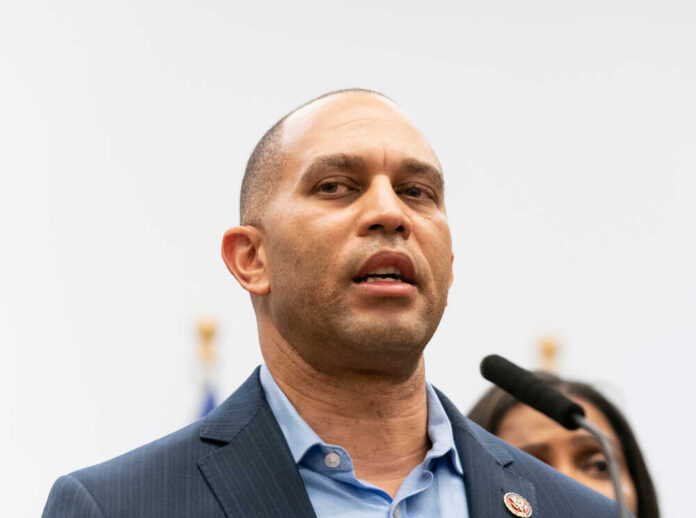
President Donald Trump’s blunt Truth Social message labeling the Democratic Party America’s “greatest enemy” landed in the middle of a fast-moving conflict with Iran tied to “Operation Epic Fury.” House Minority Leader Hakeem Jeffries responded by telling Trump to “keep his reckless mouth shut,” arguing the President’s language and decision-making could get people killed. The exchange crystallized how quickly an overseas strike can become a domestic political crisis.
Trump’s team has framed the strikes as decisive action with clear strategic goals, while critics have pressed the President on authorization and end-state. Jeffries’ comments, carried widely through cable coverage and pickup reporting, connect the rhetorical brawl to a deeper accusation: that the administration is drifting toward an open-ended “war of choice.” In a country already weary from inflation-era budgets and institutional distrust, war messaging can harden public skepticism fast.
Democrats Split on Iran as War Powers Pressure Builds
House Democrats are not speaking with one voice. Reporting highlights members such as Reps. Josh Gottheimer and Greg Landsman defending the strikes as necessary, even as other Democrats push for congressional limits and a formal vote. That split matters because it weakens Democrats’ ability to present a unified alternative while also complicating Republican messaging that the opposition is uniformly anti-military. The argument now sits at the intersection of national security and constitutional procedure.
Republicans controlling both chambers gives the White House more room to maneuver, but it does not erase the war powers question. If the administration proceeds without a clearer congressional lane, critics can argue Washington is repeating a familiar pattern: executive action first, legal and fiscal accountability later. Supporters counter that speed and deterrence matter against Iran, especially with threats around key shipping routes. Either way, Congress is being pulled into a vote-or-own-it dilemma.
Why Fox News Became the Battleground for “Keep Going” Democrats
Fox News remains one of the few venues where conservative-leaning audiences reliably hear Democratic arguments directly, without progressive framing. That reality helps explain why some Democrats keep returning even when the reception is hostile or Trump attacks them publicly. For conservatives, the spectacle often looks like Democrats chasing attention while refusing to credit successful deterrence. For Democrats, the calculation appears different: if they don’t argue their case on the largest right-leaning platform, they concede the narrative.
That “keep going” strategy can also backfire. When Democrats focus more on Trump’s tone than on verifiable points—authorization, costs, mission limits—they risk sounding performative to voters who want competence, not constant outrage. At the same time, Trump’s own choice of language (“greatest enemy”) invites a predictable escalation cycle that benefits media incentives on both sides. The net effect is more heat, less clarity, and more public suspicion that politics outranks problem-solving.
Costs, Energy Risk, and the Public’s Growing Distrust of Washington
The reported price tag—described by Jeffries as reaching $30 billion-plus—lands at a time when Americans across the spectrum question whether Washington can prioritize the basics: affordability, border control, energy reliability, and public safety. A conflict involving the Strait of Hormuz also keeps energy markets in the background of every briefing, because disruptions can translate into higher prices at home. Those bread-and-butter pressures shape how voters interpret every official statement.
House Democrat Explains Trump’s Furious Attack Is ‘Why’ He’ll Keep Going on Fox News #Mediaite https://t.co/qQBQXqnFAu
— #TuckFrump (@realTuckFrumper) May 11, 2026
Limited public detail about the operation’s scope makes it harder for citizens to judge success versus mission creep. Supporters can point to deterrence goals; opponents can point to congressional bypass concerns; both can be true in parts. The more this debate stays trapped in personal insults and partisan branding, the more it reinforces a shared left-right frustration: a federal government that looks reactive, self-protective, and increasingly incapable of transparent accountability when it matters most.
Sources:
Democrats buck party leaders, defend Trump’s ‘decisive action’ on Iran
Fetterman says Democrats have ‘no leader,’ blasts ‘Trump derangement syndrome’
Sen. Jack Reed says Trump ‘terribly weakened’ ahead of Xi meeting
Karl Rove discusses Trump’s Iran strategy and leverage