

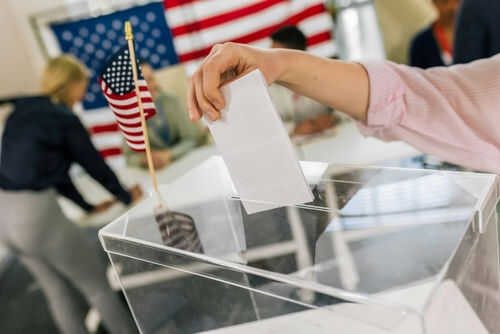
After President Trump’s primetime speech on “rigged” elections, Republican lawmakers are pushing harder than ever to pass the SAVE America Act and lock in strict proof‑of‑citizenship and voter ID rules nationwide.
Story Snapshot
- House Republicans passed the SAVE America Act, but the bill is stalled in the Senate.
- The bill would require documentary proof of U.S. citizenship to register and photo ID to vote in every federal election.
- Trump is making the SAVE America Act his top priority and pressing GOP lawmakers to act.
- Supporters say the bill will secure elections; critics claim it could block millions of eligible Americans from voting.
Trump Puts Election Integrity and the SAVE America Act Front and Center
President Donald Trump used a primetime national address on election integrity to demand that Congress pass the SAVE America Act, calling it essential to protect future elections from fraud and foreign meddling. He framed the bill as a simple promise: only American citizens should vote in American elections, and every voter should prove it with real documents and a photo ID. The speech ended with a direct call for viewers to contact their lawmakers and insist the bill reach his desk.
Trump has told Republicans on Capitol Hill that the SAVE America Act is his “number one priority” and warned he will not sign other major bills until it passes. Conservative allies argue that, after years of chaos on the border, mail-in ballot fights, and doubts about 2020, voters need strong rules that leave no room for illegal votes. Trump’s team points to polling showing broad national support for requiring proof of citizenship and ID to vote, including many independents.
What the SAVE America Act Would Do Nationwide
The SAVE America Act, which passed the House in February, would require every American to show documentary proof of U.S. citizenship, like a passport or birth certificate, when registering to vote in federal elections. It also mandates photo identification at the polls, setting one national standard instead of today’s patchwork of state rules. States would have to share their voter lists with the Department of Homeland Security so officials can check for noncitizens and clean the rolls.
The bill goes further than many state laws by tightening rules on mail-in ballots, demanding that voters include a copy of acceptable ID when they request and return absentee ballots. It also creates new name‑matching requirements that matter for married women and anyone who has changed their name. If a citizenship document does not match the current legal name, the voter must provide extra paperwork and the local election official must sign an affidavit, under penalty of perjury, confirming the person’s citizenship. Backers say this closes loopholes; opponents say it adds red tape.
House Passage and the Roadblock in the Senate
The Republican-led House approved the SAVE America Act by a narrow 218–213 vote, with every Republican and one Democrat backing the bill. That vote marked a major win for Trump and conservatives who have pressed for stricter election rules since his first term. Some House Republicans later tried to revive and expand the measure by tying it to a larger spending package, again stressing that proof‑of‑citizenship and voter ID must be in place before the next midterm elections.
In the Senate, Republicans hold a slim majority and recently voted 51–48 to advance the bill, with only one Republican breaking ranks. But the SAVE America Act faces the 60‑vote filibuster hurdle, and Senate Democrats are united in opposition. They argue the bill is “doomed to fail” and warn it could block many eligible voters, including military families, students, and naturalized citizens, from the ballot box. Trump has responded by publicly pressuring GOP leaders and hinting at changes in Senate leadership if they cannot deliver.
Supporters See a Needed Guardrail; Critics Warn of Disenfranchisement
Conservatives and many Republican election reform advocates say the SAVE America Act is basic common sense: you must prove you are an American to help choose American leaders. They point to widespread frustration with unsecured borders and lax verification in voter registration systems and argue that stronger rules will rebuild trust and protect the value of every lawful vote. For these supporters, closing any gap that might allow noncitizen voting is part of defending the Constitution and the nation’s future.
Detailed Summary of “President Trump Addresses the Nation” on July 16th, 2026
President Trump begins the address by presenting an optimistic assessment of the country's condition under his administration. He argues that the United States has undergone a dramatic turnaround from… pic.twitter.com/KWvULpimZa
— Tony Seruga (@TonySeruga) July 17, 2026
Voting rights groups and many Democrats counter that noncitizen voting is already illegal and extremely rare, and that the new requirements could make it harder for millions of legitimate voters to participate. Research cited in news reports suggests that around one in ten Americans may struggle to quickly access the required documents, especially those who do not have passports or easily available birth certificates. Critics argue that in the name of stopping a tiny problem, the law would build big barriers, particularly for married women with name changes and younger voters who move often.
Sources:
nbcnews.com, houchin.house.gov, bergman.house.gov, walberg.house.gov, cha.house.gov, theguardian.com, brennancenter.org, en.wikipedia.org, bipartisanpolicy.org, campaignlegal.org, americanprogress.org, westernjournal.com, fairelectionscenter.org