

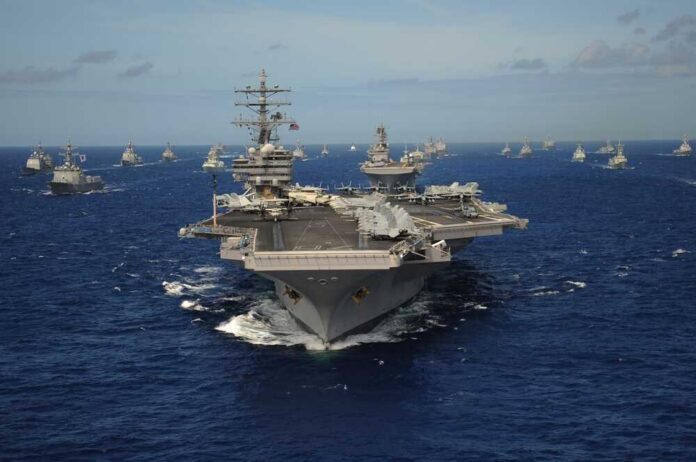
As America pours billions into supercarriers while fighting yet another Middle East war, defense experts warn these floating cities may be headed for the same dustbin as WWII’s Montana-class battleships—massive, expensive platforms rendered obsolete by changing technology before they ever proved their worth.
Story Snapshot
- U.S. Navy canceled five Montana-class superbattleships in 1943 after carriers proved dominant at Coral Sea and Midway, redirecting resources to aircraft carriers and destroyers.
- Montana-class ships would have displaced 60,500 tons with twelve 16-inch guns but were too slow, too expensive, and tactically irrelevant after carrier aviation reshaped naval warfare.
- Defense analysts now draw parallels to modern supercarriers, arguing advanced missile technology from adversaries like Iran and China may render $13 billion carriers equally vulnerable and obsolete.
- The historical lesson resonates with MAGA supporters frustrated by endless military spending on platforms that may not survive modern combat, echoing broken promises to avoid costly foreign entanglements.
When Admirals Bet Wrong: The Montana-Class Mistake
The U.S. Navy authorized five Montana-class battleships on July 19, 1940, under the Two-Ocean Navy Act as the ultimate answer to Japanese and German naval power. These behemoths would displace 60,500 tons—15,000 more than Iowa-class ships—mounting twelve 16-inch guns with unprecedented armor protection. Navy planners envisioned decisive fleet actions where massive firepower and thick steel would dominate enemy battleships. Congress funded the program, assigning construction to Philadelphia, New York, and Norfolk Navy Yards. Yet by April 1942, before a single keel was laid, the Navy suspended the program. Steel shortages, Panama Canal limitations, and emerging battlefield realities forced hard choices about America’s industrial capacity.
Carriers Proved Battleships Were Floating Coffins
Pearl Harbor exposed battleship vulnerability on December 7, 1941, when Japanese aircraft devastated the Pacific Fleet’s battleship row without surface engagement. The Battle of Coral Sea in May 1942 and Midway in June 1942 cemented the transformation—carrier aircraft decided both battles without opposing battleships ever exchanging fire. Admiral Ernest King and naval strategists recognized the shift immediately. By October 1942, the Navy prioritized eighty destroyers for Atlantic anti-submarine warfare over Montana-class construction. On July 21, 1943, the Navy officially canceled all five ships, reallocating resources to twenty Essex-class carriers and hundreds of destroyers and submarines that actually won the Pacific War. The Montana class never contributed a single shell to victory.
Billion-Dollar Carriers Face the Same Obsolescence
Today’s supercarriers cost over $13 billion each, require 5,000 crew members, and dominate Navy budgets while America fights in Iran with energy costs soaring and debt exploding. Defense experts increasingly question whether these platforms can survive modern anti-ship missiles from adversaries like China and Iran. Hypersonic weapons travel too fast for carrier defenses; swarm tactics overwhelm protective screens; satellite tracking makes stealth impossible for 100,000-ton vessels. The Montana-class consumed resources for a mission carriers performed better and cheaper. Similarly, critics argue unmanned systems, submarines, and distributed strike platforms deliver firepower without concentrating risk and expense in vulnerable floating cities. The Navy’s carrier-centric doctrine, forged in 1943, may be repeating the battleship mistake it corrected eighty years ago.
Why This Matters for Americans Footing the Bill
MAGA voters supported President Trump’s promise to end regime change wars and rebuild America, not finance endless Middle East conflicts with weapons systems designed for Cold War threats. The Iran war drains resources while supercarriers—potentially as obsolete as Montana-class battleships—absorb defense dollars that could secure borders, rebuild infrastructure, or stay in taxpayers’ pockets. The 1943 decision to cancel Montana-class ships freed shipyards to build weapons that won WWII efficiently. Today’s Pentagon resists similar hard choices, clinging to carrier doctrine despite evidence from Ukraine and Middle East conflicts showing small, cheap drones and missiles neutralize expensive platforms. Americans watching gas prices spike and national debt soar deserve leaders who learn from history: cutting losses on obsolete systems isn’t weakness; it’s strategic common sense that protects both national security and fiscal sanity.
The Montana-class cancellation saved billions in steel and labor, redirected resources to platforms that delivered victory, and validated adapting strategy to technological reality. Whether current Pentagon leadership possesses the same wisdom remains an open question as supercarriers steam toward potential obsolescence while American taxpayers finance wars they never voted for with platforms that may not survive the first salvo of a peer conflict. Montana remains the only state without a namesake battleship—a monument to strategic flexibility that today’s defense establishment seems to have forgotten.
Sources:
Montana-Class: The U.S. Navy’s Superbattleships That Never Sailed – National Security Journal
Super Battleships: Why US Navy Said No to Montana-Class – The National Interest
Montana-Class Battleships History – SOFREP