President Trump has escalated confrontation with Iran to a critical point, claiming 158 Iranian naval vessels have been obliterated while threatening to eliminate any speedboats that approach U.S. warships using the same lethal tactics deployed against drug cartels at sea.
Story Snapshot
- U.S. military blockade of Iranian ports now in effect, intercepting vessels and challenging Iran’s speedboat fleet in the Strait of Hormuz
- Trump warns remaining Iranian fast-attack speedboats will be “immediately eliminated” using systems proven against cartel boats
- Iran threatens to attack any U.S. warship within 30 minutes if it crosses the Strait, calling the blockade an act of piracy
- Conflicting reports emerge over recent U.S. destroyer operations, with Iranian state media claiming interception while American officials dispute threats
Trump’s Cartel Comparison Reveals New Naval Strategy
President Trump’s reference to cartel tactics represents more than rhetorical flourish. The administration has explicitly warned that Iranian speedboats will be eliminated using “the same system of kill that we used against the drug dealers in the boats at sea.” This comparison signals a shift toward treating Iranian Revolutionary Guard Corps Navy vessels as hostile threats rather than professional military units deserving traditional rules of engagement. The strategy acknowledges what both cartels and Iran share: reliance on small, fast vessels to challenge superior conventional forces through swarming tactics and asymmetrical warfare.
U.S. Blockade Triggers Iranian Escalation Warnings
The U.S. military blockade of Iranian ports has fundamentally altered the strategic landscape in the Persian Gulf. American forces are now intercepting ships traveling to and from Iranian ports, as well as vessels paying Iran for safe passage through the Strait of Hormuz. Iran’s armed forces condemned these restrictions as illegal acts amounting to piracy. The IRGC warned that any warships approaching the Strait would breach the current ceasefire agreement. Iranian media threatened that U.S. military ships would face attack within 30 minutes if attempting to cross the Strait, though American officials have disputed receiving such threats.
Iran’s Speedboat Fleet Faces Systematic Destruction
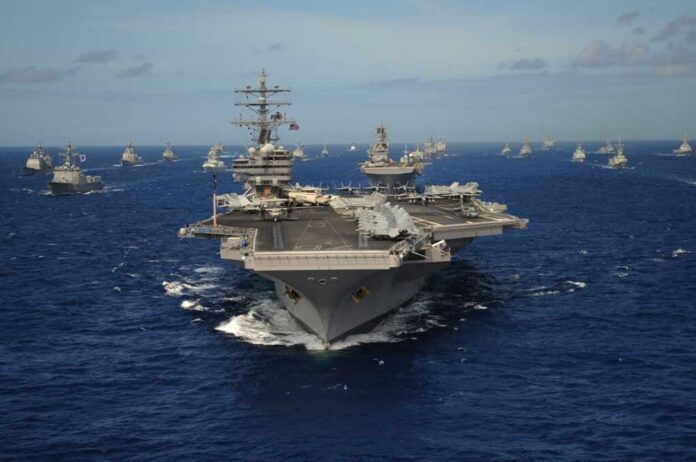
Iran operates approximately 1,500 small craft in its naval fleet, a force designed to compensate for the reality that the entire Iranian Navy combined possesses less firepower than a single American carrier strike group. This asymmetrical approach emerged from necessity rather than choice. The Pentagon documented over 35 unsafe and unprofessional interactions with Iranian vessels in the Persian Gulf in 2016 alone, establishing a pattern of aggressive behavior. Iranian Revolutionary Guard Corps Navy speedboats have repeatedly closed on U.S. warships at high speed without radio communication or warning. Iran has even practiced mass small boat attacks against replica U.S. warships, demonstrating serious preparation for swarming tactics.
Disputed Naval Encounters Reveal Information Warfare
Recent operations in the Strait of Hormuz have produced contradictory narratives that expose the propaganda dimensions of modern naval confrontation. Two U.S. Navy guided-missile destroyers, the USS Frank E. Peterson and USS Michael Murphy, reportedly transited the Strait to begin mine-clearing operations. Iranian State TV claimed Iranian naval forces intercepted these vessels and forced them to turn back. However, U.S. officials denied these claims, with CENTCOM Commander Adm. Brad Cooper stating the U.S. would establish a new passage through the Strait and share this safe pathway with the maritime industry to encourage free commerce flow.
Global Commerce and Energy Security at Risk
The Strait of Hormuz represents one of the world’s most critical maritime chokepoints, with approximately one-third of global seaborne oil passing through its narrow waters. This strategic location transforms local military confrontations into threats to global energy markets and international shipping. The current blockade and military operations create immediate disruption risks while ceasefire negotiations continue in Pakistan. If Iran follows through on threats to close all regional ports in response to its own closed ports, the economic consequences would extend far beyond the immediate combat zone, affecting civilian populations and commercial interests worldwide.
🔥Iran Now Threatening U.S. Navy With Speedboats: They Should Ask the Cartels How That Works. Take them all out. Kaboom: 💥https://t.co/JG4C3X9vYB
— Patriotic 🇺🇸Suzanne⭐️⭐️⭐️ (@suzost) April 13, 2026
The escalating confrontation reveals a fundamental problem many Americans recognize regardless of political affiliation: our government continues deploying military force in distant conflicts while critical domestic issues remain unresolved. Whether one supports Trump’s aggressive posture or questions the wisdom of risking broader Middle East war, the pattern remains consistent. Elected officials focus on foreign adventures while everyday citizens struggle with inflation, economic uncertainty, and a sense that Washington serves elite interests rather than ordinary people. Iran’s speedboat tactics may prove ineffective against American firepower, but the larger question persists: why are we still refereeing ancient regional disputes instead of fixing what’s broken at home?
Sources:
The Jerusalem Post – Iran News Article
Times of India – Iran Intercepts US Warships Video