
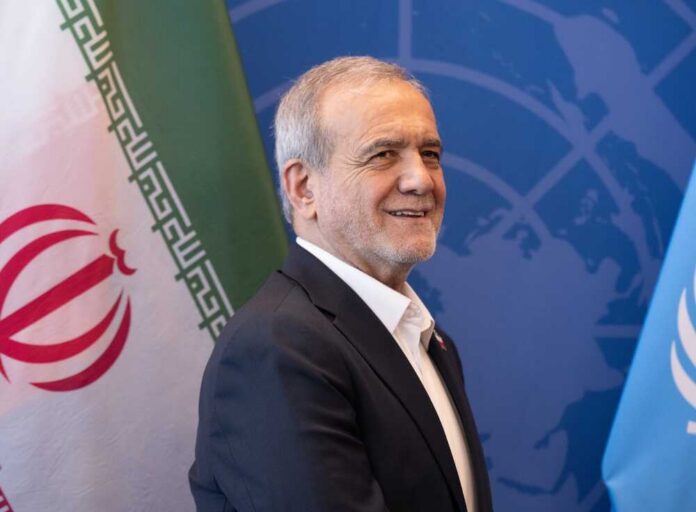
Iran’s President Masoud Pezeshkian issued a stunning public apology to neighboring Gulf Arab states for Iranian missile and drone strikes—while missiles continued pounding those same nations and he defiantly told President Trump and Israel to take their demand for “unconditional surrender” to the grave.
Story Snapshot
- President Pezeshkian apologized on state television for Iranian strikes on Gulf neighbors, calling them “our brothers” and announcing orders to halt attacks except in self-defense
- Even as he spoke, Iranian missiles and drones continued striking Dubai, Saudi Arabia, Bahrain, and Israel—exposing a command-and-control breakdown after Supreme Leader Khamenei’s killing
- Pezeshkian rejected President Trump’s call for Iran’s unconditional surrender, declaring those expecting capitulation should “take that dream to their grave”
- The chaotic mixed messaging reveals Iran’s interim leadership council struggling to control fractured military forces one week into a widening regional war
Iran’s Leadership Chaos on Full Display
President Masoud Pezeshkian delivered an unprecedented televised apology to neighboring Gulf Arab states, acknowledging Iranian missile and drone strikes that hit the UAE, Saudi Arabia, and Bahrain during the current conflict. Pezeshkian, one of three members leading Iran after the February 28 airstrike killed Supreme Leader Ayatollah Ali Khamenei, stated he was apologizing “on my own behalf” and on behalf of the Iranian nation. He described Gulf neighbors as “our brothers” and insisted Iran has “no intention or desire” to attack them, calling instead for regional unity and diplomatic solutions to resolve the escalating crisis.
Orders Issued But Missiles Keep Flying
Pezeshkian announced that Iran’s interim leadership council had instructed armed forces to cease attacks on neighboring countries unless Iran is attacked first—a conditional policy shift toward restraint. Yet the reality on the ground told a starkly different story. As Pezeshkian spoke, Iranian missiles and drones continued striking targets across the Gulf region and Israel. Dubai International Airport experienced flight disruptions as passengers sheltered in tunnels during missile alerts. Saudi Arabia intercepted drones headed for the Shaybah oil field and shot down a ballistic missile near Prince Sultan Air Base, which hosts U.S. forces. Air raid sirens blared in Bahrain, and interceptions boomed over Jerusalem.
Military Contradicts Presidential Message
Adding to the confusion, Iranian armed forces spokesman Gen. Abolfazl Shekarchi issued statements that partially contradicted Pezeshkian’s apology, claiming Iran had “not hit countries that did not provide space for America to invade our country.” This muddled messaging underscores the apparent breakdown in command and control following the killing of Khamenei and other senior Iranian officials. Over 1,230 Iranians have been killed in the conflict’s first week, along with more than 200 in Lebanon, 11 in Israel, and six U.S. troops. The leadership vacuum and severe losses appear to have fractured Iran’s ability to coordinate political directives with military operations in real time.
Defiant Rejection of American Demands
While seeking to de-escalate tensions with Gulf neighbors, Pezeshkian simultaneously delivered a defiant rejection of President Trump’s demand for Iran’s unconditional surrender. He called such expectations a “dream” that those harboring it should “take to their grave,” insisting Iran will defend its dignity and sovereignty regardless of pressure. This dual messaging—conciliatory toward Arab neighbors while confrontational toward the United States and Israel—reflects Iran’s strategic calculus: avoid transforming the Israel-Iran confrontation into a broader Iran-Arab conflict, which analysts warn would serve Israeli strategic interests. Yet the ongoing strikes on Gulf states risk precisely that outcome, exposing the gap between Tehran’s political intentions and its military’s operational reality.
Regional Stability Hanging by a Thread
The conflict has spread chaos across the Middle East, disrupting global air travel and rattling energy markets as attacks threaten critical oil infrastructure. Gulf Arab monarchies hosting U.S. military assets find themselves caught between their Western security partnerships and Iranian threats, making them both shielded by American power and exposed as targets. Iran’s apology appears to be an attempt at damage control, recognizing that alienating neighbors undermines its own economic and diplomatic position. But with over a thousand dead and military forces apparently operating beyond full civilian control, words of regret ring hollow when missiles continue to fly. President Trump’s firm stance demanding Iran’s capitulation reflects a strategic opportunity to decisively weaken a long-time adversary of American interests and regional stability.
The spectacle of an Iranian president apologizing for attacks his military continues to execute reveals the depth of Iran’s internal crisis. Leadership decapitation has left Tehran’s regime struggling to maintain coherence, control its own forces, and navigate a multi-front war it is losing. For Americans and our Gulf allies, this chaos presents both danger and opportunity: danger from an unpredictable adversary with missiles and drones, and opportunity to press for a decisive end to decades of Iranian aggression, support for terrorism, and threats to regional peace. President Trump’s refusal to accept anything less than unconditional terms sends a clear message that the era of appeasing Tehran’s theocratic regime is over.
Sources:
Iran’s president apologizes for strikes on neighbors as strikes pound their cities – WGLT
Iranian president APOLOGIZES to neighboring countries – Fox News