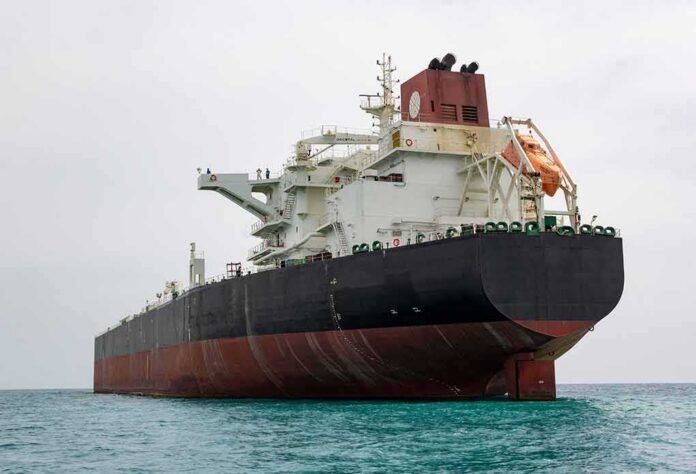
Iran’s security chief announced a new “prohibited zone” near the Strait of Hormuz that could squeeze global energy and test freedom of navigation.
Story Highlights
- Iran says it will declare a new restricted zone outside the Strait of Hormuz in coming days.
- Tehran warns ships detected in the zone while attempting Hormuz transit will face Iranian sanctions.
- International law classifies Hormuz as an international strait with non-suspendable transit passage.
- United Nations action to secure passage has stalled after Russian and Chinese vetoes.
Iran’s Announcement and Stated Enforcement Plan
Mohsen Rezaei, the Secretary of Iran’s Supreme National Security Council, said Iran will declare a “restricted” or “prohibited” maritime zone outside the Strait of Hormuz in the coming days. He stated that any vessel detected in this area while attempting to transit the Strait would be placed on Iran’s sanctions list, signaling Tehran’s intent to police the approach routes beyond the narrow choke point itself. State-linked reports carried the same warning, describing a deliberate move to expand Iran’s leverage around the vital waterway.
The declared purpose, according to Iranian media accounts, is to protect Iran’s security and respond to outside pressure on its economy and shipping. The public statement did not include precise coordinates, timelines, or rules for exceptions such as medical or humanitarian passages. The claim arrives amid ongoing regional tensions and recent tit-for-tat rhetoric. The message to shipowners is clear: Iran wants a say over which vessels approach the strait and under what conditions.
What Law Says About the Strait and Its Approaches
International maritime law treats the Strait of Hormuz as an international strait used for global navigation. Under the United Nations Convention on the Law of the Sea, vessels enjoy a right of “transit passage” that coastal states cannot suspend, ensuring continuous and fast movement through straits that connect high seas or exclusive economic zones. U.S. policy and many legal analyses classify Hormuz and its approaches under this regime, emphasizing that outside interference with passage violates core navigation principles.
These rules do not grant Iran a legal basis to bar or toll routine passage through the strait. Coastal states may adopt limited safety measures, but they cannot impose broad bans that block normal transit. Shipping lanes in Hormuz follow an established traffic separation scheme set by maritime bodies to keep traffic safe and efficient. Iran’s planned zone, described as outside the strait, aims to exert influence before ships even reach those lanes, raising hard questions about legality and operational risk.
Global Stakes: Energy Prices, Insurance, and U.S. Commitments
The Strait of Hormuz is the world’s energy artery. Even threats can lift oil prices and spike insurance. Industry reporting this year shows war risk coverage for ships linked to Western flags climbing by a multiple compared to pre-war norms, pushing costs sharply higher for each voyage. When insurers price more danger, charters may delay or reroute. That can mean tighter supplies, higher pump prices, and more strain on family budgets already hit by past inflation.
President Trump’s team has pledged to defend freedom of navigation and keep sea lanes open. The United States views transit through Hormuz as non-negotiable under international law, and the Navy has historically escorted and monitored traffic to deter interference. Clear rules and credible patrols help keep markets calm. Any attempt to force ships to seek Iranian permission would collide with long-standing U.S. policy and allied practice, risking confrontation if Tehran tries to enforce the new claim at sea.
United Nations Gridlock and What Comes Next
Diplomacy at the United Nations has not produced a united front. A draft Security Council resolution backed by Gulf partners to safeguard navigation failed after vetoes from Russia and China. The stalled effort leaves major powers split on how to push back against interference, reducing pressure on Iran at a key moment and shifting more of the burden to naval coalitions and regional arrangements.
Iran will announce a new maritime exclusion zone in the Persian Gulf, starting at the edge of the current US naval blockade and extending into Gulf waters, Supreme National Security Council secretary Mohsen Rezaei said.
Tehran will also publish maps of a new shipping corridor… pic.twitter.com/qozi8xpazd— The Geo-Political Arena (@GPoliticalArena) September 8, 2026
Shipowners and energy buyers now face a practical test: treat Iran’s zone as a political warning or as a real hazard. If Tehran harasses tankers or boards ships, costs will rise fast and schedules will slip. If navies keep traffic moving, the market may steady. The law is clear about transit passage, but sea control often comes down to presence and will. For American families, steady energy flows—and a firm stand for freedom of navigation—mean lower costs and stronger security.
Sources:
mediaite.com, cbsnews.com, straitstimes.com, english.news.cn, nypost.com, thehindu.com, apnews.com, press.un.org