
North Korea’s own laws now let Kim Jong-un fire nuclear weapons first, and America’s recent show of force against Iran just proved Washington won’t sit back and wonder if he means it.
Story Snapshot
- North Korea’s 2022 law lets Kim Jong-un order preemptive nuclear strikes, not just retaliation, if he feels threatened.
- The Pentagon’s 2026 National Defense Strategy calls North Korea a “clear and present danger” to the American homeland.
- President Trump has publicly said Kim controls “57 powerful nuclear weapons,” a number South Korean intelligence puts far higher.
- South Korea’s spy agency says North Korea’s constitution now hands nuclear launch authority straight to its top leader.
Kim’s Doctrine Goes Far Beyond Self-Defense
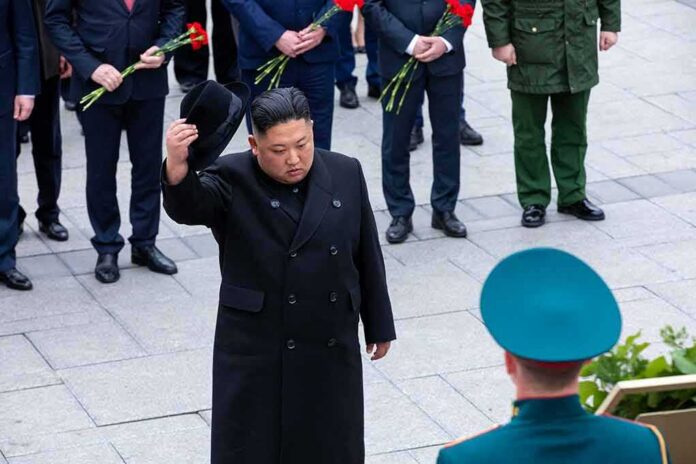
Kim Jong-un has long called nuclear weapons a “guarantor of regime security,” according to a U.S. intelligence assessment summarized by the Congressional Research Service. He has said he will “never give up” that arsenal to ease outside pressure. That sounds defensive on its face. But the actual law he signed tells a more dangerous story.
North Korea’s 2022 nuclear law does not stop at retaliation. It allows Kim to strike first if he believes an attack on the state or its leadership is coming, even a non-nuclear one, according to CNN’s reporting on the legislation. That is not a shield. That is a hair-trigger built around one man’s judgment call in a crisis.
South Korea’s National Intelligence Service told its own parliament that North Korea’s constitution, under Article 89, places full command of nuclear forces in the hands of the chairman of the State Affairs Commission, Kim himself, with power to delegate that launch authority to others. One man, or whoever he picks, controls the button. There is no congressional check, no court review, nothing.
Pentagon Calls North Korea a Clear and Present Danger
The Department of War’s 2026 National Defense Strategy does not mince words. It states North Korea’s forces are “growing in size and sophistication” and pose a “clear and present danger of nuclear attack on the American Homeland”. That is the Trump administration’s own military leadership putting the threat in writing, not activist commentary or partisan spin.
President Trump has been blunt about the numbers, telling reporters Kim holds “57 powerful nuclear weapons” while floating another meeting with the North Korean leader. South Korean estimates run as high as 80 to 120 warheads, a gap that shows how murky the real count remains even to close allies watching Pyongyang around the clock.
Iran Showed America Will Act, Not Just Talk
America’s recent military action against Iran’s nuclear program sent a message that reaches well past Tehran. When a rogue regime races toward the bomb, or already has one, Washington under President Trump is willing to use force rather than accept endless negotiations that produce nothing but delay. That is a lesson Pyongyang cannot ignore.
North Korea’s doctrine has drifted the wrong direction for over a decade. A 2013 law framed nuclear weapons as purely retaliatory, used only by “final order” to repel an attack. By 2022, the law had widened to cover preemptive strikes tied to leadership threats. That is not a nation shrinking its ambitions. That is a regime expanding its options for using the bomb first.
Analysts disagree on how much of this is bluff and how much is real war planning. North Korea does not release its actual military doctrine, forcing outside experts to guess based on speeches, laws, and missile tests. That uncertainty itself should worry conservatives who value clear-eyed threat assessment over wishful thinking about diplomacy alone.
What Comes Next for American Deterrence
President Trump’s willingness to name numbers publicly, even imprecise ones, forces a conversation Washington has avoided for years. A regime with expanding delivery systems, submarine-launch capability, and a legal green light for first use is not a problem that talks alone will solve. It demands the kind of strength the Iran operation just demonstrated America still has.
Conservatives have long argued that peace comes through strength, not appeasement. North Korea’s own laws now confirm the stakes. The Trump administration’s defense strategy already names the danger. The next question is whether allies in Seoul and Tokyo, and voters at home, back the resolve needed to keep Kim’s regime boxed in rather than emboldened.
Sources:
19fortyfive.com, europarl.europa.eu, koreajoongangdaily.com, atlasinstitute.org