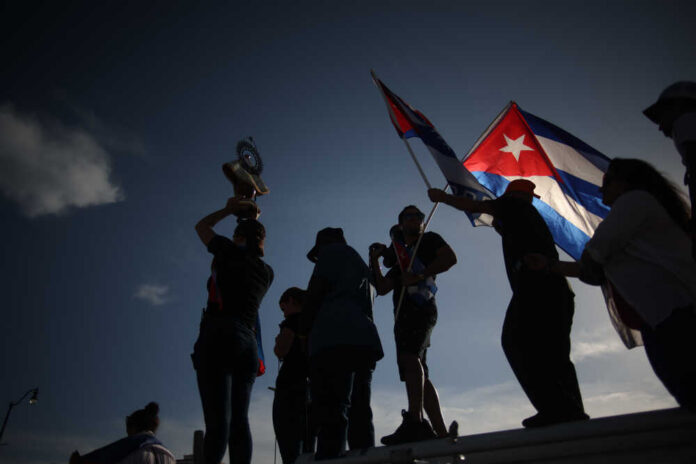
President Trump signaled on February 27, 2026, that the United States is actively pursuing a “friendly takeover” of communist Cuba, describing the island nation as a collapsed failed state ripe for American intervention following successful military pressure on Iran.
Story Highlights
- Trump calls Cuba a “failed state” with no money, oil, or food, suggesting it’s only “a question of time” before the US moves in
- Secretary of State Marco Rubio is conducting high-level talks with Cuba as the communist regime faces economic collapse from lost Venezuelan and Mexican support
- The Cuba pivot comes as Trump escalates military pressure on Iran with ongoing Operation Epic Fury strikes following failed nuclear negotiations
- Former National Security Advisor John Bolton advocates regime change in Cuba, calling it the next target after Venezuela in the administration’s “Troika of Tyranny” strategy
Trump Declares Cuba a Failing Nation Ready for US Intervention
President Trump told reporters in Washington that Cuba has become a failed state with no functioning economy, no oil supplies, and widespread food shortages. The President characterized the situation as inevitable for US action, stating it’s merely “a question of time” before America addresses the crisis. Trump described the potential intervention as a “friendly takeover,” distinguishing his approach from military aggression while making clear the communist regime’s days are numbered. This represents a significant shift in US foreign policy toward the Caribbean, signaling the administration’s willingness to pursue regime change in America’s backyard after decades of stalemate.
Rubio Leads High-Level Negotiations as Cuba Faces Economic Collapse
Secretary of State Marco Rubio, a Cuban-American with deep personal opposition to the Castro regime, is spearheading diplomatic talks with Cuban officials at the highest levels. The White House confirmed these negotiations are underway, with Rubio declaring that Cuba’s “status quo is unacceptable” and demanding fundamental change. Cuba’s economic crisis has accelerated dramatically after Venezuela’s regime instability cut off critical oil shipments and Mexico halted its petroleum exports to the island. This triple blow—loss of money, oil, and food—has created what Trump describes as a collapsing nation dependent on foreign support that no longer exists.
Iran Military Success Emboldens Administration’s Regime Change Agenda
Trump’s Cuba rhetoric follows what the administration views as successful military strikes against Iran after nuclear negotiations in Geneva collapsed. The President criticized Iran talks as unsatisfactory, demanding zero uranium enrichment, ballistic missile limitations, and curbs on regional proxies—conditions Iran rejected. US forces launched Operation Epic Fury, described by the White House as the largest military buildup since the 2003 Iraq War, with strikes prompting Iranian retaliation across Middle East allies. Advisors reportedly told Trump he’s “on a roll” following these Iran actions, creating momentum for the administration’s broader regime-change doctrine targeting what John Bolton previously labeled the “Troika of Tyranny”—Iran, Venezuela, and Cuba.
Bolton Advocates Swift Action Against Weakened Communist Regime
Former National Security Advisor John Bolton, who shaped Trump’s first-term Cuba policy, publicly advocated for regime change on the island, arguing the post-Castro government could be next after Venezuela. Bolton characterized Iran’s regime as the weakest since 1979, suggesting economic pressure rather than immediate military action against Cuba while the administration focuses on Iran. This strategy leverages Cuba’s dire economic situation—created by the loss of Venezuelan oil and Mexican support—to force concessions or collapse without direct invasion. Bolton’s influence reflects continuity from the administration’s first term, when he championed aggressive policies against all three “Troika” nations as threats to American interests and hemispheric stability.
Trump says ‘question of time’ before US turns to Cuba after Iran https://t.co/uU6nSOhEMY pic.twitter.com/8nBM9CYhCd
— Insider Paper (@TheInsiderPaper) March 6, 2026
The dual-track approach toward Cuba and Iran demonstrates the administration’s commitment to challenging adversarial regimes through combined diplomatic pressure and military readiness. Trump remains undecided on further Iran military escalation, pending advisor input, but made clear both situations represent opportunities to advance American interests. The White House praised the President’s “decisive action against the Iranian regime” on March 3, 2026, while Operation Epic Fury continues with promises of “a safer world” upon completion. For Americans frustrated by decades of failed diplomacy with communist Cuba and terror-sponsoring Iran, this administration signals a willingness to pursue tangible results rather than endless negotiations that embolden enemies and waste taxpayer resources on fruitless engagement with hostile regimes.
Sources:
MAGA Senator Lindsey Graham Says President Donald Trump Will Target Cuba Next – The Daily Beast
Thank You President Trump for Decisive Action Against the Iranian Regime – White House
When Operation Epic Fury is Complete the World Will Be a Safer Place – White House