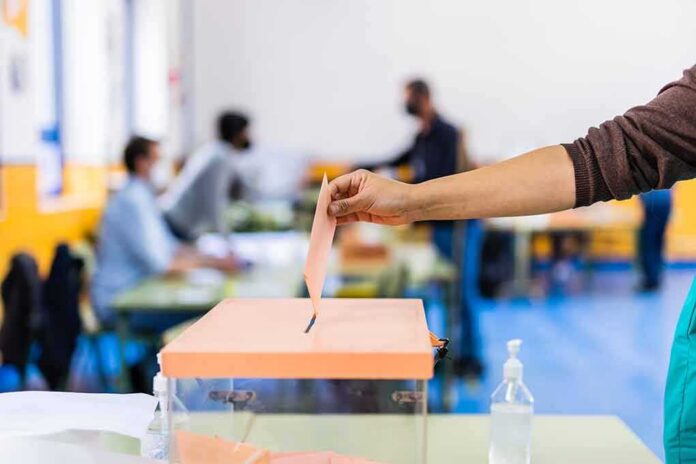
California’s drawn-out vote counting has turned another election into what Steve Hilton calls “a complete disgrace,” and millions of conservatives are asking why the world’s leading nation cannot deliver timely, trustworthy results in its largest state.
Story Snapshot
- California law lets mail ballots arrive and be counted for days after Election Day, guaranteeing delayed and confusing results.[1][2][3]
- Gubernatorial candidate Steve Hilton says the slow count “undermines confidence” and promises reforms to restore basic election common sense.[1][3]
- State officials insist the delays are “normal” and required by law, putting accuracy over speed and dismissing fraud concerns.[1][2][3]
- Both sides agree trust is eroding as Californians wait days or weeks for outcomes, turning every close race into a legitimacy fight.[3]
Hilton Blasts Delayed Results as Public-Trust Disaster
Republican gubernatorial frontrunner Steve Hilton is putting California’s election machinery on trial after yet another primary left voters waiting days for clarity while officials continued to sift through piles of uncounted mail ballots.[1][3] In an appearance highlighted by local news, Hilton called the process “yet another Democrat fiasco” and a “complete disgrace” that leaves barely half the votes counted nearly two days after polls close, feeding the sense that the system is rigged against ordinary citizens.[1]
Hilton has drawn a sharp line between questioning results and questioning the process, stopping short of repeating former President Trump’s specific fraud allegations while insisting that normal Americans should not have to live in perpetual election limbo.[1][2][3] In a Fox News interview, he argued that the glacial count is “why so many people don’t believe the results,” warning that a system run for years by a “corrupt Democrat machine” cannot keep demanding blind faith while refusing to fix obvious operational failures.[2]
How California’s Rules Guarantee Slow, Suspicious Counts
California officials freely admit their system is built for slow motion, not same-night transparency, because state law allows mail ballots postmarked by Election Day to arrive and be counted for up to a week afterward.[1][2][3] According to Bay Area coverage, counties then have up to thirteen days just to complete the count, with another layer of deadlines giving election offices up to thirty days to finalize results and the Secretary of State thirty-eight days to certify them, turning every contest into a long-running saga.[1][3]
Election administrators and election-law experts defend this timeline as an “accuracy first” design that reflects the state’s heavy reliance on mail voting and manual signature verification across millions of ballots, each of which must be checked, double-checked, and audited before certification.[2][3] A CalMatters report quotes officials explaining that nothing in law requires them to meet media expectations on speed, emphasizing that their legal duty is to count every valid ballot, even if that means Californians sit in the dark while outcomes swing days after Election Day.
Dueling Narratives: Accuracy Claims Versus Voter Mistrust
California’s political establishment and much of the media portray Hilton’s criticism as impatience at best and dangerous rhetoric at worst, stressing that there is “no evidence” of widespread fraud and that delays merely reflect inclusive rules and laborious safeguards.[2] A Los Angeles Times column flatly rejected the idea that the elections are “a joke,” arguing that voter fraud is rare and that conspiracy-style claims about cheating are not backed by proof, even while conceding the state’s count is famously plodding and should probably be faster.
At the same time, those same outlets acknowledge that the very design they defend is fueling mistrust, with CalMatters warning that the slow verification process “fuels mistrust” and ABC7 noting that leaders keep urging “patience” as the days drag on.[3] Republicans, including Hilton and other party figures, have sounded the alarm about a “flood” of uncounted mail ballots and “ballot dumps” changing margins late, arguing that even if every step technically follows the law, the optics alone are enough to undermine confidence in the system.[2][3]
Hilton’s Reform Agenda: Speed, Transparency, and Limited Mail Voting
Hilton has not limited himself to criticism; he has laid out a set of reforms aimed at restoring what many conservatives see as basic election common sense, including moving away from universal mail ballots and toward in-person voting supported by early-vote options and a possible Election Day holiday.[1][3] In one widely covered appearance, he backed mail-in ballots only for those who truly need them and suggested that Californians expect results “on election night or the day after,” not weeks later, as is routine today.[1][3]
More recently, Hilton proposed concrete operational fixes such as an “Emergency Election Support Corps” and regional surge teams to help understaffed counties process ballots quickly, arguing that empty or underutilized vote centers should be replaced with around-the-clock operations after major elections.[3] County officials pushed back, saying crews are already working full-time and that the California Voters Choice Act intentionally allows up to thirty days for certification, but their defense only underscores how deeply the state has normalized an election calendar that many voters view as a total joke.[3]
Sources:
[1] Web – WATCH: “A Total Joke” – Gubernatorial Candidate Steve Hilton GOES OFF …
[2] YouTube – California vote count criticized by GOP governor hopeful Steve Hilton
[3] Web – Trump, without proof, claims California vote fraud and orders inquiry