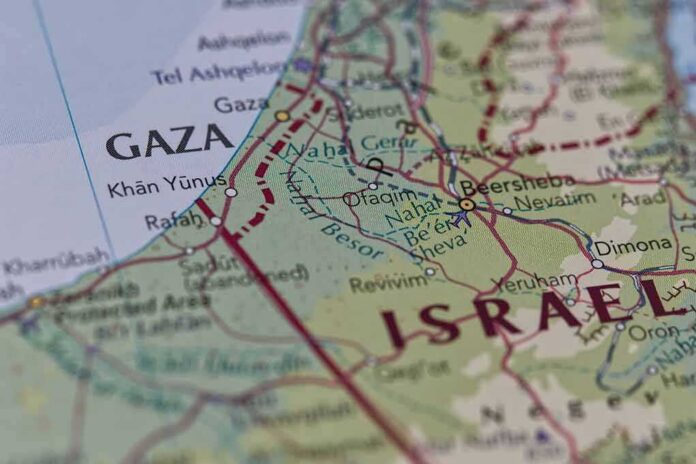
Palestinian Authority leader Mahmoud Abbas told the United Nations that President Trump’s Gaza peace plan “hasn’t materialized” on the ground, even as the administration cites phased progress and funding milestones.
Story Highlights
- Mahmoud Abbas said the Gaza plan’s next steps are not happening on the ground.
- The White House says the United States remains committed to the plan’s phased path.
- Reuters and the British Broadcasting Corporation reported a disarmament deal and a $2.45 billion rebuild plan, with hurdles ahead.
- The Board of Peace says funding commitments exceed $15 billion and reconstruction steps will start in Rafah.
Abbas Says Implementation Is Stalled
Palestinian Authority President Mahmoud Abbas told world leaders that promised steps under the Gaza peace framework have not appeared on the ground. He said the plan aimed to stop attacks, enable a withdrawal, and begin rebuilding, but that none of it had materialized in Gaza. His remarks echoed a year of delays and disputes after the first ceasefire stage, and they challenged claims that the process is moving forward as designed.
Abbas’s criticism highlighted a gap between public milestones and daily realities in Gaza. He described continued hardship and urged faster movement into the next phase. His comments followed repeated reports that the hardest issues remain unresolved, including disarmament, verified security, governance transfer, and funding delivery. Analysts have warned these second-stage steps often stall after a ceasefire unless timelines, authority, and enforcement are clear and accepted by all sides.
Trump Team Points To Phased Progress
The White House said the United States remains fully committed to the transitional framework and is working with Israel and key Arab partners to carry it out. The administration has framed the plan as phased: ceasefire, disarmament, technocratic governance, and then rebuilding. In January, President Trump’s envoy said Phase Two was launching, moving from ceasefire to demilitarization and reconstruction under a structured roadmap, with continued coordination among regional stakeholders.
President Trump and the Board of Peace announced a deal for the complete disarmament of Hamas and other armed groups, calling it a major milestone toward ending the conflict. Reuters reported the agreement would roll out in phases, with an international stabilization force and a new Palestinian police force, and with Israeli forces stepping back as disarmament proceeds. That structure ties security gains to measured withdrawals and verification to reduce risk.
Money, Mandates, And A Long Road To Rebuild
The Board of Peace unveiled a $2.45 billion recovery plan to jump-start rebuilding, while noting major uncertainty due to disputes between Israel and Hamas. The British Broadcasting Corporation reported pledges of about $18 billion but only $280 million delivered so far, and an estimated $71 billion needed over a decade for full recovery. That funding gap undercuts speed and scope, and it fuels public doubt about when real rebuilding can begin in devastated areas.
Board statements said initial reconstruction will start in Rafah, with a sequence from rubble removal to infrastructure and then housing. The Board also cited more than $15 billion in funding commitments and the launch of a World Bank administered reconstruction fund to manage relief and building projects. If money flows and access is secured, those steps could lay the groundwork for families to return to safer, more stable communities.
Why The Process Feels Stuck—and What Comes Next
Reuters and think tanks have outlined a familiar trap in peace deals: the first stage is visible and fast, while the second stage is complex and slow. The Gaza framework faces that same pressure. It hinges on verified disarmament, clear authority for security forces, and steady funding. Without those, even a signed deal can grind down. The Washington Institute warned that gaps on sequencing, oversight, and disarmament cast doubt on feasibility until the parties lock down firm terms.
For concerned readers at home, two truths can stand at once. Abbas is right that daily life has not yet improved much in Gaza. The administration is also right that a phased plan exists with partners, commitments, and a map to rebuild. The test now is delivery. That means enforcing disarmament, guarding taxpayer dollars, verifying results, and demanding timelines. Peace without accountability invites delay. Peace with enforcement protects families and advances America’s security interests.
Sources:
reuters.com, washingtonexaminer.com, nytimes.com, thenationalnews.com, cbc.ca