
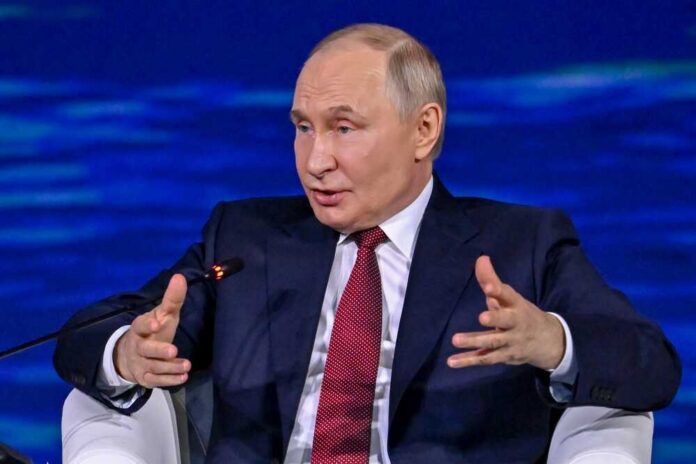
Russia has quietly handed Vladimir Putin a legal pretext to send troops into almost any country on earth, all in the name of “protecting Russians” abroad.
Story Snapshot
- Russia’s parliament passed a law letting Putin deploy forces abroad to “free” or “protect” Russian citizens held or targeted overseas.[1][2]
- The measure is framed as a response to “hostile Western justice,” deepening Moscow’s confrontation with the West.[1]
- Vague language about foreign courts and threats makes it easier for the Kremlin to justify future interventions.[1][2]
- Russia’s move tests American strength, NATO unity, and Trump-era deterrence at a time of global instability.
Russia’s New Law: A Global License to Use Force
Russian lawmakers in the State Duma, the country’s lower house of parliament, have approved a legal amendment giving President Vladimir Putin authority to use the Russian armed forces abroad to free or protect Russian citizens held in other countries.[1][2] Reporting describes a statute that allows the president to order deployments whenever Russians are arrested, detained, or prosecuted under foreign legal decisions that Moscow claims lack legitimate jurisdiction.[1] The law is now part of Russia’s formal defense framework, not just a political talking point.[1][2]
Russian officials publicly insist the law is “first and foremost about looking out for Russians abroad,” portraying it as a shield for ordinary citizens.[1] Supporters argue it protects Russians from criminal charges by foreign courts or bodies that act without Russian participation, without a valid international treaty, and without a United Nations Security Council resolution.[1] This framing lets the Kremlin reject Western criminal cases, sanctions enforcement, or extradition efforts as illegitimate, then answer them with military force if it chooses.[1][2]
Vague Triggers, Broad Powers, and a History of Pretexts
Analysts observing the law warn that its vague wording radically expands the range of situations in which Moscow can claim a right to send troops abroad.[2] Reports note that the measure does not spell out what counts as an “armed attack,” how many Russians must be threatened, or whether Russia needs consent from the country where it intervenes, beyond minimal references to international treaties or United Nations mandates.[1][2] That ambiguity lets the Kremlin stretch definitions to fit political objectives in any future confrontation.[2]
Commentators also connect this law to Russia’s previous justifications for aggression in Georgia in 2008 and Ukraine in both 2014 and 2022, where Moscow invoked protection of Russian citizens or Russian-speaking populations as a legal and moral excuse.[1] One legal expert interviewed about the new measure stressed that this pattern shows the rhetoric of protecting citizens often serves as pretext rather than genuine consular defense.[1] Critics therefore see the statute less as a rescue tool and more as groundwork for the next intervention, whether in Europe, the Middle East, or elsewhere.[1][2]
What This Means for the United States, NATO, and American Conservatives
Russia’s move comes against a backdrop where the Russian president already holds sweeping constitutional authority over foreign and security policy, including command of the armed forces and decisions on military deployment.[3] By granting an additional, explicit legal basis to send troops abroad to protect citizens from foreign courts and “hostile Western justice,” the Duma further concentrates power in the Kremlin’s hands.[1][2][3] That centralization echoes every conservative concern about unchecked executive power, especially in adversarial regimes.
For American readers, this law matters because it tests whether the United States and its allies will deter or accommodate coercive Russian behavior. Moscow can now cite its own statute anytime it wants to pressure a neighboring state that detains a Russian national, challenge Western sanctions enforcement, or intimidate countries hosting dissidents.[1][2] Each episode will measure Western resolve and, under President Trump’s administration, American clarity in drawing red lines and backing them with economic and diplomatic strength.
Lessons for American Policy: Strength Abroad, Vigilance at Home
Russia’s example highlights a stark contrast with the United States. American conservatives value a government of limited powers, accountable to law and the Constitution instead of one man’s ambitions. Russia is moving the opposite direction, writing vague doctrines that allow force against ill-defined threats to its citizens overseas.[1][2] That kind of elastic authority is exactly what our Founders feared when they warned against concentrated power and standing armies controlled by a single ruler.
American policymakers should draw several clear lessons. First, deterrence still matters; weakness, confusion, and endless globalist half-measures only invite adventurism from regimes like Russia’s. Second, Washington must avoid copying the Kremlin’s playbook at home: using elastic legal language to expand executive power, whether on surveillance, emergency powers, or domestic crackdowns. Conservatives can support a strong military and robust defense of American citizens abroad while insisting that our own laws remain clear, limited, and firmly rooted in the United States Constitution.
Sources:
[1] YouTube – Russia’s Duma gives Putin military powers to free citizens abroad
[2] Web – Russia passes law enabling military to protect citizens from foreign …
[3] Web – Chapter 4. The President of the Russian Federation