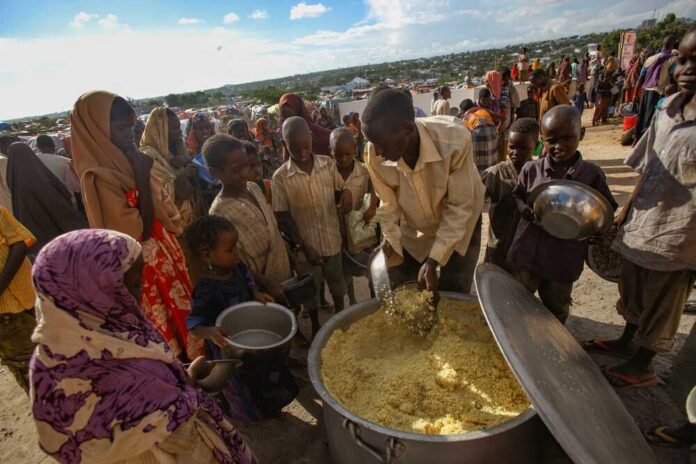
After decades of pouring taxpayer-funded aid into Somalia, the U.S. is now freezing support to the federal government after officials reportedly seized U.S.-funded food—raising a blunt question: who is foreign aid really serving?
Quick Take
- The State Department has suspended U.S. assistance to Somalia’s federal government after a January 2026 incident involving a WFP warehouse and 76 tons of U.S.-funded food.
- Recent reporting highlights Somalia’s long-running reliance on large-scale aid—roughly $2 billion annually from global donors, with U.S. aid cited at $765 million in 2024.
- U.S. officials say aid could resume only after Somali authorities show accountability and take remedial steps; the timeline and affected amounts remain unclear.
- Somalia’s economy also leans heavily on remittances, estimated at about $2 billion per year—roughly a quarter of GDP—complicating the idea that aid alone can stabilize governance.
Washington’s Suspension Puts Accountability Ahead of Autopilot Funding
U.S. officials halted assistance to Somalia’s federal government after Somali authorities were reported to have destroyed a World Food Programme warehouse and seized 76 tons of U.S.-funded food without donor coordination. The State Department’s position, as relayed in public reporting, is that aid will not resume until Somali leaders demonstrate accountability and implement remedial steps. The suspension’s duration and the precise dollar value affected have not been publicly specified.
For American taxpayers—already skeptical after years of inflation, debt growth, and overseas spending—this lands as a familiar warning sign. When aid is routed through weak institutions, the risk is not only waste but also the creation of perverse incentives: local power brokers learn that survival depends less on governing well than on managing donor relationships. It does not prove intent, but it does document a breakdown severe enough to trigger a full funding pause.
Billions Over Decades, Yet Somalia’s Core Governance Problems Persist
Somalia’s modern state failure is widely traced to the 1991 collapse of Siad Barre’s regime, which spiraled into civil war, famine, and fragmentation. International efforts have repeatedly surged to prevent humanitarian catastrophe, including a major U.S.-led deployment in late 1992 that transitioned into a UN mission but struggled to convert relief operations into durable political order. The historical record shows lives saved, yet also a pattern of temporary stabilization without lasting state capacity.
Recent commentary argues Somalia has absorbed tens of billions in global aid since 1990, including about $2 billion annually in recent years, while still showing limited structural improvement. U.S. aid is cited at $765 million in 2024 alone, according to the reporting. Those figures, even allowing for imprecision between “global totals” and “U.S. totals,” highlight the scale of the experiment: large, sustained funding paired with ongoing insecurity and weak governance. The evidence supports the “big money, limited progress” claim, even if it cannot prove aid itself “kept” Somalia failed.
Humanitarian Need Is Real, but Delivery Mechanisms Create Political Tradeoffs
Humanitarian assistance is not abstract in Somalia; it is tied to food security, drought shocks, and displacement risks that can quickly become deadly. That reality is why donors continue funding programs even when corruption or diversion risks are high. The problem is that every dollar routed through compromised political channels can weaken the very accountability donors say they want. When officials can redirect supplies or dictate access, aid can become another asset in domestic power competition rather than a bridge toward stability.
Policy analysts have long grappled with this dilemma. Research on failed states has argued that traditional “government-to-government” aid can be ineffective where governance is weakest, and that targeted approaches—often implemented through NGOs or multilateral partners—may deliver better outcomes in specific sectors like health or micro-enterprise. Somalia’s case fits that framework: donors can keep people alive without necessarily building institutions. For Americans who favor limited government and measurable results, the central question is whether future assistance can be structured to reduce dependency and reward verifiable performance.
Remittances Rival Aid, Underscoring the Limits of Donor-Driven Nation-Building
Somalia’s economic picture also complicates donor narratives. Reporting in U.S. government materials indicates remittances total roughly $2 billion per year—about 25% of GDP—meaning the Somali diaspora is effectively matching (and sometimes surpassing) external aid flows. That suggests a resilient, private support network operating outside formal state systems. It also hints at why central institutions remain brittle: if families and communities can rely on outside transfers, the pressure for government legitimacy through taxation and services may be weaker than in more typical state-building models.
The State Department suspension therefore lands at the intersection of two realities: genuine humanitarian need and a decades-long accountability problem. Conservatives will see a textbook case for conditionality—no blank checks, no automatic renewals—especially when U.S.-funded goods are allegedly mishandled. Liberals will worry about immediate human costs. Both concerns can be true. The hard test for Washington is whether it can insist on controls that protect taxpayers and aid recipients without recreating the same cycle under a different name.
https://t.co/HIH0bmRx6B $2 Billion in Annual Aid Kept Somalia a Failed State h/t .@RepOfSomaliland
— Catherine Salgado (@CatSalgado32) April 24, 2026
In practical terms, the next signal to watch is whether U.S. officials shift support away from Somalia’s federal government and toward more tightly monitored channels, or whether Somali authorities meet the stated accountability conditions for resumption. What remains clear from the available evidence is that the status quo—large sums, weak enforcement, and recurring diversion risks—keeps validating the broader, bipartisan suspicion that government systems, at home and abroad, too often protect insiders while ordinary people pay the price.
Sources:
$2 Billion in Annual Aid Kept Somalia a Failed State
U.S. Suspends Aid to Somalia’s Government
U.S. Foreign Assistance and Failed States
Security Council Meets on Somalia
2025 Somalia Investment Climate Statement