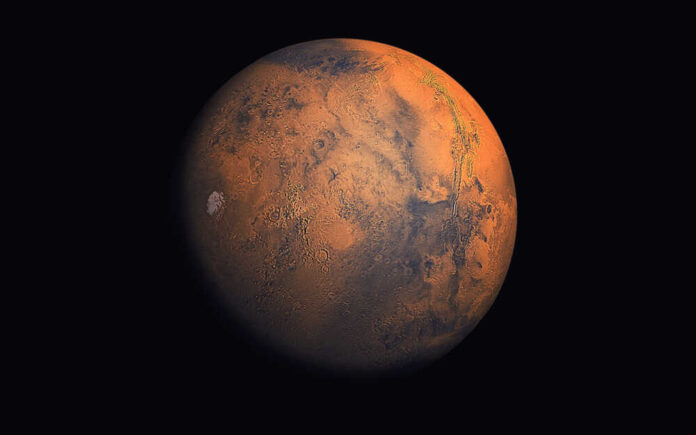
NASA’s Perseverance rover has uncovered the strongest evidence yet for ancient microbial life on Mars, a discovery that could redefine humanity’s place in the universe.
At a Glance
- Perseverance found biosignature-like compounds in Martian rock “Cheyava Falls”
- Published in Nature as the strongest evidence yet of possible ancient life
- Jezero Crater chosen for its preservation-friendly geology
- NASA calls discovery “closest we’ve come” to detecting life on Mars
- Future Mars sample return missions needed for confirmation
Breakthrough Discovery in Jezero Crater
NASA’s Perseverance rover drilled into a Martian rock formation named “Cheyava Falls” in July 2024, recovering a sample later designated “Sapphire Canyon.” The rock revealed complex chemical patterns including organic carbon, sulfur, and phosphorus compounds—key ingredients of life as understood on Earth. Acting NASA Administrator Sean Duffy called the find “the closest we have ever come to discovering life on Mars,” underscoring its historic potential.
The discovery represents the strongest case yet for past microbial activity on Mars. While earlier missions detected organic molecules, they lacked the full suite of biosignature indicators now observed. The evidence strengthens the hypothesis that Mars once hosted habitable environments capable of sustaining simple life forms.
Watch now: NASA Rover Discovers Possible Life Signs on Mars
Scientific Validation Through Peer Review
The findings underwent extensive scrutiny before being published in Nature, ensuring rigorous scientific validation. Joel Hurowitz of Stony Brook University, lead researcher on the study, emphasized that Cheyava Falls’ mineral composition provided conditions similar to those on Earth known for preserving microbial biosignatures. This strengthens the reliability of the interpretation that the compounds could indeed have biological origins.
Publication in a peer-reviewed journal also enables transparency, allowing independent researchers worldwide to test and verify the claims. By releasing raw data, NASA has invited the global scientific community to examine and challenge the evidence.
Strategic Location Yields Ancient Secrets
Jezero Crater, a 45-kilometer-wide impact basin, was chosen for exploration due to its preserved river delta—a prime candidate for trapping and protecting traces of life. The Cheyava Falls formation, rich in clay and silt, mirrors terrestrial environments where fossils and chemical traces of ancient microbes endure for billions of years.
This geological context enhances confidence that the detected compounds were not random artifacts but preserved features of Mars’ past. Previous rover missions uncovered intriguing molecules but lacked the layered evidence now presented by Perseverance.
Implications for Future Mars Exploration
NASA’s announcement accelerates momentum toward Mars sample return missions, which could confirm the biological origins of these compounds through laboratory analysis on Earth. Such missions are already under active planning, with international collaboration expected to play a central role.
The discovery also bolsters U.S. leadership in planetary science, potentially spurring new investment in space technology and exploration infrastructure. While scientists remain cautious—acknowledging that abiotic chemical processes might explain the findings—the combination of multiple biosignatures in a geologically favorable setting marks a turning point in the search for extraterrestrial life.
If confirmed, the implications would stretch beyond Mars, reshaping theories about life’s prevalence across the cosmos and fueling future exploration of other potentially habitable worlds.
Sources
NASA Says Mars Rover Discovered Potential Biosignature Last Year
NASA Perseverance Cheyava Falls Biosignatures
NASA Perseverance Rover Discovery Life on Mars