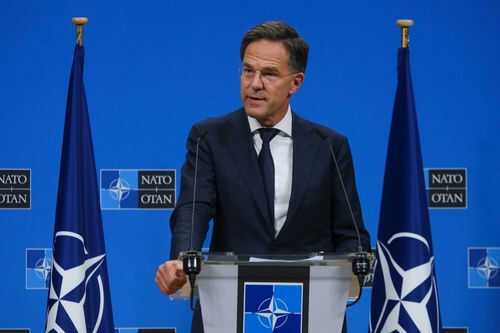
President Trump’s threats to abandon NATO over allies’ refusal to join the Iran war expose the alliance’s deepest fracture in decades, leaving many to question whether the transatlantic partnership can survive this administration’s frustrations.
Story Snapshot
- Trump calls NATO a “paper tiger” after no member state joins U.S.-Israeli military operations against Iran launched February 28, 2026
- NATO allies provided logistical support through bases and air defenses but refused direct combat involvement in undeclared Middle East conflict
- Conflict continues with no resolution despite Trump’s claim it would end “in three days,” exposing administration’s failed war promises
- Alliance faces existential crisis with July 2026 summit in jeopardy as European nations accelerate defense independence from U.S.
Alliance Refuses Combat Role Despite U.S. Pressure
The United States and Israel launched joint military operations against Iran on February 28, 2026, without consulting NATO allies beforehand. President Trump expressed public disgust when all 31 NATO member states declined to join combat operations, despite his expectations of alliance solidarity. While NATO-supplied air defenses in Turkey successfully intercepted Iranian missiles and member nations granted U.S. access to bases across the UK, France, Germany, Greece, Italy, and Portugal, no ally committed troops to the fight. Spain explicitly refused even base access for the operations.
Trump Threatens NATO Withdrawal Over War Support
President Trump escalated tensions by threatening to withdraw the United States from NATO entirely, characterizing the seven-decade alliance as a “paper tiger” that failed to support American interests. Trump told the UK Prime Minister the war would conclude “in three days,” revealing his administration’s expectation of rapid allied participation and quick victory. By early April 2026, the conflict remained active with no resolution in sight, contradicting those initial projections. This broken promise resonates deeply with supporters who backed Trump specifically to avoid new regime change wars and keep America out of Middle Eastern entanglements.
Military Success Masks Strategic Disappointment
U.S. and Israeli forces achieved overwhelming tactical victories, degrading Iranian missile capabilities by 90 percent within the first week and eliminating over 250 Iranian leaders including Supreme Leader Ali Khamenei. Despite this military dominance, strategic analysts note the strikes fall short of achieving broader U.S. objectives while Iran retains capacity to rebuild over time. American casualties mounted with 15 soldiers killed, over 520 wounded, and $800 million in damage to 17 U.S. sites across the Middle East. The human and financial costs fuel conservative frustration with another expensive military adventure that Trump promised to avoid during his campaign.
Alliance Cohesion Crumbles Under Pressure
NATO Secretary General Mark Rutte’s February claim that the alliance was “the strongest it has been since the fall of the Berlin Wall” proved hollow as the Iran conflict exposed deep divisions. The alliance withdrew its training mission from Iraq and redirected U.S. F-35s from Norwegian exercises to the Gulf, disrupting NATO’s operational readiness. European nations accelerated efforts toward defense independence, increasing military spending while reducing reliance on American leadership. The scheduled July 2026 NATO summit in Ankara faces cancellation as the conflict’s outcome threatens to fracture transatlantic relations permanently, raising fundamental questions about whether the alliance serves American interests anymore.
Constitutional Concerns Over Undeclared War
The Iran conflict proceeded without congressional declaration of war, raising constitutional questions that resonate with limited government principles. Trump’s unilateral decision to launch operations alongside Israel, then demanding NATO participation, bypassed both congressional authority and alliance consultation protocols. This pattern of executive overreach in military matters threatens constitutional checks and balances that conservatives traditionally defend. Iran’s closure of the Strait of Hormuz disrupted global trade and drove energy costs higher, compounding economic pain for American families already struggling with inflation from years of fiscal mismanagement under previous administrations.
Sources:
CBS News – Iran war: Trump threatens NATO, Tehran threatens U.S. tech companies, Strait of Hormuz
UK in a Changing Europe – Not our war: NATO and the Iran crisis
Atlantic Council – Twenty questions and expert answers about the Iran war
Brookings Institution – After the strike: The danger of war in Iran
CSIS – Who is winning the Iran war?