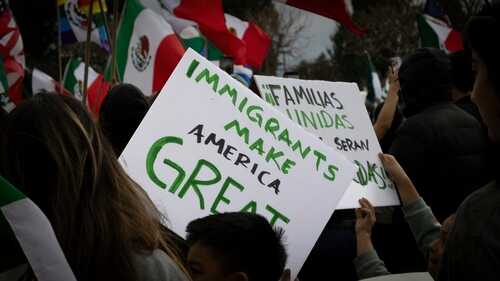
Protesters waving Mexican flags physically blocked ICE agents at a California cannabis farm during a federal immigration raid, triggering violent clashes and reigniting national debate over law, labor, and loyalty.
At a Glance
- Federal agents raided Glass House Farms in Ventura County, detaining workers and discovering juveniles allegedly working at the facility.
- Protesters waving Mexican flags attempted to block ICE agents, resulting in violent clashes and use of tear gas and rubber bullets.
- The Trump administration invoked the Alien Enemies Act as justification for the raid; Governor Newsom condemned the operation as “inhumane.”
- The incident has reignited the national debate on immigration enforcement, labor practices, and foreign influence in U.S. affairs.
A Raid Turns into a Border Showdown—In California
On July 10, Glass House Farms—a multimillion-dollar cannabis grower in Ventura County—became the site of a dramatic showdown between federal immigration agents and protesters carrying Mexican flags. Acting on reports of illegal labor and underage workers, ICE agents stormed the facility. Instead of compliance, they encountered barricades, projectiles, and crowds bent on halting federal law enforcement. At least one protester was hospitalized after agents used tear gas and rubber bullets to push through the human blockade.
Watch a report: Protesters Clash With ICE in Ventura County Raid
The Trump administration defended the operation as a matter of national security, invoking the Alien Enemies Act of 1798 to justify the raid and any resulting detentions. The symbolism of U.S. agents being obstructed on American soil by flag-waving mobs—celebrating another nation—was not lost on observers or officials. President Trump called the act “a disgraceful assault on American sovereignty” and warned that more raids were imminent.
Glass House Farms Caught in the Crossfire
Glass House Farms, touted as a “model employer” in the cannabis industry, is now under investigation for employing at least 10 undocumented workers and 10 juveniles during peak harvest. CEO Kyle Kazan, a vocal Trump supporter and former law enforcement officer, denied knowledge of any labor violations and said the company complied fully with the raid warrant.
Still, federal agents claim eight of the juveniles were unaccompanied minors, raising flags about human trafficking and labor abuse. The facility’s location—in a region long dominated by immigrant labor and political sanctuary policies—only heightens tensions. Advocacy groups like CAUSE and Americans for Safe Access immediately condemned the raid, calling it “a militarized invasion,” even as evidence of child labor continues to emerge.
Federal Crackdown Meets California Resistance
Governor Gavin Newsom denounced the raid as “a grotesque abuse of federal power” and signaled that California would pursue legal action. Meanwhile, conservative lawmakers rallied behind Trump’s decision to enforce immigration law using national security authorities, calling the standoff “a turning point in the fight for American sovereignty.”
The fallout is spreading fast. Legal groups are filing suit, labor unions are preparing walkouts, and cannabis lobbyists are sounding alarms about workforce instability. Communities in Ventura County brace for further unrest as tensions between federal authority and local defiance threaten to boil over.
The broader issue extends beyond a single raid—it concerns the United States’ commitment to enforcing its own laws. With foreign flags displayed over blocked roads and federal agents facing challenges in their own country, there is a perception that for some, American law may conflict with ideological beliefs. This raises a pertinent question: how much longer can this situation be viewed as anything less than a national emergency?