Seventy-three Palestinians have been killed while awaiting humanitarian aid in Gaza, exposing a catastrophic intersection of conflict, political maneuvering, and aid mismanagement.
At a Glance
- 73 Palestinians died at aid distribution sites across Gaza on July 20, 2025.
- The deadliest incident claimed 67 lives near the Zikim crossing.
- Responsibility remains disputed between Israeli forces and armed gangs.
- Humanitarian access is critically limited under the ongoing blockade.
- The US- and Israel-backed Gaza Humanitarian Foundation (GHF) faces backlash.
Death and Disorder at the Zikim Crossing
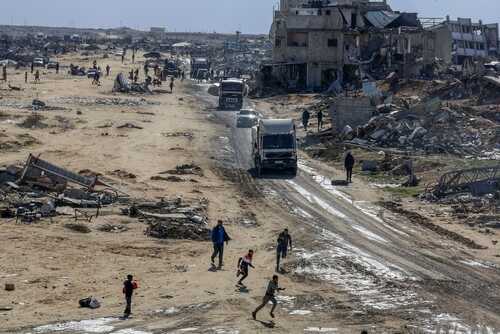
The bloodshed reached a peak at the Zikim crossing, where 67 Palestinians died and over 150 were injured while seeking desperately needed aid. Health officials and witnesses reported that many victims were shot, though conflicting reports obscure who opened fire. While some blame Israeli troops for using lethal force, others point to armed gangs exploiting the chaos. An additional seven fatalities occurred in Khan Younis, including a 5-year-old sheltering in makeshift tents.
The aftermath has further strained Gaza’s collapsing healthcare system, already battered by nearly two years of warfare following the October 2023 conflict between Israel and Hamas. The Israeli military, facing international scrutiny, has issued new evacuation warnings that threaten to choke humanitarian corridors even tighter. Ceasefire talks in Qatar proceed sluggishly, leaving the prospect of relief increasingly remote.
Watch a report: 73 Palestinians killed while waiting for humanitarian aid across Gaza • AP News
GHF’s Contentious Role in Aid Delivery
At the center of the controversy is the Gaza Humanitarian Foundation (GHF), a newly formed body supported by the US and Israel. GHF was designed to streamline aid outside traditional UN and NGO structures, but its operations have proven both politically sensitive and dangerously volatile. The recent carnage has cast a shadow over its legitimacy, with the UN and the Office of the High Commissioner for Human Rights (OHCHR) condemning the spiraling violence at aid sites.
Critics argue that GHF’s exclusion of established humanitarian players has undermined neutrality, creating targets rather than safe havens. This fragmentation of aid efforts has fueled suspicions that humanitarian assistance is being used as a lever in geopolitical strategy, further endangering Gaza’s civilians. Calls for a return to neutral, internationally overseen aid mechanisms grow louder as the body count rises.
The Growing Cost of Inaction
The world now faces a moral and strategic imperative: ensure that humanitarian aid in Gaza is delivered without turning distribution points into war zones. Without accountability and reform, the consequences are dire—not just for Gaza’s besieged population but for the credibility of global humanitarian frameworks. The deaths of 73 Palestinians are not mere statistics; they are an indictment of failed diplomacy, politicized aid, and unchecked violence.
The responsibility falls on Israel, Hamas, GHF leadership, and international mediators to rectify the perilous conditions that have made aid a death sentence for too many. Unless decisive action is taken, the Gaza crisis will deepen, further destabilizing the region and eroding any remaining trust in the world’s commitment to humanitarian principles.