

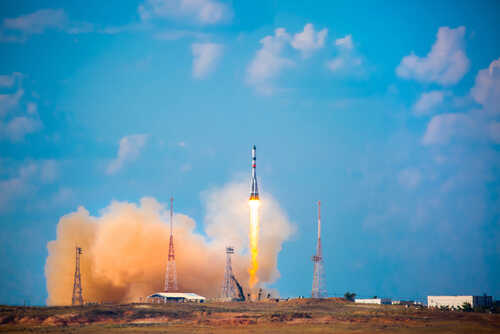
Russia’s critical space infrastructure suffered a devastating blow when its primary launch facility for International Space Station missions at the Baikonur Cosmodrome sustained significant damage following the Soyuz MS-28 launch on November 27, 2025. This critical infrastructure failure, centered on the main launch pad for ISS crew missions, immediately creates uncertainty about future crew rotation schedules. The incident exposes the strategic vulnerabilities inherent in relying on aging, Soviet-era facilities and is expected to force international partners to accelerate efforts to diversify crew transportation options beyond a single-source provider.
Story Snapshot
- Russia’s main launch pad for ISS crew missions was damaged after the Soyuz MS-28 launch
- Incident occurred on November 27, 2025, at the Baikonur Cosmodrome facility
- Damage threatens Russia’s ability to transport astronauts to the International Space Station
- Critical infrastructure failure exposes vulnerability in international space operations
Critical Infrastructure Failure at Baikonur
The Baikonur Cosmodrome in Kazakhstan, operated under Russian control through a lease agreement, serves as the primary launch site for Soyuz missions carrying crew members to the International Space Station. This Soviet-era facility has been Russia’s workhorse for human spaceflight operations, but the November 27 incident reveals the fragility of aging infrastructure. The damage occurred immediately following the Soyuz MS-28 launch, creating uncertainty about future crew rotation schedules and Russia’s ability to fulfill its ISS obligations.
SpaceVision: Russia has halted their human spaceflight program for the first time since 1961! The service tower at Baikonur’s Launch Pad 31 collapsed during the Soyuz MS-28 launch. The rocket’s exhaust plume seems to have damaged critical infrastructure. No estimate on repairs. pic.twitter.com/PUPyDHfKAy
— John Cremeans (@JohnCremeansX) November 28, 2025
Implications for International Space Operations
Russia has maintained a critical role in International Space Station operations since the Space Shuttle program’s retirement in 2011. The Soyuz spacecraft has served as the primary means of transporting astronauts and cosmonauts to and from the ISS for over a decade. This dependency has made Russian launch infrastructure essential to international space operations, involving NASA, the European Space Agency, and the Japanese Aerospace Exploration Agency. The damaged launch pad represents a single point of failure that could disrupt crew rotation schedules and strain international partnerships.
Strategic Vulnerabilities Exposed
The incident highlights Russia’s reliance on aging Soviet-era infrastructure and the risks of maintaining a monopoly on critical space transportation capabilities. Roscosmos now faces immediate questions about repair timelines, costs, and whether backup launch facilities can accommodate future missions. The damage underscores the importance of redundant human spaceflight capabilities and may accelerate international efforts to reduce dependency on single-source launch providers. This infrastructure failure could force increased reliance on American commercial crew vehicles like SpaceX’s Crew Dragon and Boeing’s Starliner.
The timing of this infrastructure failure comes at a critical moment when space operations require reliable, continuous access to the International Space Station. Russia’s launch pad damage represents more than a technical setback—it exposes the vulnerabilities inherent in centralized space infrastructure and the risks of depending on aging facilities for critical international operations. The incident may serve as a catalyst for diversifying crew transportation options and reducing reliance on any single nation’s launch capabilities.
Watch the report: Russia accidentally destroys its only way of sending astronauts to space
Sources:
Russia’s Launch Pad Damaged After Soyuz MS-28 Launch
Launch pad damaged as Russian rocket blasts off for space station, agency says | CNN