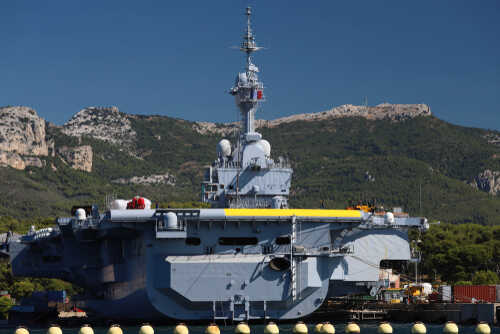
With Iran squeezing one of the world’s most critical oil chokepoints, France is sailing a nuclear-powered aircraft carrier toward the fight over who controls free passage at sea.
Quick Take
- France repositioned the aircraft carrier Charles de Gaulle through the Suez Canal toward the southern Red Sea, positioning for a possible Strait of Hormuz freedom-of-navigation role.
- French and British leaders are pushing a broad, defensive coalition approach that is described as distinct from the U.S. effort that was paused amid talks.
- The potential mission is framed as escorting and protecting commercial shipping—not joining wider regional combat—while awaiting clearer political/legal conditions.
- Any sustained disruption in Hormuz threatens energy prices and inflation, hitting American households and global supply chains at the worst possible time.
France Moves a Carrier Strike Group Toward the Hormuz Crisis
France confirmed May 6 that its nuclear-powered aircraft carrier Charles de Gaulle and accompanying strike group transited the Suez Canal and headed toward the southern Red Sea and Gulf of Aden. French officials described the redeployment as preparation for a possible multinational, defensive maritime security mission tied to freedom of navigation in the Strait of Hormuz. Reports indicate allied escorts in the formation include European warships, underscoring a coalition posture rather than a solo national operation.
The immediate significance is geography and timing. The Suez transit positions the carrier group to influence two chokepoints that increasingly define global stability: Bab el-Mandeb at the mouth of the Red Sea and Hormuz at the entrance to the Persian Gulf. French messaging has emphasized readiness and capability, while also stressing defensive intent and respect for international law and regional sovereignties. The key takeaway for markets and families is simple: naval positioning can calm prices—or a miscalculation can spike them.
Why Hormuz Still Matters to Americans Feeling the Inflation Squeeze
The Strait of Hormuz is narrow, strategic, and unavoidable for a large share of global oil and energy shipments. In 2026, that reality collides with public frustration over high costs and the sense that Washington too often reacts late to predictable crises. Researchers and reporting cited in the provided sources describe significant trade disruption risks and energy-price impacts when passage is threatened. Even if the conflict feels distant, higher oil feeds into shipping, food, and household expenses across the U.S.
The current tension stems from Iran’s leverage over the strait and escalating incidents affecting commercial vessels, including reported strikes on shipping. France’s movement follows a burst of regional instability and maritime security stress that has also included threats around the Red Sea. The French plan, as described in reporting, is not presented as an offensive campaign. It is instead described as a protective, escort-focused approach that would operate alongside diplomacy and would wait on clearer political conditions before a full mission begins.
Europe’s “Defensive Coalition” vs. America’s Paused Operation
One of the more consequential details is how Europe is framing its approach compared with Washington’s. Reports describe U.S. Central Command launching an effort dubbed “Project Freedom” around May 4, only for it to be paused by May 6 amid U.S.-Iran talks. France and the United Kingdom, led by President Emmanuel Macron and Prime Minister Keir Starmer, are described as building a larger coalition—reported as more than 40 nations—designed to look defensive and multinational rather than unilateral.
This is where domestic politics and public trust come in. Americans across the spectrum increasingly doubt that elites and institutions can deliver basic competence—whether that means securing borders at home or keeping vital sea lanes open abroad. A defensive coalition that actually restores predictable shipping would be a tangible win for working families. At the same time, the coalition model can dilute accountability: when many governments share responsibility, it can become harder to identify who is making decisions, what the rules of engagement are, and how costs are controlled.
What’s Known, What’s Unclear, and the Real Risk: Escalation
As of the latest reporting, the carrier group’s movement and purpose are well documented, including official statements and maritime-tracking style updates. What remains unclear is the precise trigger for the operation to begin in full—reports reference the need for “clarity,” including political arrangements and potential legal cover. That uncertainty matters because deterrence without defined boundaries can invite probing and miscalculation, especially in crowded waters where drones, missiles, and fast boats have featured in prior crises.
New: French Carrier Charles de Gaulle Now Headed for Hormuz for Possible Free Passage Role https://t.co/nIapnUBCwo
— Jim Polk 🇺🇸 (@JimPolk) May 6, 2026
For the Trump administration and Republicans controlling Congress, the strategic question is how to protect U.S. interests without drifting into open-ended commitments. For conservatives, the lesson of recent decades is that global stability cannot be treated as charity; it must serve clear national interests, be bounded by law, and avoid blank checks. For liberals, the concern often centers on escalation and humanitarian fallout. The shared ground is public fatigue with elite failure: when shipping lanes close, everyday people pay first.
Sources:
French aircraft carrier positions for possible Hormuz mission
French carrier strike group transits Suez amid Hormuz tensions
France sends aircraft carrier to Red Sea in new push to open Strait of Hormuz