
Washington just proved again that when Congress plays chicken, everyday Americans get punished first—this time with airport chaos and unpaid TSA agents.
Quick Take
- President Trump issued an executive order directing DHS to pay TSA workers by reallocating funds tied to his 2025 tax cuts bill, as the DHS shutdown drags into its sixth week.
- The partial shutdown began February 14, 2026, leaving more than 100,000 DHS employees missing paychecks and driving more than 400 TSA agents to quit amid soaring callouts.
- Republicans say Senate Democrats, led by Chuck Schumer, repeatedly blocked full-year DHS funding; Democrats argue Trump and GOP leaders are tying pay and funding to the SAVE Act and immigration fights.
- Airport security lines and delays have become a visible pressure point, while other DHS missions—CBP, Secret Service, Coast Guard, CISA, and FEMA—remain caught in the funding standoff.
- The order may ease the immediate TSA pay crisis, but it also raises fresh questions about executive power, congressional spending authority, and the incentives behind future shutdown brinkmanship.
Trump’s TSA Pay Order: Relief for Workers, Warning Shot to Congress
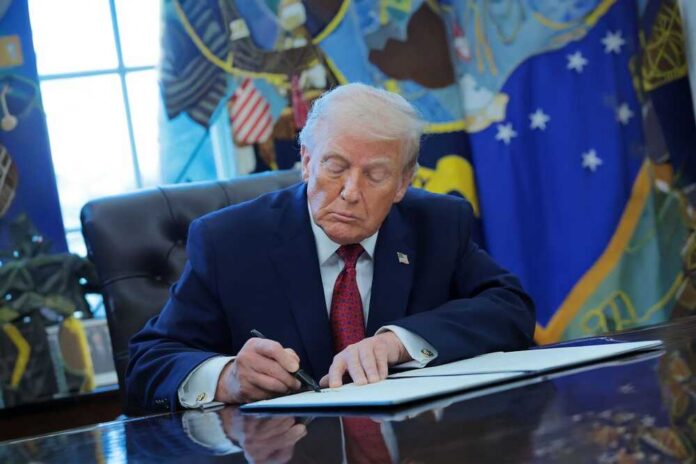
President Donald Trump announced March 26 that he would direct the Department of Homeland Security to pay Transportation Security Administration personnel during the ongoing DHS shutdown by shifting money tied to his 2025 tax cuts legislation. The move comes after weeks of missed paychecks and mounting airport disruptions. Trump compared the approach to past efforts to keep uniformed personnel paid during earlier shutdown-era fights, while Congress continued late-stage negotiations.
The immediate effect is straightforward: frontline screeners showing up for work without pay is unsustainable, and the country has watched the strain show up in longer lines and staffing gaps. By March 20, more than 100,000 DHS employees had missed paychecks, and reports cited more than 400 TSA quits. TSA callouts reportedly surged to multiple times normal rates, a sign that morale and household finances were colliding with public safety duties.
How the Shutdown Started—and Why It Won’t End Cleanly
The shutdown traces back to a fiscal year 2026 appropriations breakdown that left DHS unfunded beginning February 14. The argument is not only about dollars; it is also about policy leverage. Republicans have pushed full-year DHS appropriations and argue Democrats blocked progress repeatedly, while Democrats insist they are ready to pay workers immediately and accuse Republicans of rejecting “clean” fixes. Both sides point to procedural votes as proof.
One flashpoint is the allegation that negotiations have been tangled up with the SAVE Act—described by Democrats as “voter suppression” and by supporters as election integrity measures—plus separate disputes about immigration enforcement and constraints on ICE operations. The factual bottom line is that DHS funding has become a hostage to broader ideological fights that have little to do with whether a TSA officer can pay the mortgage. That political reality keeps driving brinkmanship.
National Security Agencies Caught in the Crossfire
TSA is the most visible casualty because travelers experience the consequences in real time, but the shutdown hits far beyond airports. DHS houses core functions tied to border security, cyber defense, and protective services. Reporting and statements around the shutdown have cited impacts across agencies including CBP, the Secret Service, the Coast Guard, and CISA. FEMA’s disaster funding has also been described as strained, a risky posture heading into peak storm seasons.
For conservative voters who prioritize order and sovereignty, this is the kind of dysfunction that feels like government failing at the few jobs it is actually supposed to do. It also spotlights the cost of Washington’s habit of governing by crisis. When lawmakers use funding deadlines as leverage, the pressure often lands on families with paychecks, not on the politicians who create the impasse. That is why shutdown tactics routinely backfire on public trust.
Constitutional Tension: Executive Workarounds vs. Congress’s Power of the Purse
Trump’s order is framed as an emergency response to keep critical workers paid, and Sen. Susan Collins has pointed to precedents and other possible funding sources for similar stopgaps. Still, shifting funds during a shutdown highlights the constitutional tension conservatives care about: Congress controls appropriations, and presidents—any president—will keep expanding “workaround” habits if lawmakers reward them with paralysis. The shutdown may end, but the incentive structure remains.
Politically, the fight is landing in a moment when parts of the MAGA coalition are already restless—angry about inflation, energy costs, and the feeling that Washington never learns. With the U.S. also at war with Iran in Trump’s second term, the base’s patience for open-ended commitments and elite-driven priorities is thin. This shutdown adds another layer: if leaders cannot fund DHS reliably, voters will ask how Washington can manage larger promises at all.
Sources:
Schumer Obstructs House Republicans Again, Move to Pay Personnel and Safeguard
Missed paychecks and airport delays pressure mounts on Congress to end the funding shutdown